Shipping Luggage Internationally
Updated 2026-08-039 min readPacking and sending
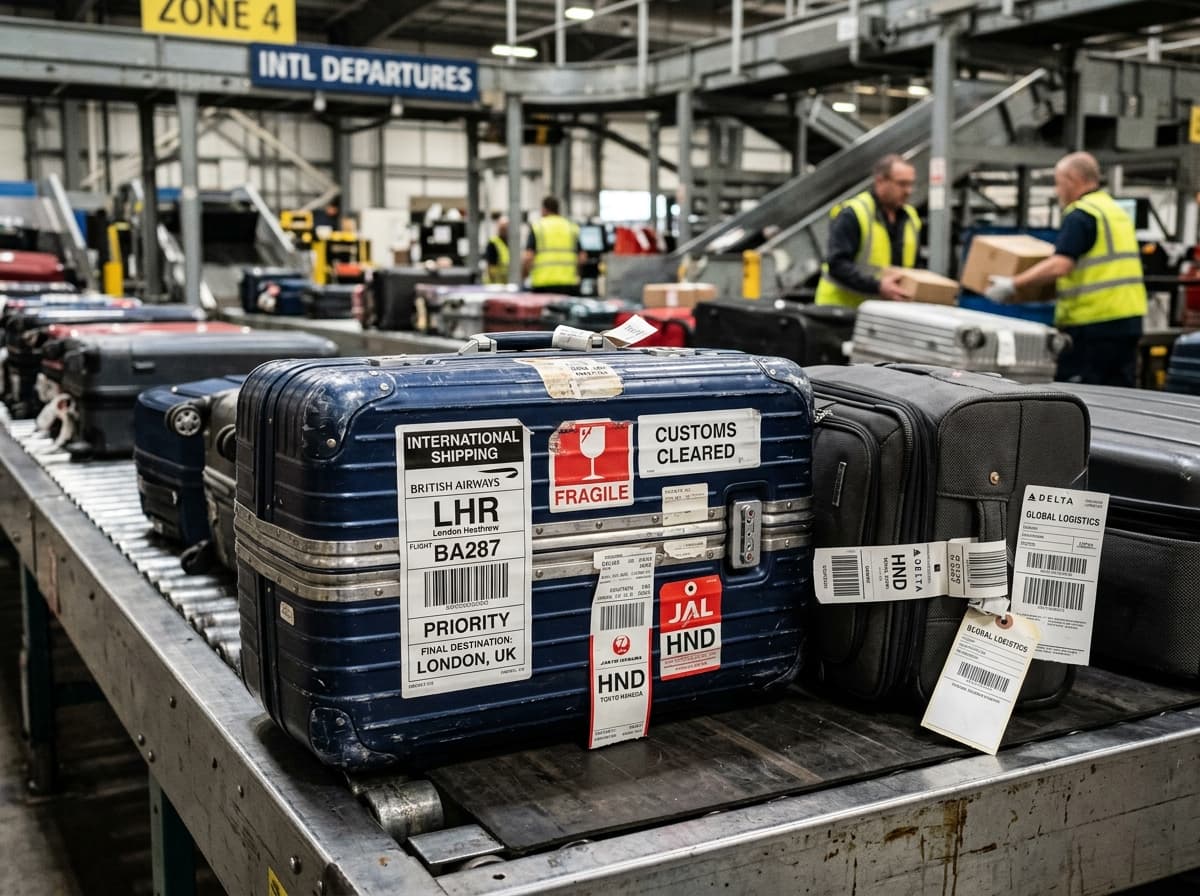
Shipping a suitcase door to door takes 3 to 10 days internationally and frequently costs less than airline excess baggage. The two things that catch people out are the dangerous goods rules, which are stricter than what you can carry on a plane, and the customs declaration, where your belongings need to be declared as used personal effects rather than as goods.
Get those two right and it is one of the more straightforward things to ship.
When it is worth doing
Four situations where shipping beats checking a bag.
A second or third bag. Airlines price additional bags steeply, and a shipped bag is priced as an ordinary parcel. The gap widens with every extra bag.
Anything overweight. Excess weight charges are the most punitive part of airline pricing, often per kilogram over the limit. A 30-kilogram bag can cost more in excess fees than the entire shipping cost.
Long stays and relocations. Moving for months or permanently means more than an airline allowance, and shipping is the only sensible route.
Sports and bulky equipment. Skis, golf clubs, bicycles and diving gear attract oversize handling charges from airlines and travel more safely in purpose-made packaging anyway.
Where checking a bag still wins: a single bag inside the allowance, and any trip short enough that a shipping lead time does not fit.
The lead time is the constraint
Allow 7 to 14 days internationally for a standard service and 3 to 5 days for express. Domestically, 2 to 5 days.
That is not the transit time alone. It includes a customs allowance, and customs is the variable. A bag selected for inspection adds days, and personal effects shipments are inspected more often than average because the contents are mixed and hard to verify from a declaration.
Ship early enough that you arrive before your luggage rather than after. Being at the destination when the bag needs a customs query answered is far easier than doing it from an airport.
Two timing traps. Public holidays in either country stop clearance entirely for the duration. And the busiest weeks of the year stretch every stage — our guide on how long international shipping really takes covers the ranges by lane.
Specialist services versus ordinary couriers
Luggage shipping companies collect from your door, deliver to your destination, handle the customs paperwork for personal effects, and often supply a cover or a box. They are built for exactly this, and the paperwork help is the main reason to use them.
Ordinary couriers — DHL, FedEx, UPS — will carry a suitcase as a parcel. Cheaper on many lanes, faster on express services, and you complete the customs declaration yourself.
Postal services are cheapest for a small bag within weight limits, and slowest. Royal Mail, USPS, Canada Post and Australia Post all have international parcel products, with weight ceilings that a full suitcase often exceeds.
Sea freight is worth considering only for a relocation with several boxes, where 4 to 12 weeks is acceptable. Below a few hundred kilograms the minimum charge makes it uncompetitive.
For a single bag on a common route, compare a specialist against an express courier. The specialist usually wins on convenience and the courier on price.
What you cannot pack
This is the part that goes wrong, because people assume the rules match hand or hold baggage. They do not — an unaccompanied shipment follows dangerous goods rules, and in several respects those are stricter.
| Item | Status in shipped luggage |
|---|---|
| Perfume, aftershave, nail varnish | Flammable liquid — ground only, quantity-limited, often refused |
| Aerosols of any kind | Pressurised — usually refused |
| Lighters and matches | Prohibited |
| Spare lithium batteries | Prohibited on most consumer services |
| Devices with batteries installed | Usually accepted, device switched fully off |
| Alcohol | Licensed shippers only |
| Food | Restricted; most fresh and animal products prohibited |
| Medicines | Restricted; prescription documentation often required |
| Cash and valuables | Prohibited or uninsured on most services |
Perfume is the most common single mistake. People pack a bottle without a thought because it travelled in a suitcase before, and it is a flammable liquid in an unaccompanied shipment. Our guide on shipping liquids and perfumes covers the rules.
Electronics with batteries installed are generally fine, switched fully off. Loose power banks and spare batteries are not — our guide on shipping electronics safely covers the distinctions.
Take valuables, medication, documents and anything irreplaceable with you on the flight. Never ship them.
Declaring personal effects
Your own used belongings are treated differently from goods, and the declaration is what secures that treatment.
Declare the shipment as used personal effects, not as merchandise. Most countries grant relief from duty on the used belongings of someone travelling to or relocating to that country, subject to conditions — usually that the goods are used, owned by you, and not for resale.
Provide an itemised inventory. A list of contents by category with approximate values: "used clothing, 25 items, £200" rather than a single line saying "personal effects". A vague declaration on a mixed shipment is close to a guarantee of inspection.
State that the goods are used and not for sale, and give a realistic total value. Undervaluing caps any insurance claim and invites a valuation query.
Where you are relocating rather than travelling, the destination may require additional evidence — a visa, a residence permit, or proof of a change of address. Check before shipping, because the relief usually cannot be claimed retrospectively.
Our guides on documents needed for international shipping and customs duties cover the general framework.
Packing a bag for shipping
A suitcase is designed to be carried by a person, not thrown onto a belt. Three adjustments help.
Use a cover, or box the case. Suitcase wheels, handles and zips are the parts that break, and a shipping cover or an outer box protects all three. Some specialist services supply a cover as standard.
Do not lock it. Customs may need to open the bag, and a locked case is opened by force or held. Use a cable tie or a tamper-evident seal instead — it shows interference without preventing inspection.
Fill it. A half-empty case collapses under stacking and the contents shift. Pack it firmly, with soft items filling the gaps, and apply the shake test from our guide on wrapping packages for shipping.
Put a printed name and address inside the case as well as on the outside. If the outer label is destroyed, that slip is what prevents the bag becoming undeliverable.
Photograph the contents before closing. It is the inventory for a claim and evidence for customs in one step.
Cost, and what drives it
Weight and distance set the base rate, and four things move it from there.
Dimensional weight. A large light suitcase may be charged on volume rather than scale weight. Our guide on calculating package dimensions explains the calculation.
Residential collection and delivery, which applies at both ends on a door-to-door service.
Remote area surcharges if either address is outside the main network.
Duty and tax, if the personal effects relief does not apply or is not claimed properly.
Compare like with like when quoting. A specialist's headline price often includes collection, delivery and paperwork, while a courier's does not. Our guide on hidden shipping fees covers what gets added afterwards.
Insurance
Standard carrier liability on a suitcase is low, and it is calculated on weight rather than contents value on some services.
Buy declared value cover matching what is genuinely in the bag, and read the exclusions — jewellery, electronics, cash and documents are excluded from most policies regardless of what you paid.
Keep receipts for anything valuable, and keep the photographs of the packed contents. A claim on a mixed bag of used belongings is difficult to evidence without them, as our guide on lost or damaged package claims sets out.
The simplest protection remains the free one: do not ship anything you would be unable to replace.
Shipping sports and bulky equipment
Skis, golf clubs, bicycles and diving gear are the most commonly shipped non-suitcase items, and each has a quirk.
Bicycles need a bike box, the handlebars turned, the pedals removed and the derailleur protected. Deflate the tyres partially — pressure changes at altitude are real, though the more common damage is a wheel taken out by a knock to an unprotected derailleur.
Skis and snowboards travel in a hard case or a padded bag inside a box. The tips and tails are what break, so pad them specifically.
Golf clubs need a hard case; a soft bag offers almost no protection against the compression of being stacked.
Diving gear brings a specific restriction: cylinders must be empty with the valve removed or open, and many carriers refuse them entirely. Regulators and computers are fine.
For all of these, check the combined length and girth before booking. Long items cross oversize thresholds easily, and our guide on shipping large items covers where those thresholds sit.
Tracking it
A shipped bag tracks like any parcel, with one predictable quiet period at the border.
Expect a customs event lasting 1 to 5 days. Personal effects shipments are inspected more often than average, so a longer stop is not unusual — our guide on why parcels get stuck in customs covers when a stop becomes a hold.
Follow it on our home page with the number from your booking. If you are travelling while it moves, set the notifications up before you fly, because responding quickly to a customs query is what keeps the bag moving.
Sending a bag ahead domestically
Domestic luggage shipping is simpler than international and worth considering more often than people do.
No customs, no declaration, no personal effects relief to claim. It is an ordinary parcel with a suitcase inside, priced by weight, dimensions and zone.
The lead time drops to 2 to 5 days on a standard service, or overnight on express. That makes it practical for a trip planned a week out, where international shipping would not fit.
Common uses: sending golf clubs or ski equipment ahead to a resort, shipping a bag to a hotel before a long trip, and moving a suitcase between homes without carrying it through airports.
Two practical points. Confirm the destination will accept and hold the item — most hotels will with advance notice, and many resorts have a specific process for equipment. And time the arrival for a day or two before you get there, not the same day, because a same-day arrival leaves no margin.
Where the destination cannot hold it, a locker or a carrier pickup point works instead.
If the bag is delayed
A late suitcase is more disruptive than a late parcel, because you are usually standing in another country without your things.
Check what the last scan was. A bag sitting at a customs facility is a documentation question and usually resolvable. A bag with no scan for a week on an economy service is behaving normally. Our guide on tracking that is not updating covers the thresholds.
Respond to any customs query the same day. The clock does not run while a question sits unanswered, and storage charges accrue in the meantime.
Raise it through the sender, which on a personal shipment means you. The shipping contract belongs to whoever booked it, so the carrier will only deal with that person.
Investigations for a lost international shipment generally cannot be opened before 30 days on express and 60 on postal services. Our guide on lost or damaged package claims covers the process.
The best defence is the one taken before departure: pack a few days of essentials in your hand luggage, and do not ship anything you will need in the first week.
Before you ship
Book 7 to 14 days ahead. Remove every restricted item, perfume and aerosols especially. Declare used personal effects with an itemised inventory and a realistic value. Cover or box the case, fill it firmly, seal it without locking it. Put an address slip inside. Photograph the contents. Insure to value and take anything irreplaceable in your hand luggage instead.