How to Wrap Packages for Shipping
Updated 2026-08-039 min readPacking and sending
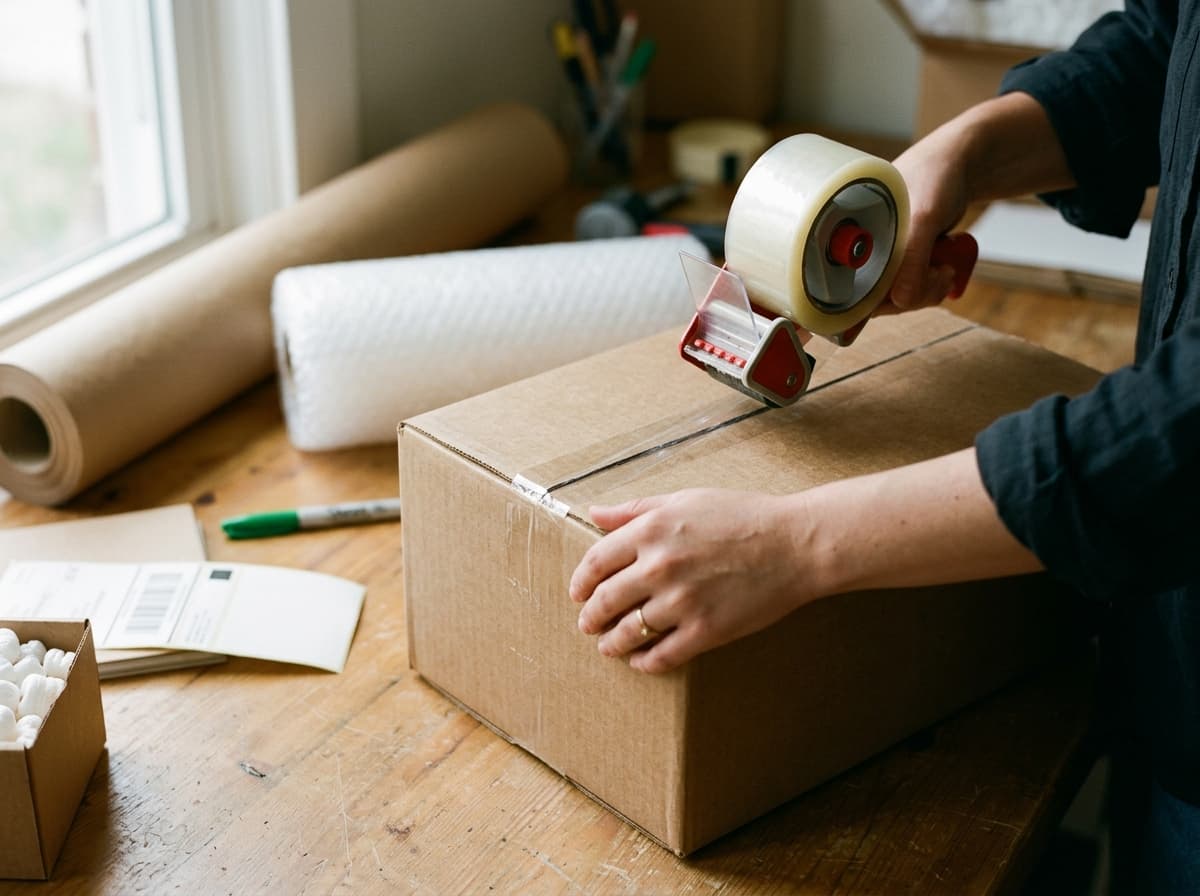
Choose a box the item fits with a small margin, fill every void so nothing moves, seal both the top and the bottom with three strips of 2-inch plastic tape, and apply one label with every old one removed. That covers the large majority of parcels.
This is the method for ordinary goods. Anything breakable needs the additional treatment in our guide on packing fragile items, which is a different problem with different rules.
Pick the right container first
Most wrapping problems are container problems, decided before any tape comes out.
A box for anything rigid, heavy, breakable or oddly shaped. Use a new one or a single-use one with crisp corners — cardboard loses much of its compression strength after one journey, because the corrugation inside is crushed and does not recover.
A poly mailer for soft, unbreakable goods: clothing, textiles, cushions, foam. Mailers conform to their contents rather than enclosing a fixed volume, so they are charged on actual weight rather than dimensional weight. On a bulky soft item that difference is substantial, as our guide on calculating package dimensions explains.
A padded envelope for small flat items that need a little protection — a phone case, a small book, jewellery in a box.
A document envelope for paper only.
The box size matters as much as the type. Aim for the item plus a modest margin, because an oversized box costs more to ship and gives the contents room to move. Where a box is too big, cut it down — score the corners, fold the walls in and re-tape. That takes a minute and often saves a size band.
Fill every void
Empty space is where damage happens. An item that can move builds up speed across the gap and hits the wall harder than if it had been packed solid.
Fill with whatever suits the contents: crumpled paper for general goods, air pillows for filling large gaps around a sturdy item, foam for anything dense. Loose fill peanuts work but settle toward the bottom on long journeys, leaving a void at the top by the time the parcel arrives.
Then apply the shake test. Seal the box, pick it up, shake it firmly. Nothing should move or make a noise. Any movement means a void to fill.
Then press each face with your thumb. If a face flexes inward more than a centimetre, the box is underfilled and will collapse when something is stacked on it in a cage. Add more fill.
Two checks, thirty seconds, and they catch most packing failures.
Wrapping the item
For general goods this is simpler than it is for fragile ones, but three habits still matter.
Bag anything that could be affected by moisture. Parcels sit in yards, on wet loading docks and in vans with open doors. A plastic bag around the contents costs nothing and prevents the most common form of arrival damage that is not impact.
Separate items that could mark each other. Metal against a painted surface, a zip against a screen, a charger cable against anything soft. A sheet of paper between them is enough.
Wrap anything with a sharp corner so it cannot push through the box wall from the inside. A book corner will pierce a single-wall box given eight hours of vibration.
Do not use newspaper directly against an unfinished surface. The ink transfers, and on unglazed ceramic or bare wood it does not come off.
Sealing: the H-tape method
Use pressure-sensitive plastic packing tape, at least 2 inches wide. Masking tape and cellophane have no shear strength. Duct tape feels strong and fails in the cold.
Tape the centre seam where the flaps meet, then both edge seams, on the top and the bottom of the box. Traced out, the three strips form an H on each face. Six strips in total.
The bottom matters more than the top. A box that fails does so at the bottom seam under its own weight, and the contents fall onto the belt. People tape the top carefully and give the bottom one strip.
Run each strip 2 inches down the sides so the tape grips the box walls rather than just the flaps.
Do not use string or straps on a parcel going through an automated network. They snag on belts and rollers, and most carriers refuse or surcharge them.
Labelling
One label, flat, on the largest face, away from seams and corners.
Remove every old label from a reused box. Scanners read every barcode they can see, and an old label is a real cause of misrouting. Cross-hatching it with a pen does not work — the barcode is still readable. Peel it off or cover it completely with an opaque label.
Do not put tape over the barcode if you can avoid it. Shiny tape creates glare that defeats some scanners. Where a label must be protected from rain, use a document pouch rather than taping over the code.
Put a duplicate address slip inside the box. If the outer label is destroyed — and it happens — that slip is the only thing that prevents the parcel becoming undeliverable. It costs one sheet of paper.
Write the sender's address as well as the recipient's. A parcel that cannot be delivered can then be returned instead of disposed of.
Items that will not fit a box
Some things cannot be boxed conveniently, and each has a standard answer.
Long thin items — poster tubes, curtain poles, fishing rods. Use a rigid tube with capped ends, then be aware a tube is cylindrical and rolls, which triggers an additional handling surcharge on most networks. Putting the tube inside a rectangular box removes the surcharge for the price of a box.
Flat items — framed art, mirrors, panels. Use a purpose-made flat box with corner protectors, and add a rigid board on each face so the item cannot flex. Flat items fail from flex, not impact.
Buckets, drums and irregular rigid shapes. Overbox them. Anything not in corrugated cardboard is additional handling on most networks.
Very large items. Covered in our guide on shipping large items, where the answer is often a pallet rather than a parcel.
Weatherproofing
Parcels get wet. Not usually enough to soak the contents, but enough to soften cardboard and lift a label.
Three low-effort defences. Bag the contents inside the box. Use a label pouch rather than a bare adhesive label on anything travelling a long distance. And avoid boxes with printed matt surfaces on the label face, which release adhesive more readily when damp.
For anything genuinely water-sensitive — documents, electronics, textiles — a sealed bag inside the box is not optional. Our guide on shipping documents internationally covers the specific case.
Packing several items together
A multi-item order is not just a bigger parcel. Items that would each be fine alone damage each other when packed loose together.
Separate anything that can mark, scratch or crush. A sheet of card or paper between items is enough for most combinations. Metal against a finished surface always needs a barrier.
Heavy at the bottom, light on top, and assume the box will spend part of its journey on its side. That assumption should change how you pack: nothing should depend on gravity to stay in place.
Use dividers for anything breakable. Cut corrugated strips into a grid, or buy a partitioned insert, so each item has its own cell.
Bag small loose items. Screws, cables, accessories and anything that could migrate into a gap and press against something else.
The alternative is splitting the order into two parcels, which is sometimes cheaper as well as safer. For dense items combining usually wins on cost; for bulky ones splitting often does, because dimensional weight scales with volume while base rates scale with parcel count.
Wrapping a return
Returns are packed worse than outbound parcels, consistently, and the reasons are worth knowing whether you are sending one or receiving one.
The item comes back in whatever box the customer has, often much larger than needed, with newspaper or nothing as fill. It arrives damaged, and the dispute about whether it was damaged before or during the return is unresolvable.
If you are returning something, use the original packaging where you kept it, and apply the same rules as a first shipment: right-sized, no voids, H-taped, one label. If you are a seller, include return instructions and, where possible, a fixed-price return label — a customer's oversized box on a weight-based label produces a reweigh adjustment on your account weeks later.
Photograph the item and the packed box before sealing either way. Our guide on returning a package to sender covers the process.
A quick reference by item type
| Item | Container | Key point |
|---|---|---|
| Clothing, textiles | Poly mailer | Charged on actual weight, not volume |
| Books | Book wrap or small box | Dense — watch the weight limit |
| Small electronics | Box, double-boxed | Anti-static bag, battery declared |
| Ceramics, glass | Box, double-boxed | 2 inches cushioning on all six sides |
| Framed art, mirrors | Flat box | Rigid board each face against flex |
| Posters, plans | Tube inside a box | A bare tube attracts additional handling |
| Bottles, liquids | Box, bagged and absorbed | Never a mailer |
| Tools, hardware | Small double-wall box | Heavy for its size; split rather than overload |
| Documents | Document envelope | Bag against moisture |
Reusing boxes
Reuse is fine within limits, and the limits are worth knowing.
A box that has shipped once has lost a meaningful share of its strength. For a light item on a short journey that is acceptable. For anything heavy, valuable or crossing a border, it is not — an international parcel is handled by two or three networks and spends longer in stacks.
Check the corners. Soft or rounded corners mean the corrugation is crushed and the box will not hold its shape under compression.
Never reuse a box with cut-out handles, a box that has been wet, or one with a previous label you cannot remove cleanly.
How long wrapping should take
A useful sanity check: a properly wrapped ordinary parcel takes about three minutes. If it is taking ten, the container is wrong for the item. If it is taking thirty seconds, something has been skipped.
For anyone shipping regularly, the way to hold that time down is to standardise. Two or three box sizes, one tape type, one fill material and a fixed sequence. Variety in packaging materials costs more per unit, takes up more storage, and slows every parcel while someone decides which box to use.
Set the sequence in the same order every time — container, contents bagged, item in, voids filled, shake test, tape, label, weigh. A fixed order is what stops the bottom seam getting one strip on a busy afternoon.
What people get wrong
An oversized box with loose fill. Costs more to ship and protects less than a right-sized box.
One strip of tape on the bottom. The most common cause of a burst parcel.
Old labels left on. A genuine misroute risk, and it is entirely avoidable.
Newspaper against a finished surface. Ink transfer.
No inside address slip. Turns a damaged label into a lost parcel.
String or strapping on a conveyor network. Snags, and attracts a surcharge.
Before you hand it over
Right-sized box, voids filled, shake test passed. Contents bagged against moisture. H-tape on top and bottom. One label, old ones removed, address slip inside. Weighed and measured after sealing, not before.
Then keep the receipt and follow it on our home page with the tracking number. If the parcel is going a long way, our guide on how long international shipping really takes sets out what to expect from the timeline.