How Long Does International Shipping Really Take?
Updated 2026-08-039 min readTracking and delivery
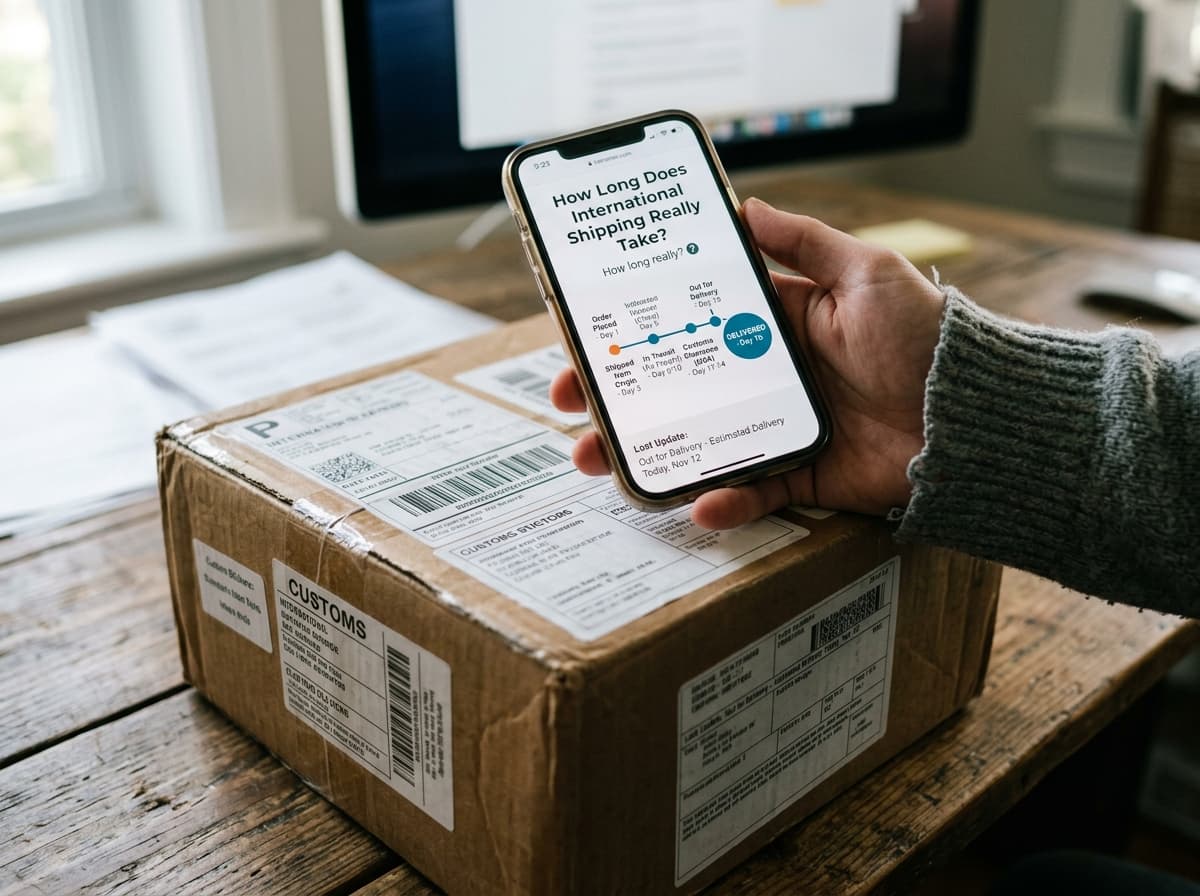
Express courier services deliver between major markets in 2 to 5 working days. Economy air takes 1 to 3 weeks. Postal and marketplace economy services take 2 to 8 weeks. Sea freight takes 4 to 12 weeks door to door. The service you paid for sets the range; the lane and customs decide where inside it you land.
Almost every complaint about international shipping being slow is a mismatch between the service actually bought and the expectation attached to it.
Where the days actually go
An international parcel spends its time in five distinct stages, and only one of them involves crossing an ocean.
| Stage | Typical duration | What is happening |
|---|---|---|
| Origin collection and processing | 1–3 days | Collected, sorted, consolidated, export-cleared |
| Departure and linehaul | 1–7 days | Waiting for a flight or vessel, then in transit |
| Arrival and import clearance | 1–5 days | Unloaded, declared, assessed, released |
| Handover to the final carrier | 0–4 days | Transferred to the domestic network |
| Last mile delivery | 1–5 days | Sorting and delivery in the destination |
The flight itself is measured in hours. Everything else is queueing, and the queues are where the variation lives.
Two stages surprise people most. Waiting for a flight can take longer than the flight, because economy services buy space on whatever cargo capacity is cheapest and that space is not always available. And the handover stage frequently produces the multi-day tracking silence people interpret as a lost parcel.
By service class
The single biggest variable is what you bought. These ranges assume no complications.
| Service class | Between major markets | To remote destinations |
|---|---|---|
| Express courier, door to door | 2–5 working days | 4–8 working days |
| Priority air | 5–10 working days | 1–3 weeks |
| Economy air | 1–3 weeks | 2–5 weeks |
| Postal international | 2–6 weeks | 4–8 weeks |
| Marketplace economy | 2–8 weeks | 4–10 weeks |
| Sea freight | 4–8 weeks | 6–12 weeks |
The gap between express and postal is not a matter of a few days. It is a different transport model. Express carries the parcel on the carrier's own aircraft and network end to end, with in-house customs clearance. Postal hands it to the destination country's postal operator at the border, and its onward speed depends entirely on that operator.
Our comparison of DHL and FedEx for international shipping covers where the express networks differ from each other.
By lane
Some routes are simply better served than others. These are realistic ranges for economy air, which is what most people actually buy.
| Lane | Economy air | Express |
|---|---|---|
| Within Europe | 3–8 days | 1–3 days |
| Within North America | 3–7 days | 1–3 days |
| US ↔ Western Europe | 7–14 days | 2–4 days |
| US ↔ East Asia | 10–20 days | 3–5 days |
| Europe ↔ East Asia | 10–20 days | 3–5 days |
| US or Europe ↔ Australia | 12–25 days | 4–6 days |
| To South America | 15–35 days | 4–8 days |
| To Africa | 15–40 days | 4–10 days |
| To Middle East | 8–18 days | 3–5 days |
Two patterns explain most of the table. Lanes with heavy passenger air traffic have plenty of cargo capacity and move quickly. Lanes with slower customs processes at the destination add days regardless of how the parcel travelled.
Destinations inside a customs union move much faster than the distance suggests, because there is no clearance step at all. A parcel crossing several European borders is domestic in practice.
Business days, not calendar days
Every published estimate counts working days, and the difference matters more than it looks.
A quoted 5 working days is 7 calendar days if it starts on a Monday, and 9 if it starts on a Thursday. Add a public holiday and it is 10 or 11.
Public holidays are the trap on international routes, because both countries' holidays apply, plus any in a transit hub. A parcel from Europe to Asia can hit three separate holiday calendars.
The largest single effect is the Lunar New Year shutdown across much of East Asia, when factories and logistics networks close for two to three weeks and millions of parcels simply stop. Tracking freezes en masse, nothing is wrong, and normal service resumes afterwards with a backlog.
Peak season in November and December adds a similar effect for a different reason: capacity is full rather than closed, so everything queues.
Customs is the biggest variable
Transport times are fairly predictable. Customs is not.
Routine clearance takes hours to 3 working days. Most parcels clear automatically on the electronic declaration without a human ever looking at them.
Random inspection adds 3 to 10 days. Parcels are selected by risk profiling and by chance, and there is nothing you can do to influence it.
A hold for missing information is open-ended. The parcel waits until someone supplies what is missing, and the clock does not start until the request is noticed. A hold ignored for two weeks is a two-week delay plus whatever the clearance then takes.
Unpaid duty works the same way. The parcel waits, storage charges accrue, and after a period it is returned or abandoned.
The practical consequence: respond to any customs contact the same day. Our guides on why parcels get stuck in customs and avoiding customs delays cover what triggers a hold and how to clear one.
Accurate paperwork prevents most of it. A vague description, a missing HS code or an under-declared value are the three most common causes, as our guides on HS codes and documents needed for international shipping explain.
Why the checkout estimate is optimistic
Estimates shown at checkout are usually transit times, not total times.
They typically start counting when the parcel enters the carrier's network, not when you place the order. Between those two points sits order processing and dispatch, which adds 1 to 3 days for most sellers and longer for made-to-order goods.
They also assume clean clearance and no capacity constraints, because that is the modal case. Add the processing time and a realistic customs allowance and you get a figure several days longer than the one displayed.
For a rough working estimate: take the quoted transit time, add 2 days for dispatch, add 2 days for customs, and convert to calendar days. That lands close to reality far more often than the quoted figure.
Reading the tracking while you wait
International tracking behaves differently from domestic tracking, and knowing the pattern prevents unnecessary worry.
Expect a cluster of scans at origin, then silence during the linehaul, then a cluster on arrival. The silence is the flight or the voyage, and on sea freight it can run for weeks.
Expect a possible carrier change at the border. A postal parcel becomes an item of the destination country's postal service, and it may pick up a new number in the process. Our guide on why a parcel changes carrier mid-journey explains the handover, and identifying a carrier from a tracking number helps when the format changes.
Expect fewer scans overall on economy and postal services. Fewer scans does not mean slower movement; it means less reporting.
You can check any international number on our home page, which searches across operators rather than requiring you to know which one currently holds the parcel.
When a delay stops being normal
Use the last scan, not the estimated date, as your reference point.
| Service | No scan for | Then |
|---|---|---|
| Express | 5 days | Contact the sender to raise it with the carrier |
| Economy air | 10–14 days | Contact the sender |
| Postal international | 21 days | Contact the sender |
| Sea freight | 30 days | Contact the freight forwarder |
Formal lost-parcel investigations generally cannot be opened before 30 days on express and 60 days on postal services. Those windows exist because international parcels genuinely do reappear after long silences.
The sender raises the case, not the recipient, because the shipping contract belongs to them. Our guide on lost or damaged package claims covers the process, and what to do when a package is delayed covers the steps before it reaches that point.
Marketplace orders run on their own clock
Orders from AliExpress, Shein, Temu and similar platforms sit at the slow end of every range above, and for a specific reason.
They ship on consolidated economy services. Parcels are collected, held until a container or air pallet fills, then moved as a batch. That consolidation step alone adds days to weeks before the parcel leaves the country, which is why the tracking number often shows nothing for a week after the order is marked shipped.
Realistic expectations: 2 to 5 weeks to major markets, longer to remote ones. Our guides on tracking an AliExpress order, a Shein order and a Temu order cover how each platform's tracking behaves and which carrier picks the parcel up at each stage.
Sea freight runs on a different calendar
For anything heavy or bulky, sea is the only economic option, and the timings work nothing like parcel shipping.
The voyage itself is the predictable part — typically 3 to 6 weeks between major ports depending on the route. Everything around it is not.
Before departure, the container waits for a sailing. Vessels leave on a weekly or fortnightly schedule, so a shipment that misses the cut-off waits for the next one. After arrival, the container is discharged, cleared, deconsolidated and trucked, which adds 1 to 3 weeks at the destination.
Door to door, plan for 6 to 12 weeks and treat anything faster as a bonus. Tracking is container-level rather than parcel-level, so you get a handful of milestones — loaded, departed, arrived, discharged, cleared — rather than a continuous trail.
Delays here come from port congestion and vessel scheduling rather than from anything about your shipment, and there is very little a shipper can do to influence them once the container is loaded.
Making it faster
Four things genuinely reduce transit time, in order of effect.
Buy an express service. It is the only change that moves you between rows of the table rather than within one.
Get the paperwork right. A specific description, correct HS code, accurate value and a complete address remove the most common causes of a customs hold.
Ship on a Monday or Tuesday. A parcel dispatched on Friday afternoon frequently sits until Monday at origin, losing the weekend at the start rather than the end.
Use a door-to-door service with in-house clearance rather than one that hands over at the border. It removes an entire stage and the queue attached to it.
Everything else — paying for a faster last mile, choosing a different final carrier — moves the total by hours rather than days.
Setting expectations as a seller
If you sell internationally, the transit time you publish matters more than the one you achieve.
Quote a range rather than a date, and quote it in calendar days. "10 to 20 days" sets an expectation your customer can plan around. A single date creates a deadline you will miss on a meaningful share of orders, and every miss is a support ticket.
Say explicitly that customs may add time and that the delay is outside your control. Customers accept this readily when told in advance and badly when told afterwards.
Then send the tracking number at dispatch with one sentence explaining that international tracking goes quiet during the flight and the handover. That single sentence removes the largest category of international shipping enquiries — a parcel that is fine, checked by someone who does not know that silence is normal.
The short version
Match the expectation to the service. Express is days, economy air is weeks, postal is many weeks, sea is months. Add dispatch time and a customs allowance to whatever the checkout said, and count in calendar days rather than working ones.
Then judge progress by the last scan rather than the promised date, and use the thresholds above to decide when a quiet parcel has actually become a problem.