How to Ship Electronics Safely
Updated 2026-08-039 min readPacking and sending
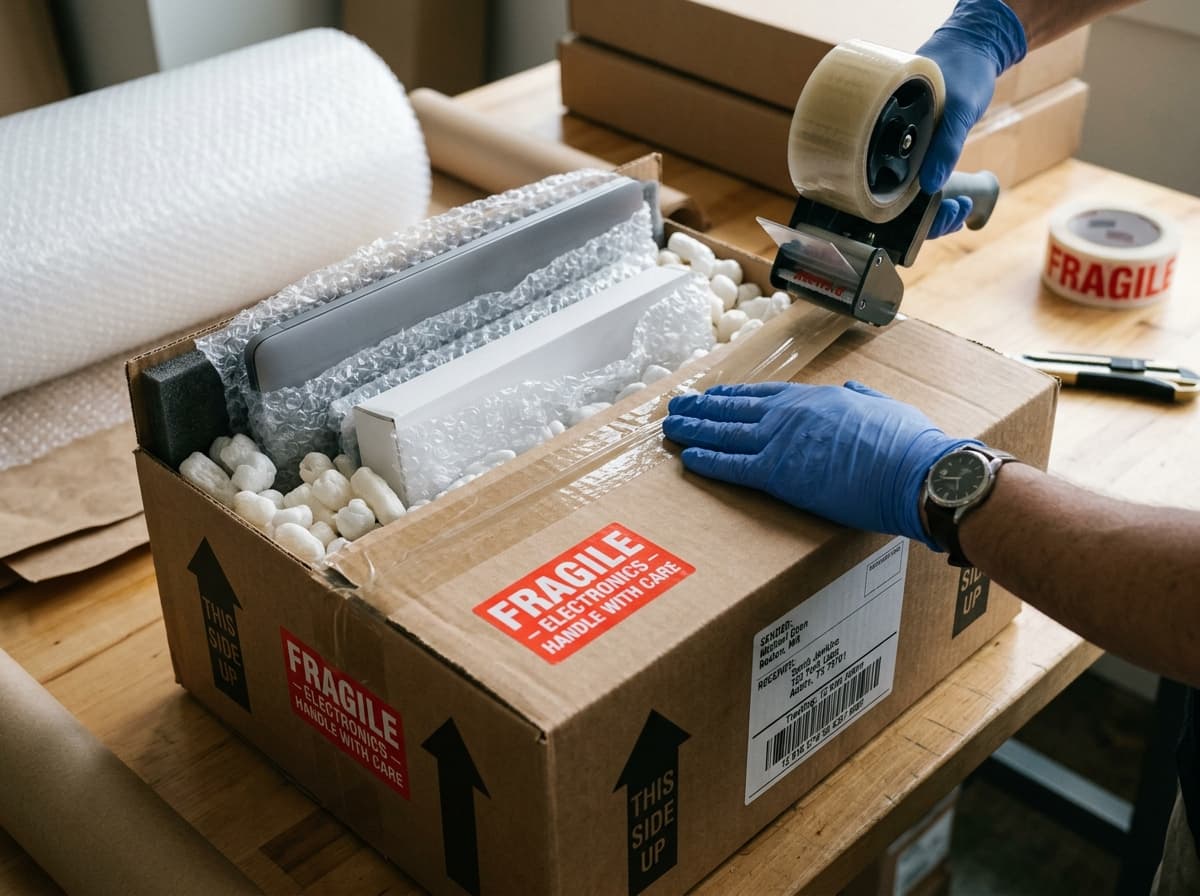
Two things decide whether an electronic item ships safely: the battery, and the box. Get the battery rules right and the parcel is accepted. Get the packing right and the device arrives working. Most failures are one or the other, and the battery failures are the expensive ones.
A laptop and a lamp weigh about the same and travel the same route. Only one of them can be refused, delayed or destroyed by the carrier for regulatory reasons, and it is not the lamp.
Lithium batteries set the rules
Almost every consumer electronic device made in the last decade contains a lithium cell. That single fact governs how it can be shipped, which services will take it, and what has to appear on the outside of the box.
The concern is a specific failure mode. A lithium cell that is damaged, crushed, short-circuited or overheated can enter thermal runaway — a self-sustaining reaction that generates its own oxygen and burns at temperatures that are extremely difficult to suppress. In an aircraft hold that is a serious event, which is why air transport rules are far stricter than ground rules.
The rules distinguish three situations, and they are treated very differently.
| Situation | Restriction level | Typical requirement |
|---|---|---|
| Battery installed in the device | Lowest | Device off, terminals protected by the device itself |
| Battery packed alongside the device | Medium | Terminals insulated, battery in its own inner packaging |
| Battery shipped on its own | Highest | Often refused by consumer services entirely |
The practical guidance follows directly. Ship the battery inside the device wherever you can. It is the least restricted case, needs the least paperwork, and is accepted by the most services.
If you must ship a spare battery, tape over the terminals and put each one in a separate plastic bag or its original packaging so nothing metal can bridge the contacts. A loose battery rolling against a set of keys is exactly the scenario the rules exist to prevent.
Loose lithium batteries as a standalone shipment are refused by most consumer counter services and require a dangerous goods process. If that is what you need to send, ask the carrier before you pack rather than after.
Watt-hours and why the number matters
Battery restrictions scale with capacity, measured in watt-hours. The figure is usually printed on the battery itself, and where it is not, you can calculate it: amp-hours multiplied by volts.
Small consumer devices — phones, headphones, tablets, cameras, most laptops — sit well below the common thresholds and ship without special treatment when installed in the equipment.
Larger items cross into restricted territory. Power tools with big packs, e-bike and scooter batteries, portable power stations and drone battery sets frequently exceed the limits for ordinary parcel services. Above the threshold the shipment becomes a declared dangerous goods consignment, needing trained shipping personnel, specific packaging and formal documentation.
E-bike and scooter batteries in particular are refused by most consumer parcel services outright. If that is what you are shipping, you are looking at a specialist dangerous goods courier, not a counter.
Check the specific carrier's published limits rather than assuming. They differ between carriers and between air and ground services from the same carrier.
Preparing the device before it goes in the box
Five steps, and they take about ten minutes.
Charge to roughly 30 per cent. Shipping rules for standalone lithium batteries specify a partial state of charge, and it is sound practice for installed batteries too. A cell at full charge has more stored energy to release if something goes wrong.
Power off completely. Not sleep, not standby — off. A device that wakes in transit generates heat inside an insulated box. On laptops, check that any wake-on-lid or scheduled wake setting is disabled.
Remove or secure anything that can move. Discs, memory cards, detachable lenses, styluses. A loose object rattling inside a device causes internal damage that looks like a manufacturing fault.
Wipe or back up the data. If the parcel is lost, the data is lost with it. If you are selling the device, factory reset it and sign out of any account lock, because a locked device arriving at a buyer is functionally a brick.
Photograph the device working. Screen on, serial number visible. This is the evidence that decides a damage claim, and it takes thirty seconds.
Packing so it survives the belt
Electronics fail from three things in transit: impact, compression and static.
Anti-static first. Bare circuit boards, RAM, graphics cards and drives need an anti-static bag. Ordinary bubble wrap and polystyrene generate static charge, and a static discharge kills a component invisibly — the device simply does not power on. A complete device in its own case is largely protected by that case; a bare component is not.
Then cushioning. At least 2 inches, or 5 centimetres, of padding between the device and every wall of the box, including top and bottom. Foam is better than bubble wrap for anything dense, because bubble wrap compresses permanently under weight and stops protecting halfway through the journey. Our guide on packing fragile items covers the method in full.
Then double-box. Retail packaging is designed to look good on a shelf and to survive a short trip in a pallet. It is not shipping packaging. Put the retail box inside a corrugated outer box with 2 inches of cushioning around it.
Double-boxing has a second benefit for electronics specifically: it hides what the parcel contains. A box with a well-known manufacturer's branding and a shipping label on it advertises itself, and parcel theft is targeted rather than random.
Screens need a rigid layer. A monitor, laptop or tablet screen fails from flex, not just impact. Put a piece of stiff corrugated board or thin plywood against the screen face before wrapping, so pressure on that face is spread rather than concentrated.
Cables and accessories go in their own bag, not loose in the box. A charger connector loose against a screen for two days does real damage.
What to declare and label
If the shipment contains lithium batteries, the carrier will ask, and the answer goes on the paperwork.
For batteries installed in equipment, many services require a lithium battery handling mark on the outside of the box. The carrier supplies the specification, and most online label tools prompt for it during the booking flow. Answer the battery question honestly there and the system usually generates whatever mark is needed.
For international shipments, the customs declaration needs a plain description — "used laptop computer", not "electronics" — plus the value and the HS code. A vague description is one of the most reliable ways to get a parcel held for inspection, as our guides on avoiding customs delays and what an HS code is explain.
Do not under-declare the value to reduce duty. Beyond being a customs offence, the declared value is the ceiling on any claim, so an under-declared laptop is an under-insured laptop.
Undeclared batteries carry real consequences: removal from the network, destruction of the parcel, a penalty against the shipper, and a voided insurance position. There is no scenario where hiding it works out cheaper.
Insurance and declared value
Electronics are among the most claimed-on categories, and carriers know it.
Some services exclude or limit liability on electronics as a category, regardless of the insurance you buy. Check the terms for the specific service before assuming a high declared value gives you cover. Where the carrier excludes the category, third-party shipping insurance is the alternative.
Whatever cover you buy, the same two rules apply as with any damage claim. The sender files it, because the shipping contract belongs to them. And the claim is refused if the assessor judges the packing inadequate, which for electronics means anything without proper cushioning or a second box.
Our guide on lost or damaged package claims covers the filing process and the deadlines.
Buy a signature service on anything valuable. An expensive device left on a doorstep is a claim waiting to happen, and the carrier's position is much stronger than yours when the tracking shows a completed delivery. Our guide on signature required versus no signature delivery covers which tier to choose.
Shipping electronics internationally
Three extra frictions apply.
Battery rules differ by country and by airline, and the transit country matters as much as the destination. A route that changes at a hub with stricter rules can see the parcel refused mid-journey.
Some countries restrict specific electronics — radio transmitters, drones, encryption devices, satellite equipment. These need import approval and are seized without it.
Duty is charged on the declared value, and electronics generally sit in dutiable categories. The recipient pays unless you shipped on delivered-duty-paid terms, and they also pay the carrier's advancement fee on top. Our guide on customs duties covers how the calculation works.
For a valuable device crossing a border, an express service with in-house customs clearance costs more and clears faster than a postal service that hands over at the border. On a laptop, the difference in transit time is often a week.
Selling a device online
Shipping electronics you have sold to a stranger adds a layer that has nothing to do with packing.
Record the serial number and photograph it as part of the listing, before the item leaves. The most common dispute in used electronics is a buyer claiming the device received is not the device sold, and a serial number in the listing settles it in seconds.
Ship to the address the platform holds, never to an address supplied separately in a message. Buyer protection schemes only cover a delivery to the registered address, and a redirect request is one of the oldest patterns in marketplace fraud.
Use a signature service and keep the proof. For an expensive device, delivery confirmation without a signature is weak evidence in a dispute over whether it arrived.
Remove account locks. A phone still tied to an account, or a laptop with a firmware password, arrives unusable and generates a refund request that is entirely your fault.
Our guides on tracking an Amazon order and an eBay order cover how tracking information flows through those platforms, which matters because a dispute is usually judged on what the platform can see.
Choosing the service
The right service depends on value more than on weight.
For an inexpensive accessory, a standard ground service in a well-packed box is fine. For anything worth more than the cost of expediting it, three things are worth paying for: a shorter transit time, because fewer days in the network means fewer handling events; a signature on delivery; and adequate declared value.
Internationally, an express service with in-house customs clearance moves a valuable device faster and with fewer handovers than a postal service that transfers it at the border. Fewer handovers means fewer opportunities for damage and a clearer chain of custody if something goes wrong. UPS, FedEx and DHL all operate this way on major lanes.
Common mistakes
Shipping in the retail box alone. The single most common failure, and it fails on both protection and discretion.
Full charge. More stored energy, more heat, and against the rules for standalone batteries.
Loose spare batteries with exposed terminals. The exact scenario the regulations were written for.
Bubble wrap on a bare circuit board. Static, not impact, is what kills it.
"Electronics" as the customs description. Guarantees a slower inspection.
No photographs. Turns a straightforward claim into a contested one.
Before you hand it over
Battery installed and device fully off, charged to around a third. Anti-static bag on anything bare. Two inches of foam on all six sides. Retail box inside a shipping box. Battery question answered honestly at booking. Value declared accurately, description specific. Photographs taken. Signature service bought if it is worth anything.
Then keep the receipt, and follow the parcel on our home page with the tracking number. If it stops moving at a border, our guide on parcels stuck in customs explains what the hold usually is and how long it should last.