Why Is My Package Stuck in Customs?
Updated 2026-08-0210 min readCustoms and duties
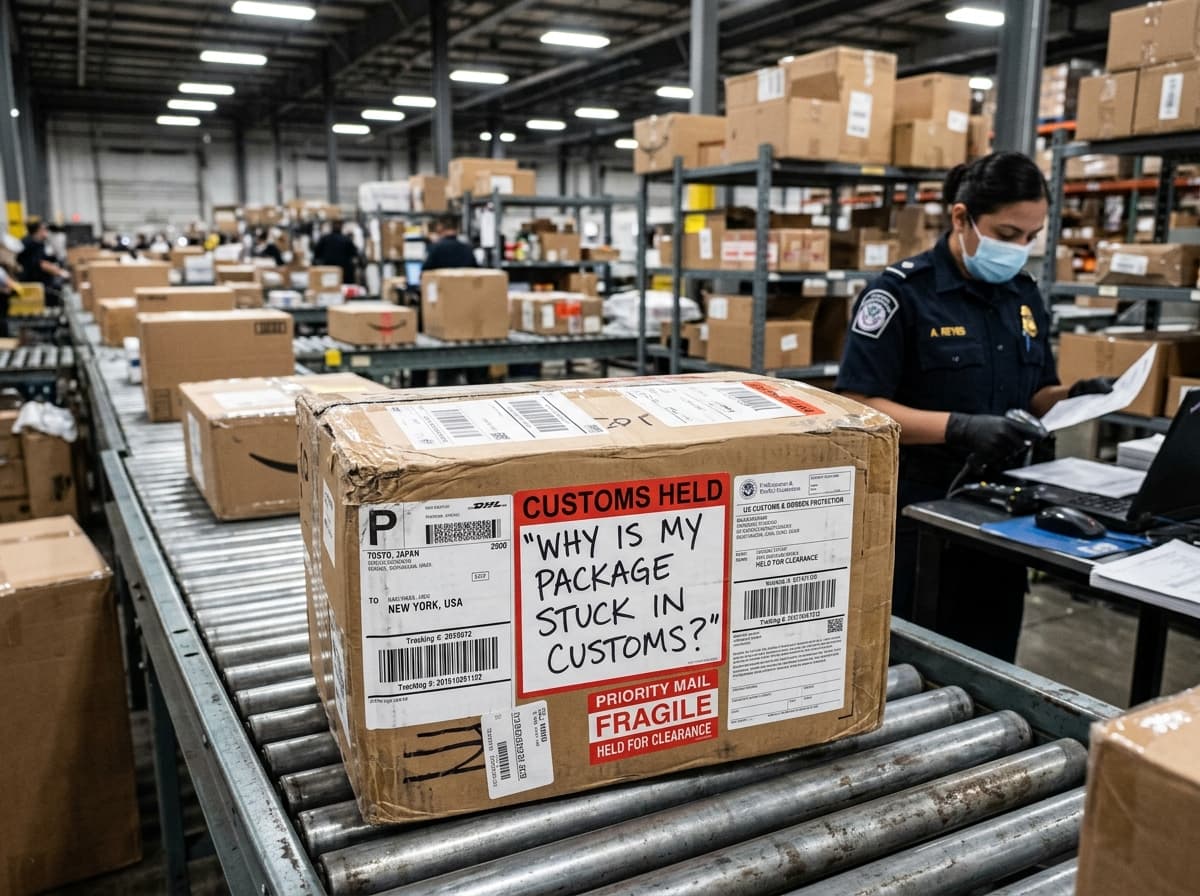
A parcel that has stopped at customs isn't usually being investigated. It's waiting in a queue, and in a large share of cases it's waiting for money that nobody told you was owed.
Customs is the single least transparent leg of an international journey. You get one scan saying the parcel arrived, then silence, then either a delivery or a demand for payment. Understanding what happens inside that silence is the difference between waiting sensibly and panicking on day four.
What customs actually does with your parcel
Every parcel crossing a border gets assessed against three questions: what is it, what is it worth, and is anything owed on it.
Most of that assessment is automated. Customs systems read the electronic data the carrier submitted — a description, a declared value, a commodity code — and either release the parcel or flag it. The vast majority clear without a human ever seeing the box.
Parcels get flagged when the data looks wrong, when the value crosses a threshold that triggers duty, when the commodity code suggests something restricted, or at random for spot checks. Only flagged parcels get physically examined, and even then most examinations are a scan rather than an opening.
Quick fact: In most developed markets, over 90% of low-value parcels clear customs automatically without human review. Physical inspection rates run in low single digits.
The four reasons parcels sit
Almost every held parcel falls into one of four situations, and only one of them needs you to do anything.
Routine screening — no action needed
The parcel is in a queue waiting to be processed. Nothing is wrong with it.
Volume is the enemy here. A single wide-body freighter can deliver more than a hundred thousand small parcels, and they all queue for the same processing capacity. Add a national holiday or a post-sale surge and the queue lengthens.
Normal wait: 3 to 5 working days. Up to 14 during peak periods like late November, the weeks after Singles Day, or the run-up to Christmas.
What to do: nothing. This one clears on its own.
Unpaid duty or tax — you must act
The most common cause of a genuinely long hold, and the one people miss.
When a parcel's declared value crosses your country's threshold, duty and import tax become payable before release. The carrier fronts the payment to customs, then bills you — usually by SMS, email, or a card through the letterbox.
That notification fails constantly. It lands in spam, goes to an email address the seller supplied rather than yours, or arrives as a text from an unrecognised number that looks exactly like a scam. Meanwhile the parcel sits.
Normal wait: indefinite. The clock doesn't start until you pay.
What to do: go looking rather than waiting. Check spam, then check the carrier's own website — most have a "pay import charges" page where you enter the tracking number and it tells you whether anything is owed. That takes two minutes and resolves a surprising share of "stuck" parcels.
Warning: unpaid parcels don't wait forever. Most carriers hold them 21 to 30 days, then return them to the sender or dispose of them. Two of those weeks can pass before you realise a payment was ever requested.
Missing or wrong paperwork — the sender must act
Customs needs a description, a value, and often a commodity code. Vague or missing data gets a parcel set aside.
"Gift," "sample" and "goods" are not descriptions. A parcel declared as "gift, $5" containing a phone gets flagged for undervaluation, which is a slower and more serious problem than simply paying the duty would have been.
Commercial shipments need more: a commercial invoice, sometimes a certificate of origin, sometimes a licence for the specific product category.
Normal wait: 5 to 15 working days, because the carrier has to reach the sender, get corrected documents, and resubmit.
What to do: tell the sender immediately. You can't fix their paperwork. A commercial invoice, an accurate description and a correct value are the three that matter most.
Restricted or prohibited contents — often terminal
Some things simply can't cross a given border, and the rules vary far more than people expect.
Food, seeds, plants, cosmetics, supplements, medicines, anything with a lithium battery, alcohol, and knives all sit on restricted lists somewhere. Perfume is a common surprise — it's classed as flammable and banned from air mail almost everywhere.
Normal wait: if it's genuinely prohibited, it isn't a wait. The parcel is seized or returned.
What to do: you'll get a formal notice explaining the decision and any appeal route. Appeals rarely succeed on prohibited items but often do on misclassified ones.
Reading your tracking page
The scan wording tells you which situation you're in, if you read it carefully.
"Arrived at customs" / "Import scan" / "Held by customs" — routine screening has begun. Start the 5-day clock.
"Customs clearance in progress" — actively being processed. Usually clears within days.
"Awaiting payment" / "Customs charge due" / "Held pending payment" — this is the payment case. Act today.
"Additional information required" / "Documentation issue" — paperwork. Contact the sender.
"Customs clearance complete" / "Released by customs" — done. The parcel has re-entered the delivery network and should move within a day or two.
Many carriers only emit two of these events in total, so if you see "arrived at customs" and nothing else, that isn't a bad sign. Our guide on tracking that stops updating covers why the silence is structural rather than suspicious.
Who pays, and why it varies
Two shipping terms decide whether a bill reaches you, and they're worth knowing before you order rather than after.
DDP — Delivered Duty Paid. The seller has already paid the duty and tax. Nothing is owed, and the parcel clears without contacting you. Large retailers shipping internationally usually work this way, and the cost is baked into the price you paid.
DAP or DDU — Delivered At Place / Delivered Duty Unpaid. The seller paid for transport only. Duty, tax and the carrier's handling fee fall to you on arrival.
Marketplace purchases are usually DAP, which is why a $40 order can arrive with a $22 bill attached. Our import tax guide for online shoppers explains how the charge is calculated.
That handling fee catches people out too. Carriers charge for fronting the money and doing the paperwork — commonly $10 to $20, or a percentage, and it applies even when the duty itself is small.
What happens if they open it
Border agencies can inspect any international shipment without telling you first, and they don't need a reason.
Most "inspections" are a scan rather than an opening — the parcel goes through an X-ray, an officer looks at the image, and it continues. That adds hours, not days.
Physical opening is rarer and leaves evidence. The parcel is resealed with official tape carrying the agency's name, and there's usually a notice inside explaining that it was examined. Nothing has gone wrong; you simply drew a spot check or the X-ray showed a shape worth confirming.
Items are only removed when they're restricted or prohibited, and that comes with a formal written notice rather than silence. If your parcel arrives resealed with everything inside, that's a completed inspection, not a partial theft.
Quick fact: an opened parcel is rarely repacked as well as it was sent. Fragile items are more likely to arrive damaged after an inspection, which is worth knowing if you're claiming — keep the official tape and the notice as evidence of when the packaging was disturbed.
Why the same item clears differently in different countries
Two identical parcels sent to two countries can behave completely differently, and it's not random.
Countries set their own thresholds for when duty and tax kick in, their own restricted lists, and their own processing capacity. A supplement that's an ordinary grocery item in one market needs an import licence in another. A $40 order that clears untouched in one country triggers a bill in the next.
Processing speed varies just as much. Some agencies clear low-value e-commerce parcels almost entirely automatically. Others still handle a meaningful share manually, which turns a five-day queue into a three-week one during peak periods.
This is why "how long does customs take" has no single answer, and why advice from someone in a different country may be useless to you. Check your own country's rules rather than assuming they match a neighbour's.
Making the parcel move
There's a short list of things that genuinely work, and a long list of things that don't.
Pay any outstanding charge. Parcels typically move within 24 to 48 hours of payment clearing. This is the single most effective action available to you.
Supply information the carrier asked for. If a scan mentions incomplete data, most carriers have a self-service form where you can add a description or value.
Ask the sender to correct their paperwork. Only they can resubmit a declaration.
What doesn't work: contacting the customs agency directly. They handle policy and enforcement, not individual parcel queries, and will redirect you to the carrier. Calling the carrier's national line repeatedly doesn't help either — the parcel is in a bonded facility that the call centre cannot influence.
When to escalate, and to whom
Past 15 working days at customs with no payment request and no document query, something has gone wrong beyond a queue.
Contact the sender, not the carrier. The shipping contract is theirs, so only they can open an investigation. Give them the tracking number, the exact wording of the last scan, and its date.
Keep an eye on two deadlines while you wait. The carrier's storage period runs 21 to 30 days before the parcel is returned or destroyed. And if you bought through a marketplace, buyer protection typically expires 60 to 90 days after dispatch — file the dispute before that closes, because you can always withdraw it if the parcel appears.
Bonded warehouses and why nobody can help you
While a parcel is at customs it sits in a bonded facility — a warehouse where goods are legally not yet in the country, even though they are physically inside its borders.
That status is why front-line staff cannot help you. The carrier's call centre can see the same tracking page you can. They cannot walk into the bonded area, cannot ask an officer to prioritise your parcel, and cannot give you a release date. The facility is under customs control, not theirs.
It also explains why nothing is scanned. Movements inside a bonded warehouse are recorded for customs, not for the carrier's public tracking feed, so the silence is structural rather than negligent.
The one lever that reaches inside is money. A parcel held for an unpaid charge is released by the payment clearing, and that happens automatically without anyone making a decision about your case.
Peak periods make everything worse
Customs queues are seasonal, and knowing the calendar explains a lot of otherwise baffling delays.
The heaviest stretch runs from mid-November into early January, driven by Black Friday, Singles Day and Christmas volume arriving all at once. A five-day clearance can become three weeks, and there is no way around it beyond ordering earlier.
Late January and February bring a different problem. Chinese factories and logistics networks close for two to three weeks around the Lunar New Year, and the surge of parcels dispatched just before the shutdown lands in destination customs together.
Local holidays matter too. Customs offices close, and a three-day national holiday can add a working week to the queue once the backlog is cleared.
If you are ordering something needed by a date and it crosses a border, add two weeks to whatever the seller quoted during these windows. That single adjustment prevents most of the panic.
Reducing the odds next time
Customs delays are mostly decided before the parcel ships, which means the buyer has more influence than it feels like.
Buying from a seller who ships DDP removes the payment hold entirely. Sellers who declare accurately get flagged far less often than those who under-declare to "help" you avoid duty — that tactic causes more delays than it prevents, and the penalty falls on the parcel.
And check what you're buying against your country's restricted list before ordering. Perfume, supplements and anything battery-powered are the three categories that most often surprise people at the border. Our guide on avoiding customs delays covers the rest.
Most held parcels clear on their own within a week. The ones that don't are usually waiting for a payment nobody mentioned — so before you assume the worst, spend two minutes checking whether the carrier is quietly waiting for your card details.