How to Ship Books and Printed Material Cheaply
Updated 2026-08-039 min readPacking and sending
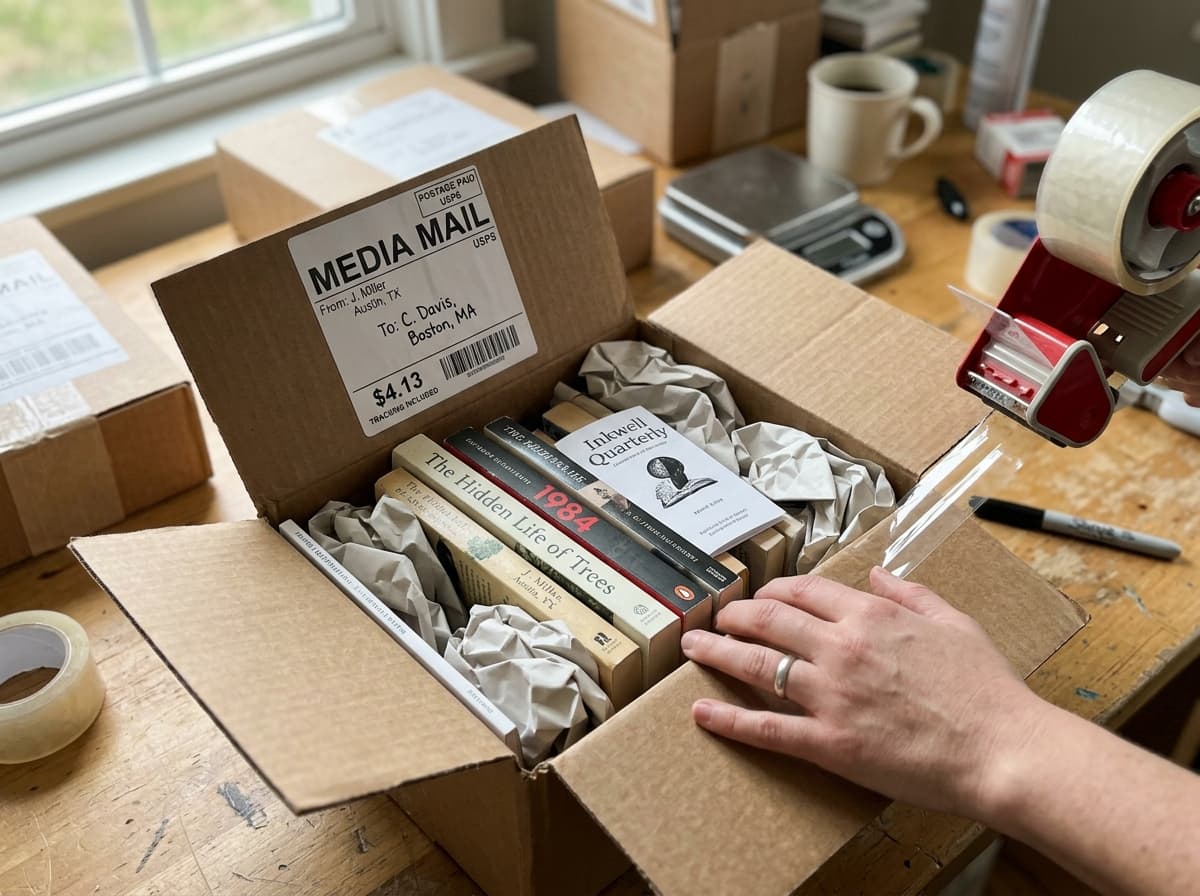
Books are dense, which reverses the usual shipping arithmetic. A small box of books is heavy for its size, so it is charged on scale weight rather than volume — and that makes flat rate boxes and postal media rates comfortably the cheapest options available.
The other half of the problem is corner damage. Books are damaged in transit far more often than their sturdiness suggests, and the cause is always the same.
Why density changes everything
Most shipping advice is about avoiding dimensional weight — the charge carriers apply when a box is large and light. Books have the opposite problem.
The break-even density for most carriers is around 8.7 pounds per cubic foot, or 200 kilograms per cubic metre. Books sit at roughly two to three times that. They are charged on actual weight every time, and the weight rises fast.
Two consequences follow, and both work in your favour.
Flat rate boxes are excellent for books. A fixed price with the weight irrelevant up to a limit is exactly the right product for a dense item, and it is often the cheapest shipping available for a full box. Our guide on flat rate versus weight-based shipping explains where the crossover sits.
Small boxes beat large ones by more than usual. Filling a large box with books produces a parcel that may exceed the box's rated weight and will certainly exceed comfortable handling. Two small boxes are frequently cheaper and always safer than one large one.
Media and printed-matter rates
Several postal services offer discounted rates specifically for books and printed material, and where one exists it is normally the cheapest option by a wide margin.
The trade-offs are consistent across countries. The service is slower — often several days longer than standard post. The contents are restricted to qualifying printed material, so including a note, a bookmark or any non-qualifying item can disqualify the parcel. And parcels are subject to inspection to verify the contents, which is a legitimate part of the service rather than a suspicion of you.
Check what your own postal operator offers. USPS, Royal Mail, Canada Post and Australia Post all have some form of printed-matter or book product, with different names and different rules.
Couriers do not offer an equivalent. There is no UPS or FedEx media rate, because the discount exists as a public-interest provision within postal services rather than as a commercial product.
What actually damages books
Books arrive damaged more often than people expect, and almost always in the same three ways.
Bumped corners. The book slides inside its packaging, the corner hits the box wall repeatedly, and the board is crushed. This is the overwhelming majority of book damage.
Bent covers. Paperbacks in a flexible mailer take on the shape of whatever pressed against them in a cage.
Water. Cardboard absorbs moisture and passes it to the contents. A slightly damp box produces a permanently cockled book.
All three are solved by the same three decisions: a snug fit, a rigid outer, and a plastic bag.
Packing books properly
Bag the book first. A plastic sleeve or bag against moisture. This is the single most effective thing you can do and it costs almost nothing.
Protect the corners. Wrap in bubble or card so the corners specifically have material over them, rather than relying on a general layer. The corners are what hit things.
Fit snugly. A book that cannot move cannot bump. A book wrap — a scored corrugated sheet that folds around the book and locks — is purpose-made for this and is the best value option for single books.
Use a rigid outer. A box or a book wrap, not a padded envelope, for anything hardback or valuable. Padded envelopes are fine for a cheap paperback and inadequate for anything else.
For multiple books, pack them spine to spine, flat, in layers, with a sheet of card between layers. Do not stand them on edge in a partly filled box, because they will fall over and slide.
Fill any remaining space completely. A box of books with a two-inch gap at the top will have shifted by the time it arrives, and the top layer will be damaged.
Weight limits and the box rating
Books hit weight limits before size limits, which is unusual and catches people out.
Check the box maker's certificate on the bottom flap — it states a maximum gross weight, and a box of books will reach it in a surprisingly small volume. Exceeding it means the box will not hold its shape in a stack.
Use double-wall corrugated for anything over about 10 kilograms. Single-wall is not rated for the weight books reach.
There is also a practical limit worth respecting: a box heavy enough that it is awkward to lift is a box that will be dropped. Below roughly 20 kilograms per box, and split into two if you exceed it.
A worked cost comparison
The same three hardback books, roughly 3 kilograms, sent domestically a long distance. Relative outcomes rather than prices, because rates change annually.
| Option | Relative cost | Speed | Notes |
|---|---|---|---|
| Postal media or printed-matter rate | Lowest | Slowest | Contents restricted to printed matter |
| Flat rate box | Low | Standard post speed | Only if they fit and stay under the limit |
| Standard postal parcel | Medium | Standard | The default, and rarely the best choice |
| Courier ground | High | Faster, tracked in detail | Rarely justified for books |
| Courier express | Highest | 1–2 days | Only when the deadline is real |
The pattern holds almost universally: the two cheapest options are the two that ignore or discount weight, and the gap between them and a courier widens as the parcel gets heavier.
Where the comparison flips is speed with a deadline attached. A media rate service has no guarantee and can take well over a week domestically. If the arrival date matters, the discount does not.
Comics, magazines, prints and posters
Flat printed material is a different packing problem, because the failure mode is bending rather than corner damage.
Comics and magazines need a rigid backing board behind them and a bag in front, then a stiffened mailer. The board is what does the work — without it the item takes on the curve of whatever it was stacked against.
Prints and posters go in a tube, and the tube goes in a rectangular box. A bare tube rolls, which triggers an additional handling surcharge on most networks and costs more than the box. Cap both ends properly; open-ended tubes crush.
Large flat art ships in a purpose-made flat box with corner protectors and a rigid board on each face. Our guide on wrapping packages for shipping covers the general method for flat items.
Never fold anything you would not want creased. A folded print is a damaged print regardless of how carefully it was folded.
Signed, rare and collectible books
Value changes the calculation, and three things become worth paying for.
Declared value that matches the item. The declared figure is the ceiling on any claim, so an under-declared first edition is an under-insured one. Be prepared to evidence the value — a listing, a valuation or a receipt.
A signature service. An expensive item left on a doorstep is a claim the carrier will contest, and their position is strong once a delivery scan lands. Our guide on signature required versus no signature delivery covers the tiers.
Double-boxing. An inner box holding the wrapped book, suspended inside an outer box with 2 inches of cushioning between them. It is the single biggest improvement available and it costs the price of a second box.
Photograph the book before packing, including the corners, the spine and any signature. Those photographs are what decide a damage claim, as our guide on lost or damaged package claims explains.
Avoid media and printed-matter rates for valuable items. They are slower, handled less carefully, and generally carry minimal liability.
Shipping books internationally
Books are among the easier things to send across a border, with two things worth knowing.
Printed matter is duty-free in many jurisdictions, or attracts a low rate. The applicable HS code sits in chapter 49, and a correct code is what secures the treatment — our guide on what an HS code is covers finding it.
Some countries restrict certain printed content on political, religious or cultural grounds. This is unusual for general trade books and real for some categories, so check the destination's rules if the subject matter is sensitive. Our guide on countries with the strictest customs rules covers which destinations screen most closely.
Declare the contents specifically — "one paperback novel, printed book" rather than "books" or "gift". A specific description clears automatically far more often, as our guide on documents needed for international shipping explains.
International printed-matter rates exist through most postal operators and are slow — expect 2 to 8 weeks depending on the destination.
Selling books online
For anyone shipping books regularly, three decisions determine profitability.
Standardise on two or three packaging sizes. Book wraps in two sizes and one small box covers almost every order, and buying in volume drops the per-unit cost considerably.
Weigh accurately at listing time. Book weights vary enormously — a mass-market paperback and an illustrated hardback of the same page count differ by a factor of four. A wrong weight means either an underpriced shipping charge you absorb, or a reweigh adjustment weeks later.
Set condition expectations honestly. A large share of book returns are condition disputes rather than damage, and photographs of corners and spine before dispatch resolve them.
Our guide on the best courier for e-commerce sellers covers the carrier decision. For books specifically, the answer is nearly always a postal service, because postal pricing on dense low-value goods is not something couriers try to compete with.
Sending a large collection
Moving a whole library is a different problem, and parcel shipping is the wrong tool for it.
Above roughly 100 kilograms, palletised freight is cheaper per kilogram than parcels by a wide margin. Our guide on shipping large items covers how pallet shipping works.
Between a few boxes and a pallet, the practical answer is several small boxes on a postal media rate, sent over a few days rather than all at once. It is slower and it avoids both the weight limits and the handling risk of one enormous box.
Textbooks and course materials
A category worth its own note, because the economics are unusual.
Textbooks are heavier than trade books, often by a factor of two, and they are frequently shipped at the start and end of an academic term. That produces a predictable seasonal spike in which media rate services slow noticeably.
Two implications. Post earlier than the quoted transit time suggests during term-change weeks. And weigh accurately — an illustrated textbook can weigh more than three paperbacks, and a listing priced from a guess loses money on every sale.
For rental and buyback programmes where books travel back and forth repeatedly, a rigid reusable mailer is worth the extra cost. Each journey degrades ordinary cardboard, and a book wrap that has been opened once no longer holds tightly.
The short version
Use a media or printed-matter rate if your postal service has one, and a flat rate box if it does not. Bag the book, protect the corners, fit it snugly in a rigid outer, and keep each box under 20 kilograms. Declare printed matter specifically when it crosses a border.
Then track it on our home page. Media rate services scan less often than standard post, so expect fewer updates and longer gaps — our guide on tracking that is not updating covers how long a quiet period should last before it means anything.