A Simple Way to Calculate Your Package Dimensions
Updated 2026-08-039 min readPacking and sending
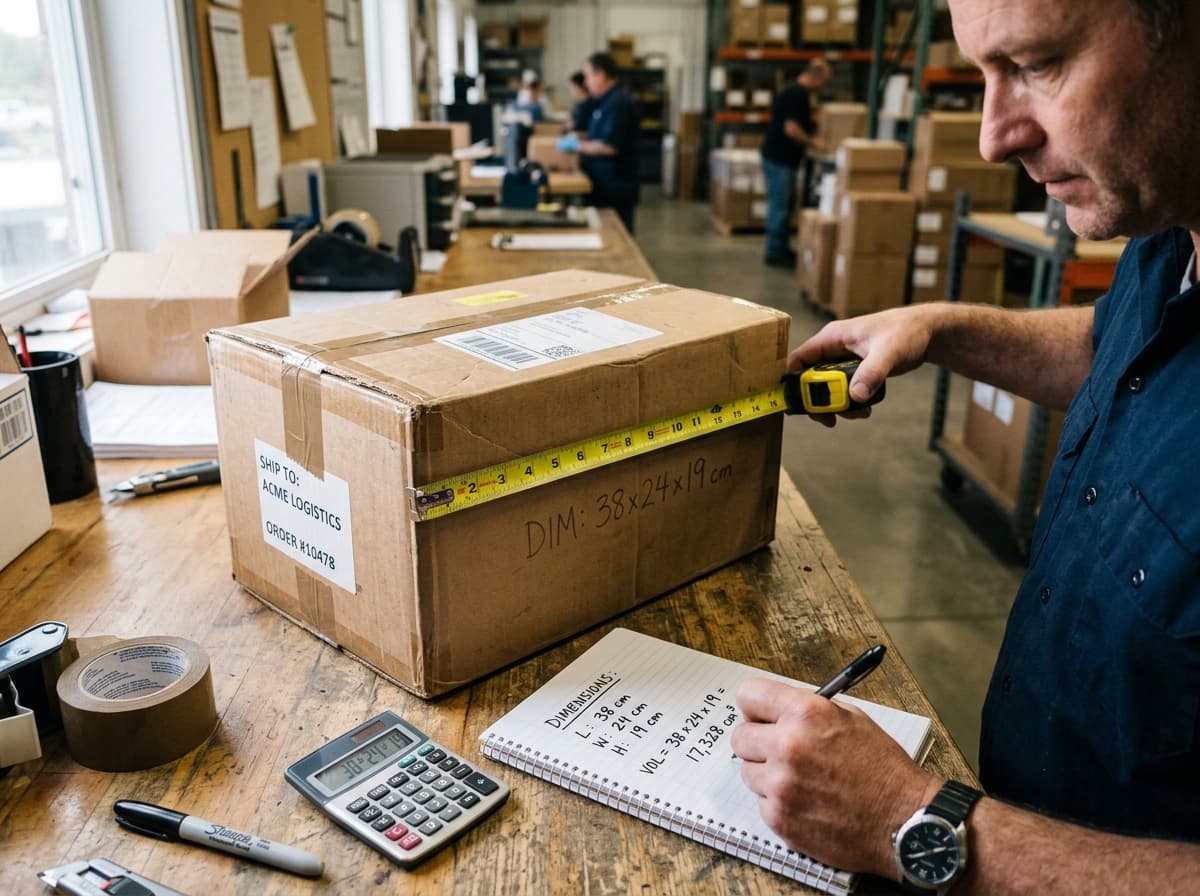
Measure the sealed box at its widest points, multiply length by width by height, and divide by your carrier's divisor — 139 for inches, 5000 for centimetres. That gives dimensional weight. You are charged on whichever is higher, that or the actual weight on the scale.
Almost every surprise shipping bill traces back to this one calculation. The parcel weighed 2 kilograms, the quote said 2 kilograms, and the invoice charged for 7. Nothing went wrong; the box was simply large.
Why carriers charge for space
A delivery van has a fixed volume and a much higher weight limit than it ever reaches. Fill it with pillows and it runs out of room while barely loaded. Fill it with books and it hits the weight limit with space to spare.
Dimensional weight exists so that the pillow shipper pays for the space they consume. It converts volume into a weight-equivalent figure using a fixed ratio, and the carrier bills on whichever number is larger.
The practical effect: a box that is large and light costs the same as a small heavy one. Understanding that changes how you pack, not just how you quote.
The calculation
Three steps, and the whole thing takes under a minute.
Step one — measure. Length, width and height of the sealed box, at the widest point of each dimension. Round each one up to the next whole unit. Length is the longest side by convention, though the order does not change the result.
Step two — multiply. Length × width × height gives cubic inches or cubic centimetres.
Step three — divide by the carrier's divisor. The result is dimensional weight in pounds or kilograms.
A worked example. A box measuring 18 × 14 × 12 inches gives 3,024 cubic inches. Divided by 139, that is 21.8 pounds, rounded to 22. If the box actually weighs 6 pounds, you are billed for 22.
The same box in metric: 46 × 36 × 31 centimetres is 51,336 cubic centimetres, divided by 5000 gives 10.3 kilograms. Round up to 10.5 or 11 depending on how your carrier rounds.
Divisors, and why they differ
The divisor is the ratio the carrier chooses between volume and weight. A lower divisor produces a higher charge, so the number matters a great deal.
| Divisor | Unit | Typically used for |
|---|---|---|
| 139 | cubic inches | Standard US retail and small business rates |
| 166 | cubic inches | Some domestic ground and lower-density services |
| 5000 | cubic centimetres | Most international and European carriers |
| 6000 | cubic centimetres | Air freight, some volumetric postal services |
| 4000 | cubic centimetres | Certain express and courier services |
Two things follow. First, always check which divisor your specific service uses, because the same box can differ by 30 per cent between two products from the same carrier. Second, negotiated business accounts often include a more favourable divisor, and that is frequently worth more than a headline rate discount.
Divisors change periodically, and always in the carrier's direction. If you are pricing a product line around shipping cost, re-check the divisor annually.
Measuring properly
Measurement errors are common, and every one of them goes against you.
Measure the outside of the box after it is sealed and after the contents have pushed the walls out slightly. A box described as 12 inches on the flat pack measures 12.4 inches when it is full.
Include anything that protrudes. Tape ridges, a bulging flap, a handle, a pallet foot — the carrier's scanner measures the smallest rectangular box that would contain your parcel, including all of it.
Round up, always. Carriers round fractional dimensions up to the next whole unit before calculating. Declaring 11.5 inches when the system will round it to 12 creates a small discrepancy that gets billed back.
For an irregular shape — a bicycle, a lamp, a chair — imagine the smallest rectangular box that would enclose it entirely and measure that. That is exactly what the scanner computes.
Use a rigid tape measure rather than a soft one. A soft tape follows the curve of a bulging side and reads short.
Girth and size limits
Beyond dimensional weight, carriers set hard limits on physical size, and they express those limits using girth.
Girth = 2 × width + 2 × height. It is the distance around the parcel at its thickest point, ignoring length.
Combined length and girth = length + girth. This is the number that determines whether a parcel is accepted, surcharged or refused.
The common thresholds, which vary by carrier and service:
| Combined length and girth | Usual consequence |
|---|---|
| Under 130 inches / 330 cm | Standard parcel handling |
| 130–165 inches / 330–419 cm | Oversize or additional handling surcharge |
| Over 165 inches / 419 cm | Refused, or moved to freight |
There is normally a single-side limit too, often around 108 inches for length. A long thin item can pass the girth test and still be refused on length alone.
Worked example: a box 40 × 20 × 16 inches has a girth of 72 inches and a combined figure of 112. Comfortably standard. Stretch it to 50 × 30 × 24 and girth becomes 108, combined 158 — still accepted, but now carrying an oversize surcharge that often runs to tens of dollars or pounds.
When dimensional weight bites hardest
Some items are almost guaranteed to be charged on volume rather than mass.
Anything with air in it — pillows, duvets, cushions, soft toys, inflatables. Anything packaged protectively around a small object, which includes most well-packed fragile items. Anything sold with retail presentation packaging. Empty containers, lampshades, plastic storage boxes.
The density threshold is worth internalising. At a divisor of 139, the break-even density is roughly 8.7 pounds per cubic foot. Below that, you pay on volume. Most household goods sit well below it, which is why so many people are caught out.
In metric at a divisor of 5000, the break-even is 200 kilograms per cubic metre. Water is 1,000. Books are around 500. A packed box of clothes is nearer 100.
If you ship the same product repeatedly, calculate its density once and you will know permanently which number you are being billed on.
Reducing the charge
Four adjustments, in rough order of effect.
Use a smaller box. The obvious one, and the biggest. Dropping a box from 18 × 14 × 12 to 16 × 12 × 10 cuts dimensional weight from 22 pounds to 14 — a 36 per cent reduction from two inches off each side. But do not cut into the 2 inches of cushioning a fragile item needs; a damage claim costs far more than a size band.
Cut the box down. If the contents leave a five-inch void at the top, score the corners, fold the walls in and re-tape. This costs nothing and is routinely worth several pounds per parcel.
Use a poly mailer for anything soft and non-fragile. Clothing in a mailer is charged on actual weight because a mailer conforms to its contents rather than holding a fixed volume.
Split or combine deliberately. Two small boxes sometimes cost less than one large one, because dimensional weight scales with volume while base rates scale with count. For dense items, combining wins. For bulky ones, splitting often does. Calculate both rather than assuming.
Measuring awkward shapes
Rectangular boxes are easy. Everything else needs a rule, and the rule is always the same: measure the smallest rectangle that would fully enclose the item.
Cylinders and tubes. Diameter counts as both width and height. A poster tube 36 inches long with a 4-inch diameter measures 36 × 4 × 4, not 36 × 4. People routinely under-declare tubes by a factor of four this way.
Items with a protruding part. A lamp with a switch, a machine with a lever, a chair with a leg sticking out. The protrusion sets the dimension, even if it accounts for two per cent of the volume. Either fold it in, or measure to its tip.
Irregular soft goods. A rolled rug or a bagged duvet has no fixed shape. Compress it, secure it with strapping, then measure the compressed form. The scanner measures it as presented, so how tightly you strap it directly sets the price.
Pallets and crates. Measure to the outer edge of the pallet including any overhang, and include the pallet's own height in the vertical dimension. Overhanging freight is a common reason for a reweigh charge.
When in genuine doubt, place the item against a wall, mark the floor at its widest points and measure between the marks. That gives the enclosing rectangle without any guesswork.
When a parcel stops being a parcel
Above a certain size or weight, carriers stop treating the shipment as a parcel and move it to freight, where pricing works differently.
The thresholds vary, but the common trigger points are a single dimension above roughly 108 inches, combined length and girth above 165 inches, or an actual weight above 150 pounds — around 70 kilograms.
Past any of those, the parcel is either refused outright or accepted at a large-parcel rate with additional handling attached. Freight pricing then uses either a density-based class system or a per-pallet rate, and dimensional weight in the parcel sense no longer applies.
This is worth knowing before you pack rather than after. An item that lands just above a threshold often costs several times one that lands just below it, and a couple of inches off the box can move it across the line.
Flat rate sidesteps the whole problem
Fixed-price boxes ignore weight and dimensions entirely up to a stated limit. If the item is dense and fits, the calculation above stops mattering.
The rule of thumb is straightforward. If the item is heavy for its size and fits inside the box, flat rate wins. If it is light and bulky, flat rate is poor value because you are paying a dense-item price for air.
Our guide on flat rate versus weight-based shipping works through the crossover point with real numbers.
Why the invoice differs from the quote
Every major carrier runs automated dimensioning scanners on the sorting belt. As your parcel passes through, a laser or camera array measures all three dimensions and weighs it, in under a second, on every parcel in the network.
If the measured figures exceed what you declared, the difference is billed back to the account afterwards, usually with an adjustment fee on top. This is a routine automated process, not a dispute.
Three habits prevent it. Measure the sealed box rather than the empty one. Round up rather than down. Re-measure when you change box supplier, because a box sold as the same size often is not.
For business shippers, these adjustments are worth auditing monthly. A systematic under-declaration across hundreds of parcels adds up quietly, and it appears on the invoice rather than the quote — the same pattern our guide on hidden shipping fees describes across other surcharges.
A worked comparison
The same contents, three different packing choices, at a divisor of 139.
| Packing | Dimensions | Actual weight | DIM weight | Charged on |
|---|---|---|---|---|
| Oversized box, loose fill | 20 × 16 × 14 in | 4 lb | 32 lb | 32 lb |
| Right-sized box | 14 × 11 × 9 in | 4 lb | 10 lb | 10 lb |
| Poly mailer | conforms | 4 lb | n/a | 4 lb |
Same item, same journey, an eightfold difference in billed weight. Nothing about the contents changed.
Getting it right first time
Measure the sealed box at its widest points. Round every dimension up. Multiply, divide by your divisor, and compare against the scale. Bill yourself on the higher number and you will never be surprised.
Then check girth if the parcel is large, because a surcharge for combined length and girth arrives on top of everything else.
Once the parcel is away, you can follow it on our home page with the tracking number from your receipt. Our guide on choosing a courier covers which carriers use which divisors and where the differences are worth chasing.