How to Ship Documents Internationally
Updated 2026-08-039 min readPacking and sending
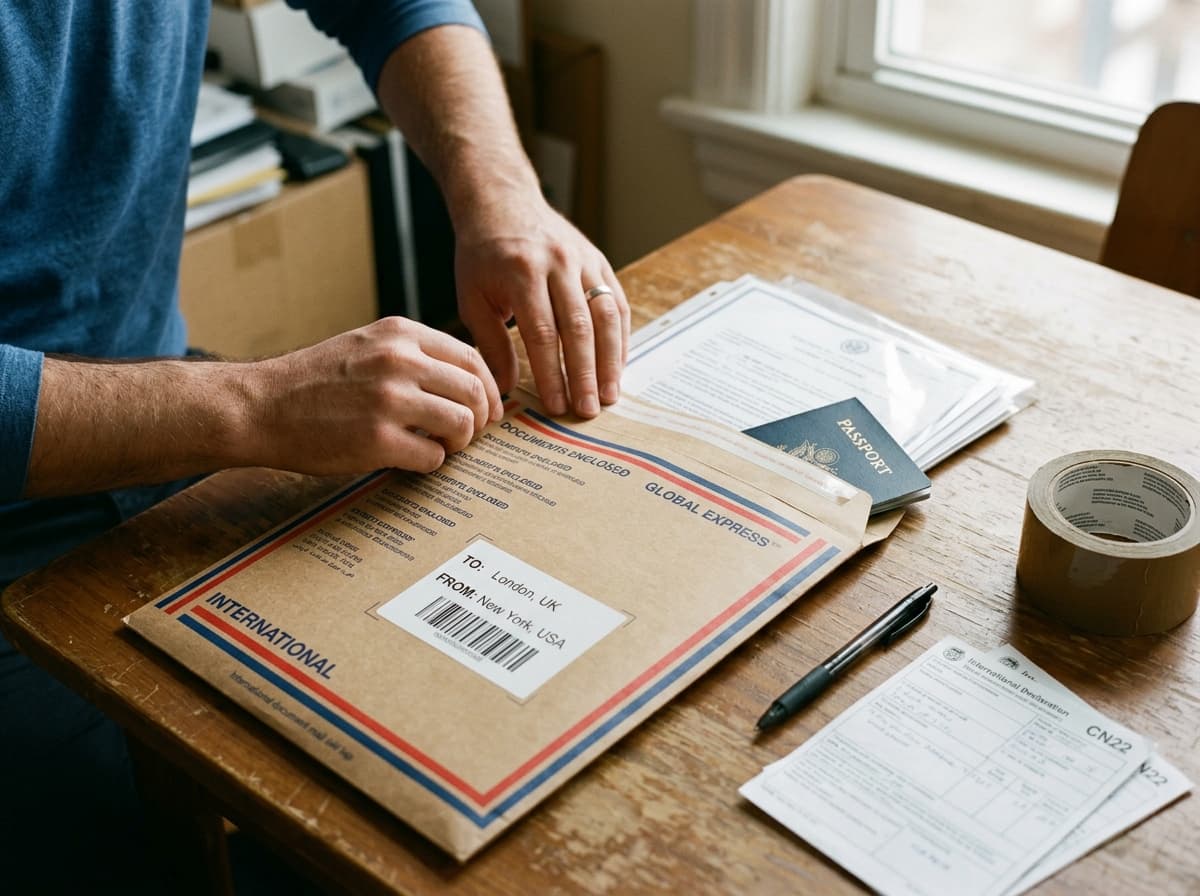
Genuine documents — contracts, correspondence, certificates, business paperwork — clear customs on a simplified basis and are usually duty-free. An express courier delivers them between major cities in 1 to 3 working days, with a signature. The main risks are choosing a service without tracking, and sending something that stops counting as a document.
The distinction between a document and a good is the part worth getting right, because it changes the paperwork, the price and the transit time.
What customs counts as a document
A document, for customs purposes, is paper with no commercial value in itself. The information matters; the paper does not.
That covers contracts, letters, invoices, reports, manuscripts, plans, academic transcripts, medical records and most certificates.
It stops covering the item as soon as the paper has intrinsic or resale value. Printed books for sale are goods, classified in chapter 49. So are tickets with a face value, bearer instruments, stamps, banknotes, share certificates and anything collectible.
Two grey areas come up regularly. Passports and identity documents are frequently prohibited outright rather than treated as documents. And certificates with a fee attached — some official documents issued for payment — are treated as goods by some destinations.
When in doubt, declare it as goods with a nominal value. Declaring goods as documents to avoid a declaration is a false declaration; declaring documents as goods is merely slower.
Choosing a service
| Service | Typical speed | Tracking | Best for |
|---|---|---|---|
| Express courier document service | 1–3 working days | Full, with signature | Anything legally significant or time-critical |
| International tracked post | 5–15 days | Basic | Non-urgent originals |
| International signed post | 5–15 days | Basic, with signature | Non-urgent, needs proof of receipt |
| Standard international letter post | 1–4 weeks | None | Nothing you cannot replace |
The choice is mostly about consequence rather than urgency. If losing the document means re-executing a contract, re-applying for a certificate or missing a legal deadline, buy the tracked service with a signature. The difference in price is small against the cost of the alternative.
Express document services are cheaper than they look. Because documents are light and exempt from most duty processing, carriers price them as a distinct product rather than as a small parcel — often well below what a parcel of the same weight would cost.
Packing a document properly
Documents are damaged by three things: moisture, bending and being lost inside a larger parcel.
Use the carrier's document envelope. It is rigid, water-resistant, purpose-sized, and usually supplied free. It also identifies the shipment as a document to the network, which is what routes it through the simplified process.
Bag the contents. A plastic sleeve inside the envelope. Envelopes get wet on loading docks, and a soaked contract is as unusable as a lost one.
Add a rigid backing board for anything that must not bend — certificates, artwork, anything to be framed or scanned at high quality. Paper takes on the curve of whatever it is pressed against for two days.
Never fold an original unless it was folded when issued. A crease through a signature or a seal raises questions that are tedious to answer.
Do not put documents loose inside a parcel of goods. They get separated during inspection. If documents must accompany goods, use an external document pouch on the outside of the box.
Declaring documents
Even on a simplified service the description matters.
Write what it is: "signed employment contract, printed paper, no commercial value" or "university transcript, printed paper, no commercial value". The phrase no commercial value is the one that matters, and stating a nominal value rather than zero avoids a valuation query.
If the shipment contains anything other than paper — a USB drive, a bound presentation, a sample — it is no longer a document shipment. One memory stick converts the whole thing into a goods shipment needing a full commercial invoice, as our guide on documents needed for international shipping sets out.
That single mistake is the most common cause of a document shipment being held.
Legal and official documents
Anything with legal effect deserves more care than the paper suggests.
Use a service with a signature. Proof of delivery to a named recipient is often as important as the delivery itself, and it is the evidence you will need if the receipt is disputed later.
Keep a certified copy and a scan. Send the original, retain proof of what was in it. If the original is lost, a scan plus a proof of posting is what supports a replacement application.
Check whether the destination requires legalisation. Documents intended for official use abroad frequently need notarisation, an apostille or consular legalisation, all obtained before sending. A document arriving without them cannot be legalised at the destination and has to come back.
Allow time. Legalisation processes take days to weeks in most jurisdictions, and that time sits before the shipping time rather than overlapping it.
Consider sending two copies by separate services where a deadline is genuinely critical. It costs twice and removes the single point of failure entirely.
Passports, identity and financial instruments
These need naming separately because they are not ordinary documents.
Passports and national identity documents are prohibited by many carriers and restricted by many postal services. Where they can be sent, it is usually only on specific tracked services. Check the carrier's prohibited items list before packing, because a seized passport is a considerably worse outcome than a slow one.
Banknotes, bearer instruments and negotiable securities are prohibited on virtually every consumer service. Value that transfers to whoever holds the paper is not something carriers accept liability for.
Cheques and drafts are generally permitted, being payable to a named party, but should always go tracked and signed.
If a carrier's list is ambiguous, ask before shipping. Discovering a prohibition through a seizure is expensive.
Liability, and why it is low
Carrier liability on documents is minimal, and it is worth understanding why rather than being surprised by it.
A carrier can compensate you for the value of the paper, which is nothing. It cannot compensate you for the consequences of a missed deadline, a re-executed contract or a lapsed application, and no consumer service accepts that exposure.
So insurance on documents is largely unavailable and largely pointless. The protection is procedural instead: tracking, a signature, a retained copy, and enough time in hand that a delay is recoverable.
Where the consequence of loss is genuinely severe, redundancy beats insurance. Two shipments by two routes cost less than most of the outcomes they prevent.
Sending documents alongside goods
A frequent requirement in trade, and it has a specific answer.
Commercial paperwork that must travel with a shipment — the invoice, the packing list, a certificate of origin — goes in a document pouch on the outside of the box, not inside it. An adhesive pouch on the largest face, clear enough to read through.
The reason is practical. Customs needs the paperwork before the box is opened, and paperwork found inside a sealed box has already caused the delay it was meant to prevent.
Put a second copy inside as a backup, because pouches come off.
Where an original document is legally required to release the goods — an original bill of lading being the classic case — it usually travels separately by courier rather than with the shipment. Whoever holds an original bill of lading controls the goods, which is exactly why it is not stapled to the outside of a container.
For businesses shipping documents regularly
Three things reduce cost and friction at volume.
Use the carrier's document product deliberately. Booking documents as a small parcel costs meaningfully more and routes them through goods processing. The saving per shipment is modest and the saving in clearance time is not.
Standardise the description. A stored template reading "business correspondence, printed paper, no commercial value" removes the most common source of variation and the most common cause of a hold.
Set a rule about what is never sent by post. Identity documents, originals with no copy, and anything with a hard legal deadline should go by tracked express as policy rather than as a judgement call each time. The cost difference is small; the variance in outcomes is not.
For frequent international document flows, an account with a single express carrier is usually worth more than shopping each shipment, because the account brings stored addresses, saved templates and one point of contact when something is held.
Do you need to send paper at all?
Worth asking before doing any of this.
A great deal of what is still couriered internationally is accepted digitally: signed PDFs, electronic signature platforms, certified digital copies and secure transfer services. Where the recipient accepts a scan, sending one takes seconds and carries no risk at all.
Paper is genuinely required in three situations: where a wet-ink original has legal effect, where an official body requires a physical certificate with a seal or watermark, and where the recipient's process simply will not accept anything else.
Ask which of those applies. It is a common finding that nobody actually needs the original, and the courier booking was made out of habit.
Tracking a document shipment
Document services are scanned like any other shipment, and often more consistently because they move on express networks with frequent scan points.
Expect a customs event that resolves quickly — genuine documents clear in hours rather than days, since there is nothing to assess. A document shipment sitting at customs for more than a day usually means it was reclassified as goods, which points back to something in the envelope that was not paper.
You can follow any carrier's number on our home page. If it stops moving, our guide on tracking that is not updating covers how long a gap should last, and what to do when a package is delayed covers the escalation.
The mistakes that cause most problems
A USB drive in the envelope. Converts a document shipment into a goods shipment and produces a hold. So does a bound sample, a printed book, a promotional item or anything else with physical value.
Choosing an untracked service to save a little. The saving is small and the failure mode is total, because an untracked document that does not arrive cannot even be proved to have been sent.
Sending an original with no copy retained. A scan takes seconds and is the basis of any replacement application.
Assuming legalisation can happen at the destination. It cannot, in most cases. Apostilles and consular legalisation are issued in the country the document came from.
Folding a certificate. A crease through a seal or a signature is a question you will spend longer answering than the fold saved in postage.
Leaving no time in hand. Documents move fast; re-issuing them does not. The whole point of a deadline-critical shipment is to arrive with days to spare.
Before you send
Confirm the item is genuinely a document and that nothing non-paper is in the envelope. Check the carrier's prohibited list for identity and financial documents. Obtain any legalisation first. Bag the contents, add a rigid board if it must stay flat, and use the carrier's own document envelope. Choose a tracked service with a signature for anything that matters. Keep a scan and the proof of posting.
Then, if the deadline is real, send it earlier than you think you need to. Documents move quickly; legalisation and re-issue do not.
One last habit worth building: keep a record of what was sent, when, by which service, and to whom it was signed for. For business paperwork that record answers most later questions in seconds, and for legal documents it is occasionally the thing that matters more than the document itself.