How to Handle Lost or Damaged Package Claims
Updated 2026-08-0310 min readTracking and delivery
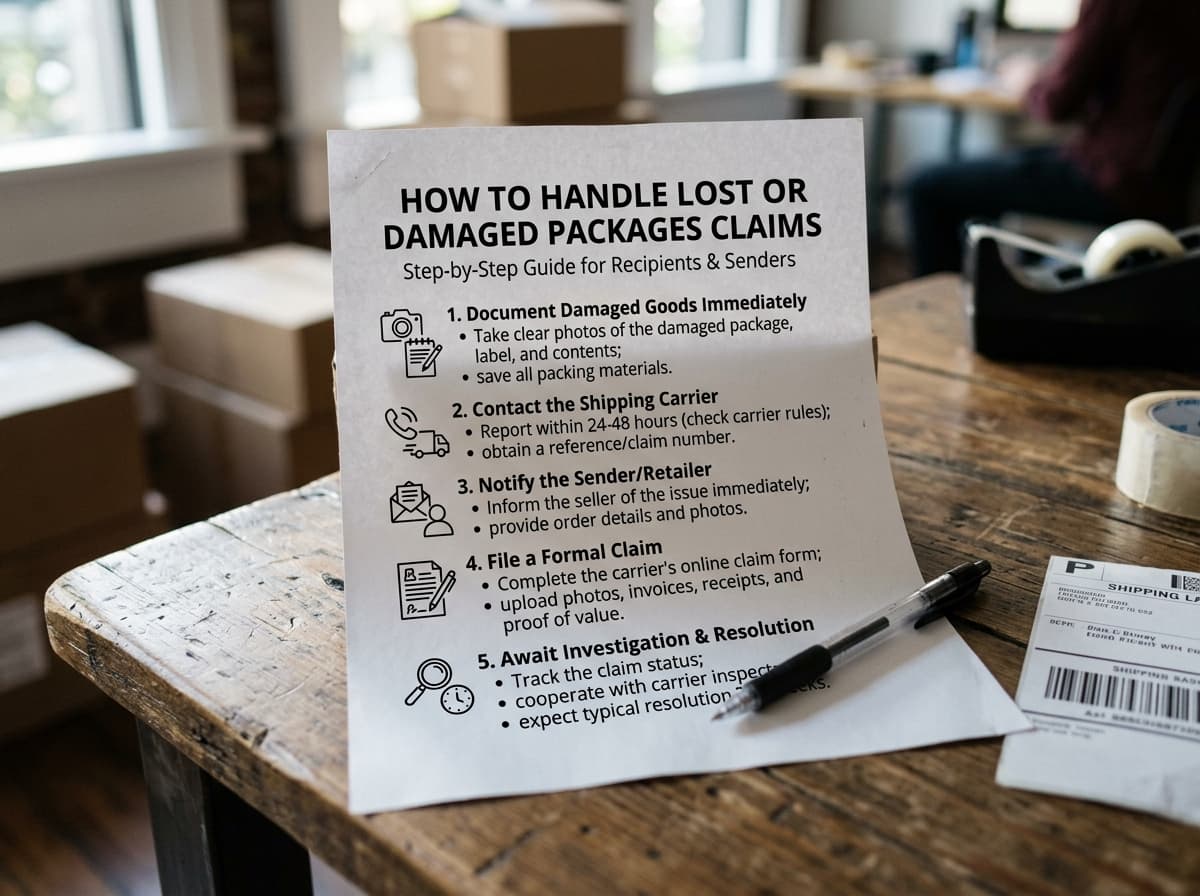
Most claims that fail don't fail on merit. They fail because somebody missed a deadline, threw away a box, or spent three weeks asking the wrong company.
The rules are consistent enough across carriers to plan around. Here's who does what, what you need to keep, and how long you have.
The rule that decides everything: the sender files
This surprises people every time, so it's worth stating plainly.
The shipping contract is between the sender and the carrier. The sender chose the service, paid for it, and agreed to the terms. That makes the sender the customer, and the customer is the only party with standing to claim.
As a recipient you can usually report a problem, and you can often chase a depot about a failed delivery. You generally cannot open a formal claim, and most carriers will decline to discuss the shipment with you beyond reading out the tracking page.
That isn't obstruction. It's the same reason your neighbour can't query your bank account.
What this means in practice: if you bought something, your counterparty is the shop. Go to them, and make it easy for them to file.
What to send the seller
Vague messages get vague replies and lose a week. Send everything they need in one go:
"Tracking number [X]. Last scan: [exact wording] on [date]. The estimated delivery was [date]. The parcel has not arrived / arrived damaged. Please open a claim with [carrier] and send me the case reference."
Asking for the case reference is what turns a promise into something you can verify. A seller who has genuinely filed can produce one within a day or two. One who hasn't will change the subject, and that tells you to escalate.
The deadlines, and why they matter more than anything
Every carrier runs a claim window, and they're shorter than people assume.
Loss claims are typically 21 to 60 days from the shipping date, depending on carrier and service. Some require you to wait a minimum period first — often 5 to 15 days — before they'll accept that a parcel is missing, which squeezes the window from both ends.
Damage claims are often shorter, and several carriers require the damage to be reported within a few days of delivery.
Marketplace disputes run on their own clock, usually 60 to 90 days from dispatch.
Miss any of these and the claim is refused regardless of how obviously right you are. So the first thing to do when a parcel looks wrong is write the deadline in a calendar, not send an angry message.
Warning: the carrier's tracking data also expires. Most purge scan events 30 to 120 days after the last one, which frequently means the evidence disappears at exactly the point a dispute gets serious. Screenshot the tracking page the day you first feel uneasy.
Evidence: what actually matters
Claims are decided on documents, not on how reasonable you sound.
For a lost parcel:
The tracking page showing the last scan and its date. Proof of value — the invoice or order confirmation, not a screenshot of a product listing. Proof of postage, which the sender holds. And a short factual account of what you checked, particularly for a parcel marked delivered.
For a damaged parcel:
Photographs before you unpack any further, showing the outer box, the label, the damage to the packaging, and the damage to the contents. Then the packaging itself, kept intact.
That last point causes more rejections than any other. Carriers assess whether the item was packed adequately, and they can't do that from a photograph of a broken vase on a table. Keep the box, the void fill and the tape until the claim closes.
If a driver hands you something visibly damaged, note it when signing. "Signed for damaged" on the delivery record is worth a great deal later.
What carriers actually pay
Less than people expect, and the reason is the declared value.
Most services include a base level of cover — often a modest amount that reflects the price of the shipping rather than the value of the goods. Anything above that had to be declared and paid for before the parcel shipped.
A £400 laptop shipped with £20 of included cover is worth £20 if it disappears. That decision was made at the point of booking and cannot be revisited afterwards.
Carriers also pay the value of the goods, not what you would have sold them for. A retailer claiming for lost stock gets the cost price, not the retail price, unless they bought cover on the higher figure.
And most policies exclude a long list: cash, jewellery above a threshold, perishables, fragile items packed inadequately, and anything on the prohibited list. Those exclusions are why a claim can be refused even when the parcel is genuinely gone.
The undervaluation trap
Worth flagging because it's common on international orders.
If a seller declared a low value to reduce your customs bill, the insurance is capped at that declared figure too. A laptop declared at $20 to dodge duty is worth $20 in a claim.
Our guide on customs duties explains why the tactic costs more than it saves. In a claim it costs everything.
How a carrier investigation actually runs
Knowing the process stops you chasing it pointlessly.
The carrier raises a trace. The number is flagged across the network so any scan triggers an alert, and staff at the last-known facility check for unscannable items — parcels with torn or unreadable labels in an overflow area.
That check is genuine but not exhaustive. A hub handles enormous volume and the overflow area is a cage, not a filing system.
Traces run 5 to 10 working days, during which the tracking page shows nothing new. Chasing daily doesn't accelerate anything, and opening a second case on the same number usually gets one closed as a duplicate — which can reset the clock rather than speed it up.
Most traces end with the parcel found. The remainder move to a compensation decision or close inconclusively, at which point the sender escalates.
The marketplace shortcut
If you bought through a marketplace, its dispute process is usually faster and more generous than a carrier claim, and it's worth using first.
Platforms refund from the seller's held funds rather than fighting the carrier. The decision takes days rather than weeks, and the evidence bar is lower — a tracking page and a factual account is usually enough.
The seller then pursues the carrier on their own account, which is appropriate, because they're the one with standing.
File early. A dispute can always be withdrawn if the parcel turns up, and the deadline is the one thing that can't be recovered.
When the parcel says delivered
This is its own category, because carriers treat it differently.
A delivered scan shifts the burden. The carrier's position is that they completed the job, so the claim has to show otherwise. That's why the delivery photo and GPS data matter so much — a photo of somebody else's door resolves the question immediately.
Ask the sender to request both early. Carriers hold that data for a limited window, often 30 to 90 days, and it's the difference between a strong case and an argument.
Our guide on tracking that says delivered when nothing arrived walks through the seven steps to take before filing anything.
Partial loss and wrong contents
Two situations fall between loss and damage, and they are handled differently enough to be worth separating.
A parcel that arrives lighter than it left. Items removed in transit are treated as pilferage rather than loss, and carriers investigate them differently — they look at weight recorded at each scan point, which is one of the few places where the internal data helps you. Report the weight discrepancy explicitly if you know the original.
The wrong item inside. This is almost never a carrier problem. A sealed parcel that arrives sealed with the wrong contents was packed wrong, and the claim goes to the seller rather than the carrier. Photograph the sealed parcel before opening if you already suspect something is off.
A parcel that arrives empty or obviously opened. Sign for it as damaged, photograph it before moving it, and report it the same day. An opened parcel that was resealed with official customs tape is a different thing entirely — that is an inspection, not a theft, and our guide on parcels stuck in customs explains what it means.
If the claim is refused
Refusals are common and often reversible, because the first decision is frequently made on incomplete information.
Read the stated reason. Most refusals cite one of four things: filed late, inadequate packing, item excluded, or insufficient proof of value. Each has a different answer.
Late filing is the only one that is genuinely final. The others are arguable.
Inadequate packing is contested with photographs of the packed item. This is why photographing before sealing matters — it is the evidence that does not exist unless you created it in advance.
Exclusion depends on the carrier's own list, and misclassification happens. An item recorded as fragile when it was not, or as a prohibited category when it was not, can be corrected.
Insufficient proof of value is the easiest to fix. An invoice, a bank statement line, or an order confirmation usually settles it.
Appeals generally have their own deadline, often shorter than the original claim window. Ask what it is when the refusal arrives, and act inside it.
Who pays in the end
It helps to know where the money actually comes from, because it explains why sellers behave the way they do.
When a marketplace refunds you, it usually takes the money from the seller's held funds first and pursues the carrier separately, or not at all. The seller absorbs the loss unless their own claim succeeds.
That is why some sellers resist opening a carrier case: the refund to you happens either way, and the carrier claim is extra work with an uncertain outcome. It also explains why a seller who did buy proper cover is generally far more cooperative — they have something to recover.
None of this changes what you should do. It does mean that pressing a small seller for a carrier case reference is sometimes pressing on something they were never going to pursue, and going straight to the marketplace dispute is faster for both of you.
Timelines, end to end
Putting the deadlines in one place makes the sequence easier to manage than reading them in isolation.
Day 0 — parcel ships. Note the date and the service. Write the claim deadline in a calendar now, not later.
Days 3 to 5 — if tracking has gone quiet, check whether the silence is normal for that lane. Our guide on tracking that stops updating gives the windows.
Days 5 to 15 — most carriers will not accept a loss report before this. Use the time to gather the invoice, the tracking screenshot and the account of what you checked.
Days 15 to 21 — report to the sender and ask them to open a case. Request the case reference.
Days 21 to 60 — the carrier claim window. The trace itself runs 5 to 10 working days inside this.
Days 60 to 90 — the marketplace dispute window closes. This is the last usable deadline for most consumers, and it is the one worth protecting above all others.
Working to those dates turns an anxious month into six decisions. It also means that if the claim does fail, it fails on facts rather than on a date nobody was watching.
Reducing the odds
Three habits make claims rarer and easier to win.
Declare the real value and buy cover to match on anything you'd genuinely miss. The premium is small next to the loss.
Photograph valuable items packed, before sealing. It proves the contents and the packing quality in one image, and it takes ten seconds.
Note the deadlines when the parcel ships, not when it goes wrong. Write the claim window and the marketplace dispute date somewhere you'll see them. People discover both at the moment they need them, which is always too late.
The parcels that are genuinely lost are a small minority — our guide on tracking that stops updating covers the far more common explanations. But when one is, the claim is won on paperwork you either kept or didn't, and on a date you either noticed or missed.