Customs Duties Explained — What You Need to Know
Updated 2026-08-029 min readCustoms and duties
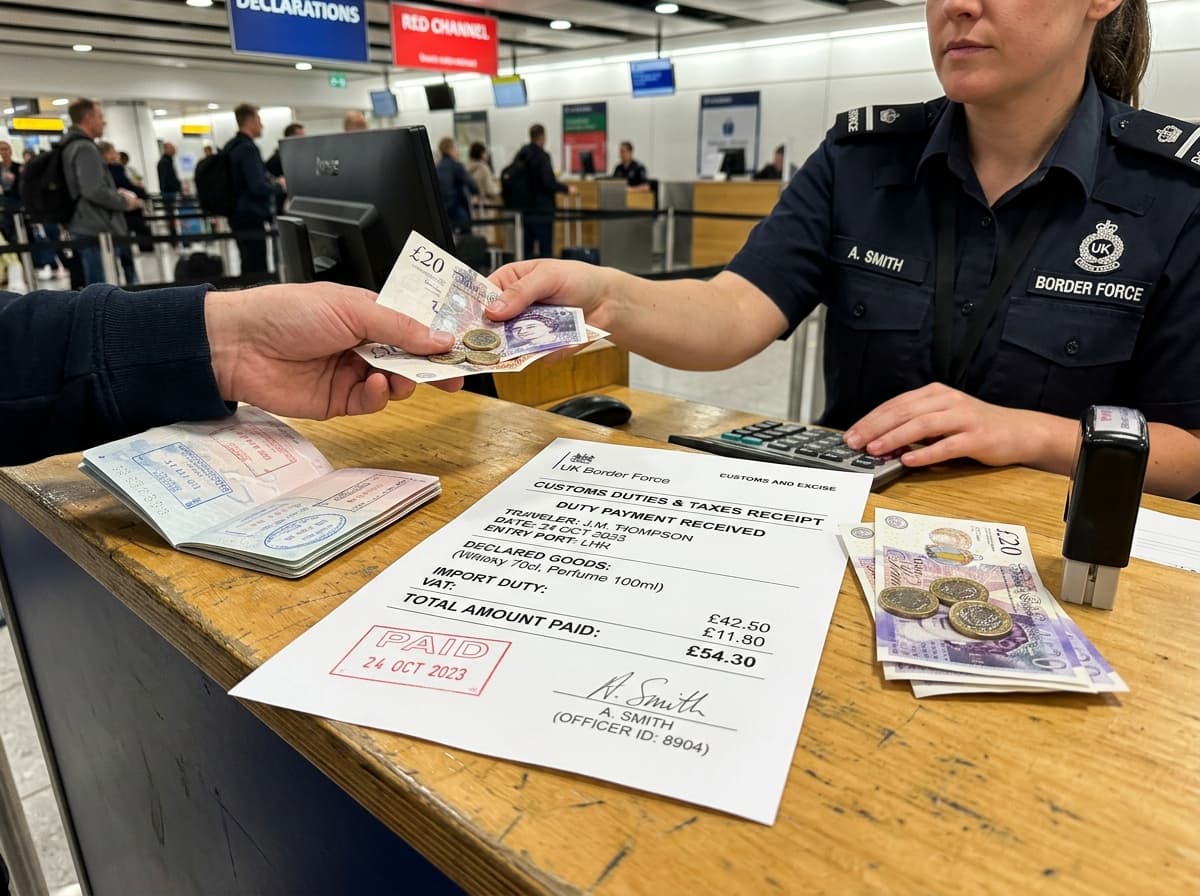
A $40 order arrives with a $22 bill attached, and it feels like a mistake. It usually isn't. That bill is three separate charges stacked on top of each other, and only one of them is what people mean when they say "customs."
Knowing how the three are calculated tells you in advance roughly what an international order will really cost — which is the only way to avoid the unpleasant surprise at the door.
The three charges, and who sets each one
Customs duty is a tariff on the product. Your government sets the rate based on what the item is and where it was made. A cotton shirt, a laptop and a bottle of perfume all carry different rates, and the same shirt can carry a different rate depending on its country of origin.
Import tax is your country's ordinary sales tax — VAT in Britain and the EU, GST in Australia, India and Canada — applied to imports so foreign goods aren't cheaper than domestic ones purely on tax. The rate is the same one you pay in a shop.
The carrier's handling fee isn't a government charge at all. The carrier paid customs on your behalf and filed the paperwork, and this is what they charge for the service. It's typically $10 to $20 or a percentage of the charge, whichever is larger.
That third one causes most of the anger, because it can exceed the duty itself. A parcel owing $6 in duty can arrive with a $15 handling fee on top.
How the calculation actually stacks
The order of operations matters more than people expect, and it works against you.
Start with the customs value — normally the item price plus shipping plus any insurance. Not just the item price. A $30 item with $20 shipping has a customs value of $50.
Duty is applied to that. At 5%, that's $2.50.
Import tax is then applied to the customs value plus the duty. At 20% VAT, that's 20% of $52.50, which is $10.50.
Then the handling fee, say $12.
Your $30 item has become $55. The shipping you already paid was taxed, and you paid tax on the duty.
Quick fact: shipping cost being included in the customs value is the most commonly missed part of the calculation. It's why cheap items with expensive shipping produce charges that feel disproportionate.
Thresholds — the number that decides everything
Every country sets a value below which small parcels are waved through. Above it, charges apply. That single threshold decides whether your parcel arrives quietly or with a bill.
The thresholds vary enormously and change with policy, so check your own country's current figure rather than trusting a number you read once. Britain, the EU, Australia and the United States all operate on different bases, and several have tightened low-value exemptions in recent years specifically because of marketplace volume.
Two rules hold almost everywhere:
Duty and tax often have different thresholds. A parcel can be under the duty threshold and over the tax one, so you pay VAT but no tariff.
Gifts get treated differently, within limits. Most countries allow a genuine gift from one private individual to another a higher allowance. Marking a commercial purchase as a gift to dodge this is fraud, and it's also the fastest way to get a parcel flagged for undervaluation — which costs you weeks rather than dollars.
Who pays depends on two letters
Whether a bill reaches you at all is decided by the shipping terms, before the parcel ever moves.
DDP — Delivered Duty Paid. The seller pays everything in advance. Nothing is owed on arrival. Large international retailers usually work this way, with the cost built into the price.
DAP or DDU — Delivered At Place / Delivered Duty Unpaid. The seller pays for transport only. Duty, tax and handling fall to you.
Marketplace purchases are almost always DAP. That's the mechanism behind the classic AliExpress or Temu surprise — the checkout showed a low price because the tax was never in it.
Some marketplaces now collect tax at checkout for certain destinations, which produces a third situation: tax already paid, duty and handling still owed. Keep the checkout receipt, because it's your evidence if a carrier bills you for tax you already paid.
Why the commodity code matters
Every product has a commodity code — a number from the international Harmonised System that tells customs exactly what the item is. That code sets the duty rate.
The difference between codes is not small. Categories like footwear, textiles and electronics carry meaningfully different rates, and a mis-coded parcel gets assessed at the wrong rate or set aside for manual review.
You don't choose the code, the sender does. But a sender who codes carelessly costs you both money and time. The code is set by the sender, and a careless choice costs you both money and time.
The undervaluation trap
Sellers offer to declare a lower value "so you don't pay customs." It's worth understanding why accepting is a bad deal.
Customs systems compare declared values against what similar items actually sell for. A phone declared at $15 doesn't slip through — it gets flagged, and flagged parcels go to manual review, which adds one to three weeks.
If the undervaluation is obvious, customs can reassess the parcel at the value they believe is correct, and you pay duty on that figure plus, in some countries, a penalty. Insurance is capped at the declared value too, so a $400 laptop declared at $20 is worth $20 if it goes missing.
The saving is small, the delay is large, and the risk sits entirely with you rather than the seller.
Paying, and paying quickly
Most carriers notify you by SMS, email or a card through the door, then hold the parcel until payment clears.
That notification fails often. It lands in spam, or goes to whatever email address the seller supplied, or arrives as a text from an unknown number that looks exactly like a phishing attempt — which is a fair suspicion, because scam versions of these messages are common.
The safe approach: never click the link in the message. Go to the carrier's own website, find their import charges page, and enter the tracking number there. It'll tell you whether anything is genuinely owed.
Warning: unpaid parcels aren't held indefinitely. Most carriers keep them 21 to 30 days, then return or destroy them. If your parcel has been quiet at customs for two weeks, check for an unpaid charge before assuming it's a queue. Our guide on parcels stuck in customs covers the other causes.
Once paid, parcels usually move within 24 to 48 hours.
Three worked examples
Numbers make this concrete. These use a 20% sales tax rate and a $15 handling fee, which is typical of several markets — substitute your own figures.
A $25 phone case with free shipping. Customs value $25. Under most thresholds, so nothing is owed and nothing is collected. Total cost: $25. This is why cheap marketplace orders usually arrive without drama.
A $120 jacket with $18 shipping. Customs value $138. Duty on apparel, say 10%, is $13.80. Tax on $151.80 is $30.36. Handling $15. You pay $59 on top of a $138 order — a 43% uplift, and the handling fee alone is more than a tenth of it.
A $600 laptop with $40 shipping. Customs value $640. Electronics often carry 0% duty, so nothing there. Tax on $640 is $128. Handling $15. You pay $143 extra. Note that the biggest charge here is ordinary sales tax, not duty at all — which surprises people who budgeted for "customs."
The pattern across all three: tax usually costs more than duty, and the handling fee hurts most on small orders where it's a large share of the total.
If you're importing for a business
Commercial imports work differently in ways worth knowing if you're moving from buying to selling.
Registered businesses can usually reclaim import tax. VAT or GST paid on imported stock is generally recoverable through your normal return, the same way as tax on domestic purchases. Duty is not recoverable — it's a genuine cost.
That single difference changes the maths. A charge that feels crushing to a consumer is often 60 to 70% recoverable for a registered business.
You'll need an importer number. Most countries require a registration code — an EORI number in Britain and the EU, an importer of record identifier elsewhere. Shipping commercial volume without one causes delays that are entirely avoidable.
Duty relief schemes exist. If you import components, process them and re-export, several countries offer relief or suspension. These are worth an accountant's hour if you're importing regularly.
Formal entry thresholds. Above a certain value, parcels stop being handled as simple imports and need a full customs entry with a broker. That adds cost and time, and the threshold catches people out on their first large order.
An accountant's hour is usually cheaper than the first mistake.
Getting money back
Charges are sometimes wrong, and they're refundable — but you have to ask.
Returned items. If you send the goods back, the duty and import tax paid on them can usually be reclaimed. The process is slow and paperwork-heavy, and the carrier's handling fee is generally not refundable.
Wrong classification. If duty was charged at a rate for the wrong product category, you can dispute it with evidence — the invoice and a correct description.
Tax charged twice. If a marketplace collected tax at checkout and the carrier billed you again, the checkout receipt is your proof. This is increasingly common as marketplaces adopt collection schemes at different speeds than carriers update their systems.
Claim windows are usually generous compared with lost-parcel deadlines, but they aren't unlimited. Keep receipts for a year.
Estimating before you buy
You can get close enough to avoid surprises with a simple rule of thumb.
Take the item price plus shipping. If that's over your country's threshold, assume duty at 0 to 12% depending on category, add your national sales tax rate on the total, and add $15 for handling.
For a $60 order with $15 shipping into a 20% VAT country: customs value $75, duty maybe $4, VAT about $16, handling $15. Total extra: roughly $35.
That's not a precise figure, but it's the right order of magnitude, and it's enough to decide whether the order still makes sense. Our import tax guide for online shoppers goes deeper on the country-by-country detail.
The currency problem
One detail that catches people out: charges are calculated in your country's currency, using an exchange rate customs sets, not the rate your card provider used.
Customs agencies publish a fixed conversion rate, usually monthly, and apply it to every declaration in that period. If your card charged you at Tuesday's rate and customs assessed at the month's rate, the two figures will not match.
The gap is normally small, a percent or two. It matters when it pushes a parcel across a threshold — an order that sat just under the duty-free limit at your card's rate can land just over it at the customs rate, and suddenly a charge appears on something you calculated as exempt.
There is no way to influence this. It is worth knowing only so the bill makes sense when it arrives slightly higher than your own arithmetic predicted.
The short version
Duty is on the product, tax is on the total including duty, and the handling fee is the carrier's own charge for doing the admin. Shipping counts toward the value. DDP means it's already paid; DAP means it isn't.
Check your country's current threshold once, keep it in mind at checkout, and treat any "declare it as a gift" offer as a delay rather than a discount. And when a parcel goes quiet at the border, check for an unpaid charge before you check anything else — the status guide on our home page will tell you whether the silence itself is normal, but only the carrier's payment page will tell you whether they're waiting on you.