How to Ship Liquids and Perfumes
Updated 2026-08-039 min readPacking and sending
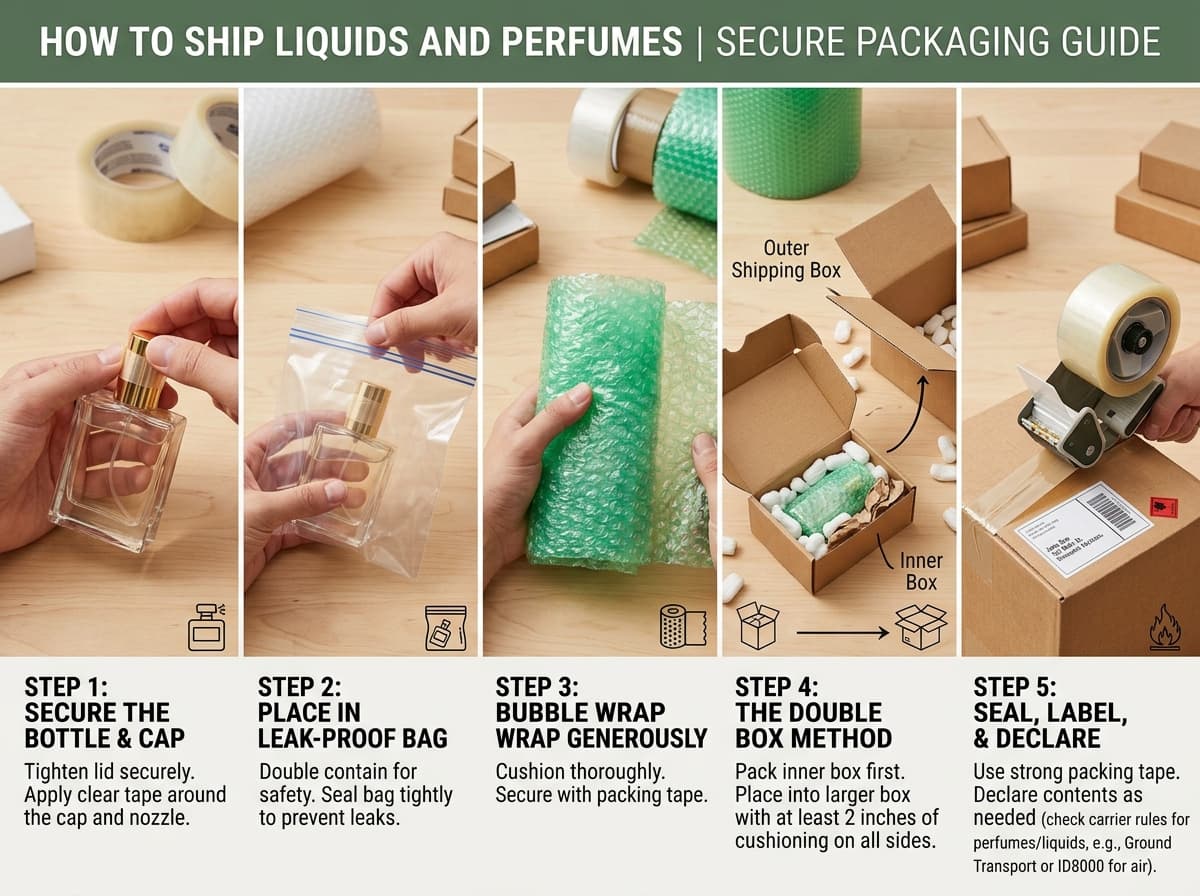
Non-hazardous liquids ship normally with leakproof packing. Perfume, aftershave and most alcohol-based products are classified as flammable liquids, ship by ground only under quantity limits, and are refused by most air and international services. The classification depends on the alcohol content, not on the shelf it is sold from.
That distinction catches out almost everyone who tries to post a bottle of perfume. It is not a cosmetics rule. It is a dangerous goods rule.
First: is your liquid hazardous?
The test is flash point — the lowest temperature at which the liquid gives off enough vapour to ignite. A low flash point makes it a flammable liquid regardless of what the product is marketed as.
Perfume and eau de toilette are typically 60 to 90 per cent alcohol by volume. That places them firmly in the flammable category, alongside things nobody would question, like nail varnish remover.
| Product | Usual classification | Normally shippable by |
|---|---|---|
| Perfume, eau de toilette, aftershave | Flammable liquid | Ground only, quantity-limited |
| Nail polish and remover | Flammable liquid | Ground only, quantity-limited |
| Hand sanitiser | Flammable liquid | Ground only, quantity-limited |
| Aerosols of any kind | Gas under pressure | Restricted, often refused |
| Shampoo, lotion, conditioner | Non-hazardous | Any service, packed properly |
| Water-based cosmetics | Non-hazardous | Any service, packed properly |
| Cooking oil, sauces, honey | Non-hazardous | Any service, packed properly |
| Bleach, drain cleaner, solvents | Corrosive or toxic | Specialist dangerous goods only |
| Wine, beer, spirits | Alcohol — licensing rules | Licensed shippers only, age check |
If you are unsure, look up the product's safety data sheet. Manufacturers publish them, and the flash point is stated on it directly. That is a two-minute check that settles the question properly.
Alcoholic drinks are a separate matter entirely. They are not usually restricted as dangerous goods at consumer strengths, but they are restricted by licensing and age verification, and most carriers only accept them from approved shippers with a specific agreement.
What the restrictions actually mean
For a flammable liquid, three things change at once.
Air transport is largely closed. Most consumer express and air services refuse it. The rules governing what goes in an aircraft hold are stricter than the rules for a van, for obvious reasons, and consumer-facing services choose not to handle the compliance burden at all.
Ground services accept it under limits. There is normally an allowance for small quantities in consumer-sized packaging, provided the packaging and marking rules are followed. Both a per-container limit and a per-parcel total usually apply.
International post generally prohibits it. Postal operators publish prohibited items lists, and flammable liquids appear on nearly all of them. Sending perfume abroad through the post is not a grey area — it is a prohibited item, and the parcel is seized rather than returned.
The practical answer for most people sending perfume: a ground service domestically, declared correctly, in the right packaging. Internationally, the realistic options are a specialist dangerous goods courier or not sending it.
Quantity limits
Small quantities of dangerous goods in retail-sized containers can move under a limited quantity provision, which relaxes the full dangerous goods requirements in exchange for staying under strict size limits.
Two ceilings apply together: a maximum per inner container, and a maximum gross weight for the whole parcel. Both must be met, and the individual container limit is the one people breach — several small bottles are usually fine where one large one is not.
Parcels moving under this provision carry a specific diamond-shaped mark on the outside. The carrier will tell you which mark and where it goes, and most booking systems prompt for it once you answer the dangerous goods question truthfully.
Exceed the limits and you are into full dangerous goods territory, which needs trained shipping staff, UN-specification packaging and a formal declaration. That is a business process, not something to attempt at a counter.
The three-layer packing method
This applies to every liquid, hazardous or not. Assume the bottle will break, and pack so that nothing leaves the box when it does.
Layer one — seal the container. Tighten the cap fully, then tape over it. For a screw cap, wrap tape around the join. For a spray bottle, remove the nozzle if it detaches, put the travel cap on, and tape it. Pressure changes in transit force liquid past a cap that seemed tight on the kitchen table.
For anything not factory-sealed, add a layer of film or foil under the cap before closing it.
Layer two — bag it. Put the sealed container in a genuinely leakproof bag with a zip or heat seal, expel the air, and close it. Then bag it a second time. Two bags is the standard, and it is standard because single bags fail at the seam.
Layer three — absorb and contain. Surround the bagged container with absorbent material — vermiculite, absorbent pads, or in a pinch, plenty of paper towel. The requirement is that the absorbent could soak up the entire contents of the container, not just a dribble.
Then place all of that inside a rigid corrugated box with at least 2 inches of cushioning on every side. Not a padded envelope, and not a poly mailer. Liquid in a mailer is the single most common way a shipper ends up paying to clean somebody else's parcels.
Glass bottles need the treatment described in our guide on packing fragile items as well: individual wrapping, corner protection and ideally a second box.
Orientation and temperature
Two details that get overlooked.
Assume the parcel travels upside down. It will spend part of the journey on its side or inverted, whatever arrows you print on the box. Pack so that orientation does not matter — a bottle that only seals when upright will leak.
Assume it gets cold, and then hot. A parcel can sit in an unheated depot overnight and in a van in direct sun the next afternoon. Liquids expand, contract and force their way past seals. Leave a small air gap in a full bottle rather than filling it to the brim, and expect a pressure differential in any air segment.
Anything that must not freeze — certain cosmetics, some food products — needs either a temperature-controlled service or a shipping window that avoids the season.
Declaring it correctly
When the booking system asks whether the shipment contains dangerous goods, answer accurately.
The temptation to describe perfume as "cosmetics" or "gift" is understandable and it is a bad idea. Undeclared dangerous goods carry real consequences: the parcel is removed from the network and often destroyed, the insurance is void, and shippers can face penalties. A leak from an undeclared parcel that damages other parcels is billed back to the shipper, cleaning costs included.
For international shipments, the customs description must also be specific. "Perfume, 50 ml, one bottle" clears. "Gift" gets inspected, as our guide on documents needed for international shipping explains.
Aerosols are a separate problem
An aerosol is not simply a liquid in a can. It is a pressurised container, which puts it in a different hazard class with its own rules, and those rules are stricter.
Deodorant, hairspray, dry shampoo, spray paint, air fresheners, insect spray and compressed air dusters all fall in this group. Most contain a flammable propellant as well, so they attract two classifications at once.
Consumer parcel services generally refuse aerosols by air and accept only limited quantities by ground, when they accept them at all. Some refuse them entirely, including empty cans, because an empty can still holds residual pressure and propellant.
Two things make aerosols worse than liquids in transit. Pressure rises with temperature, and a van in summer reaches temperatures well above what the can was designed around. And the valve is a mechanical part that can be depressed by a neighbouring parcel, discharging the contents inside the box.
If you must send one, use a ground service, keep it within the stated limit, fit the protective cap, and pack it so nothing can press the valve. If the destination is abroad, assume the answer is no.
When it has to go by air
Sometimes ground is not an option — an island, an overseas territory, a destination with no road link.
Three realistic routes exist, in order of practicality.
A specialist dangerous goods courier. They hold the certifications, supply the UN-specification packaging and complete the declaration. It costs several times a standard parcel rate and it is the only clean answer for anything above limited quantity.
A freight forwarder, if the volume justifies it. Consolidated dangerous goods shipments are routine in freight, and per-unit cost drops sharply with quantity.
Buy locally and ship nothing. For a gift, ordering from a retailer inside the destination country is faster, cheaper and legal, and it avoids the entire problem. This is the answer more often than people expect.
What does not work is describing the contents as something else and hoping. Screening at air cargo facilities is designed to catch exactly that, and the consequences fall on the shipper.
Shipping non-hazardous liquids
Most liquids are not hazardous, and for those the rules are simply good packing.
Shampoo, lotion, sauces, honey, cooking oil and water-based cosmetics all ship on any service. Use the same three-layer method anyway, because a leaked bottle of olive oil ruins the parcel just as thoroughly as a leaked bottle of perfume — it is just not a regulatory matter.
Food liquids add their own restrictions on international routes. Many countries prohibit or restrict food imports entirely, and a parcel of homemade sauce is likely to be destroyed at the border rather than returned. Check the destination's rules before sending, not after.
Weight is the other consideration. Liquid is dense, so a small box of bottles is heavy, and it usually prices well on flat rate. Our guide on flat rate versus weight-based shipping explains where the crossover sits.
For sellers shipping regularly
If liquids are part of your product line, three decisions are worth making once.
Pick a carrier that has a documented process for limited quantity shipments, rather than testing whether each parcel gets through. Carriers differ substantially in what they accept from small business accounts.
Buy proper packaging — UN-marked boxes, absorbent pads, leakproof bags — rather than assembling it per order. It is cheaper per parcel and it makes compliance consistent.
Set shipping rules by destination in your store. Blocking perfume from air-only destinations at checkout prevents an order you cannot fulfil, which is far better than cancelling it afterwards.
If you sell on Shopify, this is a shipping profile with its own zones. Our Shopify shipping integration guide covers how to configure it.
What to do if a parcel leaks
If the carrier contacts you about a leak, the parcel is already stopped and the outcome is mostly decided.
Expect the parcel to be disposed of rather than returned, a cleaning charge if other parcels were affected, and a refused claim on the contents. Carriers treat leaks as a packing failure by default, and the position is difficult to argue against without photographs of the packing.
That is the reason to photograph the sealed layers before the box closes. Four photographs — bottle, bag, absorbent, sealed box — are what turn a contested outcome into a defensible one.
Before you send
Check the flash point. If it is flammable, use ground only, stay inside the quantity limits, and declare it. Seal the cap, double-bag it, surround it with enough absorbent to hold the whole contents, and pack it in a rigid box with 2 inches of cushioning. Do not use a mailer. Describe it accurately on the customs form.
Then track it on our home page with the number from your receipt, and if it stops at a border our guide on why parcels get stuck in customs explains what the hold is likely to be.