What Documents Are Needed for International Shipping
Updated 2026-08-039 min readCustoms and duties
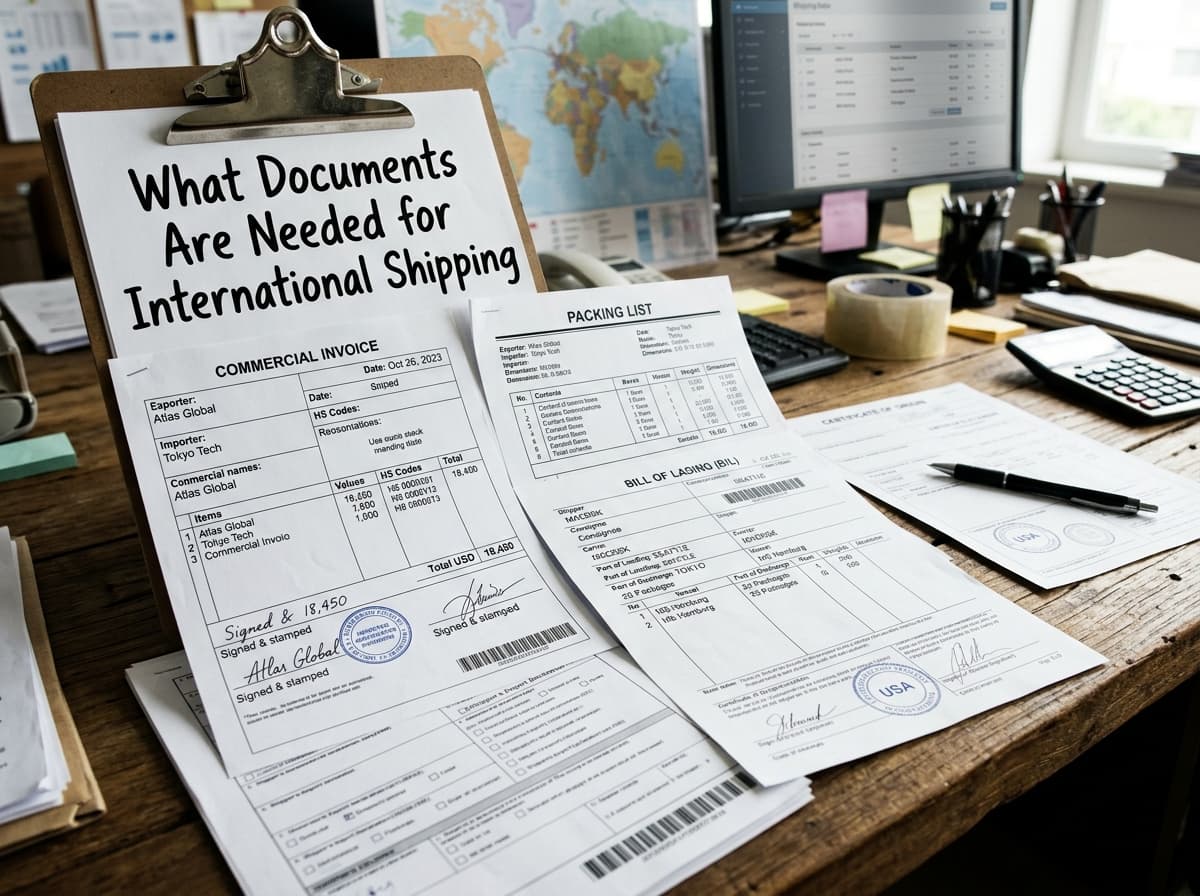
For most parcels, two documents do the work: a commercial invoice describing the goods and their value, and a customs declaration submitted to the authorities. The carrier generates the transport document itself. Everything else — certificates of origin, licences, permits — applies only to particular goods, destinations or duty claims.
The documents are not the hard part. Filling them in specifically enough is, and that is where nearly all customs holds begin.
What applies to your shipment
| Document | When it is required |
|---|---|
| Commercial invoice | Almost every non-document international shipment |
| Customs declaration | Every international shipment, in some form |
| Air waybill or bill of lading | Generated by the carrier, always present |
| Packing list | Multi-piece or commercial shipments |
| Certificate of origin | Claiming preferential duty, or required by the destination |
| Export licence | Controlled goods — technology, weapons, dual-use items |
| Import permit | Restricted goods at the destination — food, plants, medicines |
| Health or phytosanitary certificate | Food, plants, animal products |
| Dangerous goods declaration | Batteries above limits, flammables, aerosols |
| Proforma invoice | Non-sale shipments — samples, replacements, repairs |
Most consumer parcels need the first three. Most business parcels need the first four. The rest are triggered by what you are sending, not by how you are sending it.
The commercial invoice, field by field
This is the document customs actually reads, and each field does a specific job. Getting any one of them wrong slows the shipment.
Shipper details. Full legal name, address and contact. A business also needs its tax or EORI-equivalent registration number where the destination requires one.
Consignee details. Full name, address and a working phone number. The phone number matters more than people think — it is how the broker reaches someone when a question arises, and an unanswered question becomes a hold.
Description of goods. The field that causes the most problems. Write what the item physically is, what it is made of, and what it is for. "Men's cotton T-shirt, short sleeve, for retail sale" clears. "Clothing" does not, and "gift" certainly does not.
HS code. Per line item. This is what determines the duty rate, and supplying it removes the customs officer's need to classify it themselves. Our guide on what an HS code is covers how to find the right one.
Country of origin. Where the goods were manufactured, not where they are being shipped from. These are different for most e-commerce goods and conflating them is a common error.
Quantity and unit. Number of pieces, with the unit stated.
Unit value and total value. The actual transaction value, in a stated currency. Under-declaring is a customs offence and it also caps any insurance claim at the declared figure.
Reason for export. Sale, gift, sample, return, repair, replacement. This determines which valuation and duty rules apply.
Incoterm. Which party is responsible for duties and where liability transfers. Covered below.
Weight. Both net and gross where possible.
Signature and date. A commercial invoice is a declaration, and an unsigned one is incomplete.
Descriptions that clear, and descriptions that do not
Since this is the single largest cause of delay, it is worth being concrete.
| Rejected or delayed | Clears |
|---|---|
| Gift | Ceramic coffee mug, 350 ml, unbranded |
| Electronics | Bluetooth wireless headphones, over-ear, with lithium battery |
| Parts | Steel bicycle brake caliper, replacement part |
| Samples | Cotton fabric swatches, 10 cm square, no commercial value |
| Clothing | Women's woven cotton dress, size M |
| Documents | Signed contract, printed paper, no commercial value |
The pattern is the same in every row: material, form, and purpose. Three attributes turn an unclassifiable phrase into something a system can match against a tariff line.
The customs declaration
For postal shipments, this is a form attached to the outside of the parcel — a short one for low-value items and a longer one above a threshold. Most postal operators now generate it electronically when you buy the label, and print it as part of the label set.
For courier shipments, the declaration is submitted electronically by the carrier from the data you supplied at booking. You do not fill in a separate form; the booking screen is the form.
Either way the data must match the commercial invoice. A value on the declaration that differs from the invoice is one of the fastest ways to be selected for inspection, and it happens routinely when someone updates one document and not the other.
Transport documents
The air waybill for air shipments, or the bill of lading for sea, is generated by the carrier. It is the contract of carriage and the tracking reference.
There is one distinction worth knowing. An air waybill is not a document of title — the goods are released to the named consignee. An original bill of lading is a document of title, and whoever holds it controls the goods. That is why original bills of lading are couriered separately and treated as valuable documents in freight.
For parcel shipping, the carrier handles all of this and you never see it as a separate step.
Certificates of origin
A certificate of origin states where the goods were manufactured, and it exists for two reasons.
To claim preferential duty under a trade agreement. Reduced or zero rates apply only to goods originating in a qualifying country, and the certificate is the proof. This is frequently worth more than any shipping saving, and it is regularly left unclaimed.
Because the destination requires it, regardless of any agreement. A number of countries require one on all commercial imports.
Some agreements accept a declaration of origin printed on the invoice itself rather than a separate certificate, which is considerably simpler. Check which form the specific agreement accepts before paying for a chamber-of-commerce certificate you may not need.
Origin is determined by where the goods were substantially transformed, not by where they were shipped from or where the seller is registered.
Licences, permits and certificates
These are triggered by the goods, and the trigger is often broader than expected.
Export licences apply to controlled technology, weapons, encryption above certain strengths, and dual-use items with both civilian and military applications.
Import permits apply to food, plants, seeds, animal products, medicines, and in some countries to categories as ordinary as cosmetics or electronics.
Health and phytosanitary certificates accompany food, plant and animal products, and are issued by a designated authority in the exporting country before shipment.
Dangerous goods declarations apply to lithium batteries above certain thresholds, flammable liquids and aerosols. Our guides on shipping electronics safely and shipping liquids and perfumes cover what falls into these categories.
The common failure here is discovering the requirement after the parcel has been detained. A permit issued after the shipment arrived does not always release it, and goods requiring pre-shipment certification generally cannot be certified retrospectively.
Incoterms decide who pays
An incoterm is a three-letter code on the invoice stating where responsibility and cost transfer between shipper and recipient. Two matter for parcel shipping.
DDP — delivered duty paid. The shipper pays duty and tax. The recipient receives the parcel with nothing to settle. Costs more upfront and produces by far the better customer experience.
DDU or DAP — delivered duty unpaid. The recipient pays duty, tax and the carrier's advancement fee on arrival. Cheaper for the seller, and the source of the most common complaint in cross-border retail.
State the term explicitly on the invoice. Where it is absent, the carrier defaults to billing the recipient, which is frequently not what either party intended. Our guides on customs duties and hidden shipping fees cover what those charges include.
Gifts, samples, returns and repairs
Four non-sale scenarios with their own rules.
Gifts. Many countries apply a higher duty-free allowance to genuine gifts between private individuals. The declaration must say gift, state a realistic value, and the sender and recipient must be individuals. A business sending "a gift" to a customer does not qualify.
Samples. Often admitted duty-free if marked as having no commercial value and, in some cases, rendered unsuitable for sale. Mark them clearly and state a nominal value rather than zero — a zero value invites a valuation query.
Returns. Declare it as a return of previously exported goods and reference the original shipment. Done correctly this usually avoids duty being charged a second time. Done as a new sale, it will be.
Repairs. Goods sent for repair and returned are handled under specific procedures that charge duty only on the repair value. This needs declaring on the way out as well as on the way back, and missing the outbound step is what makes the return expensive.
The packing list
Separate from the invoice, and needed on multi-piece and commercial shipments.
Where the commercial invoice states value, the packing list states contents and configuration: what is in each box, how many pieces, the dimensions and weight of each, and how the boxes are marked.
It matters for two reasons. Customs uses it to verify a physical inspection against the paperwork without opening every box. And the recipient uses it to check the delivery is complete, which is the difference between a clean receipt and a dispute weeks later.
For a single-parcel consumer shipment it is unnecessary. From three boxes upward it starts to earn its place, and on any commercial consignment it is expected.
Who submits what
Worth being clear about, because sellers often assume the carrier handles everything.
You supply the data — description, value, HS code, origin, incoterm, recipient details. This is the part that determines whether the shipment clears.
The carrier or broker submits the declaration electronically to both customs authorities, using your data.
Customs assesses and either releases the shipment or raises a query.
The carrier does not check your descriptions or verify your classification. They transmit what you give them. A parcel held for a vague description was held because of what was typed at booking, not because the carrier did something wrong — which is why the fix is always upstream.
Documents that stay with the parcel
Even with electronic submission, put a printed copy of the commercial invoice in a document pouch on the outside of the box, and a second copy inside.
Electronic submissions fail, get separated from the shipment, or arrive under the wrong reference. A physical copy is the fallback that stops a parcel sitting unidentified in a customs facility.
Put a duplicate address slip inside the box too. If the outer label is destroyed, that slip is what prevents the parcel becoming undeliverable — the outcome our guide on returning a package to sender describes at its worst.
The errors that cause most holds
A vague description. Comfortably the leading cause.
A missing or wrong HS code, which forces manual classification.
Mismatched values between the invoice and the declaration.
A missing phone number for the recipient, so nobody can be reached when a question arises.
Country of origin confused with country of dispatch.
No incoterm, so duty is billed to a recipient who was not expecting it and refuses the parcel.
Each takes under a minute to get right at booking and days to resolve afterwards. Our guide on avoiding customs delays covers the process side, and why parcels get stuck in customs covers what to do when one is already held.
Before you ship
Write a description a stranger could identify the item from. Add the HS code. State the real value and the real country of origin. Choose an incoterm and put it on the invoice. Include a recipient phone number. Print two copies of the invoice — one outside, one inside. Check whether the goods need a licence, permit or certificate before the parcel leaves.
Then follow it on our home page. Well-documented parcels clear in hours; the ones that sit for a week almost always sat because of one field.