Hidden Shipping Fees You Should Know About
Updated 2026-08-039 min readShipping costs
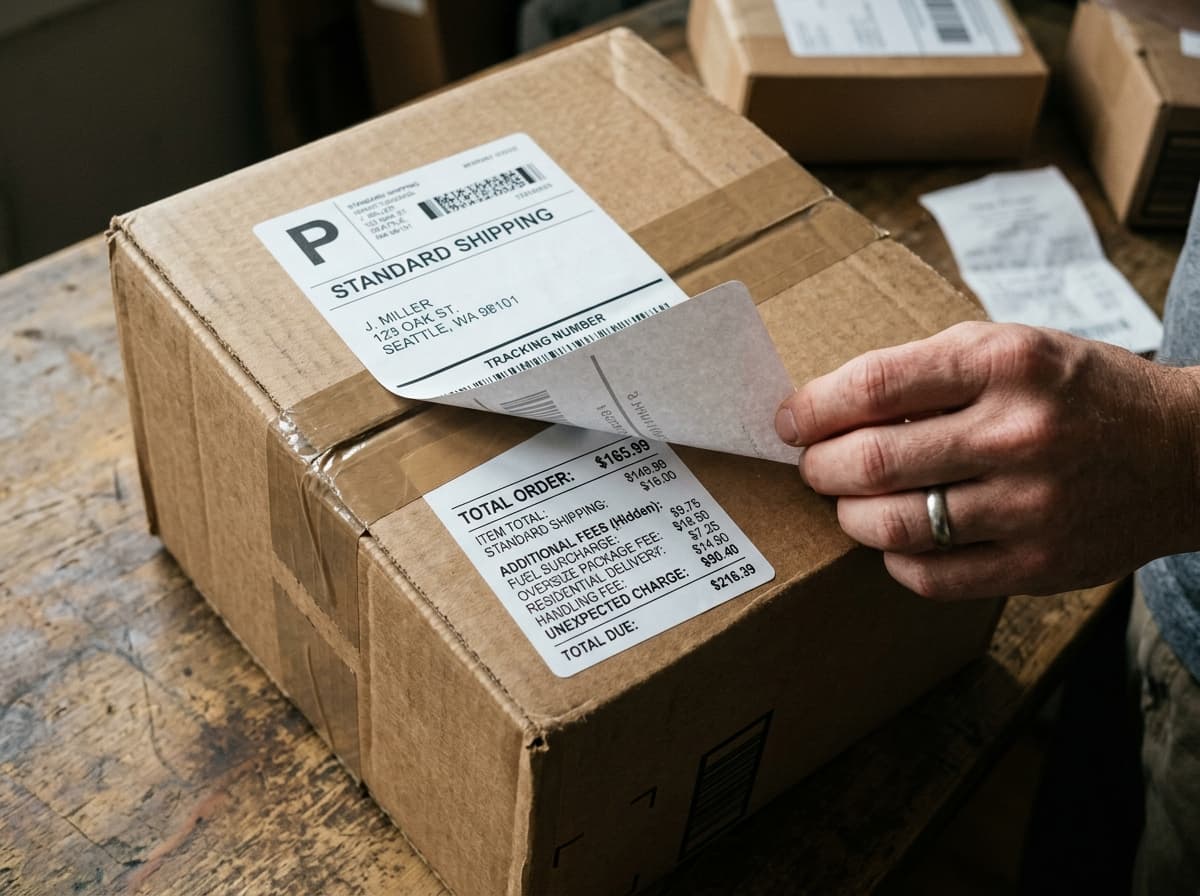
The quote covers the base rate. The invoice adds fuel, residential delivery, remote area delivery, reweigh adjustments, address corrections, signature fees and duty advancement. On a typical parcel these surcharges add 15 to 40 per cent, and on an awkward one they can exceed the base rate entirely.
None of them are hidden in the sense of being secret. They are published. They are hidden in the sense that no quoting tool shows them to you before you commit.
Fuel surcharge — the one that applies to everything
A percentage added to the base rate, recalculated weekly or monthly against a published fuel index. It applies to nearly every service and, importantly, to most other surcharges as well.
That compounding is what people miss. A residential delivery fee is not a flat addition; the fuel surcharge is then applied to it. Several accessorial charges stack the same way.
Air services carry a higher percentage than ground, because jet fuel moves further and faster than diesel. The gap is typically several percentage points.
You cannot avoid it and you cannot really negotiate it. What you can do is account for it. If you are modelling shipping cost for a product line, apply the current percentage to your base rate before you decide anything, or every number you produce will be optimistic.
Residential delivery
Delivering to a house costs more than delivering to a business, because a commercial route drops twenty parcels at one address while a residential route drops one parcel at twenty addresses.
The surcharge is applied automatically from the carrier's own address database, not from what you type. A home office, a small studio, a flat above a shop — all normally classified residential regardless of how you label them.
There is often a second, larger version applied when the delivery is both residential and outside the main network, which stacks with the first rather than replacing it.
The only real avoidance is to deliver somewhere genuinely commercial: a workplace, a parcel locker, or a carrier-operated pickup point. For e-commerce sellers, offering pickup-point delivery as a cheaper option shifts this cost off the order and is often popular with buyers anyway.
Remote or extended area delivery
Charged when the destination sits outside the carrier's standard route network. Rural addresses, islands, mountain areas and anywhere the driver makes a special trip.
This is one of the largest single surcharges, frequently in the tens of dollars or pounds per parcel, and it applies per parcel rather than per shipment. A five-box order to a remote address carries it five times.
Every carrier publishes a postcode list. Check it before quoting, not after. If you sell nationally, a small number of postcodes will be responsible for a disproportionate share of your shipping losses, and finding them takes one afternoon.
Postal operators are the exception worth knowing. USPS, Royal Mail, Canada Post and Australia Post all carry a universal service obligation and generally do not apply a remote surcharge, because reaching every address is the job. For genuinely remote destinations, the postal option often beats a courier by a wide margin even before the surcharge.
Reweigh and re-rate adjustments
Every parcel passes through an automated dimensioning scanner that measures all three dimensions and weighs it in under a second.
If the measured figures exceed what you declared, the difference is billed back afterwards — usually with an adjustment fee on top of the rate difference. Under-declaring by a single inch on one dimension is enough to trigger it if the parcel is near a band boundary.
This is the surcharge most within your control. Measure the sealed box at its widest points, round every dimension up, and re-measure whenever you change box supplier. Our guide on calculating package dimensions covers the method and the divisors.
For a business shipping regularly, audit these adjustments monthly. A systematic under-declaration across hundreds of parcels is invisible per parcel and substantial per quarter.
Address correction
Charged when the carrier has to fix an incomplete or wrong address — a missing apartment number, a wrong postcode, a street name that does not exist at that number.
It is a per-parcel fee, it is not small, and it applies even when the parcel is delivered successfully on the first attempt. The carrier charges for the correction work, not for a failure.
Address validation at checkout removes almost all of it. Most e-commerce platforms and shipping tools include it, and it is worth switching on even for a small store.
Additional handling
Applied to parcels that cannot go through the automated sort. The usual triggers:
| Trigger | Typical threshold |
|---|---|
| Longest side too long | Over roughly 48 inches |
| Second-longest side too long | Over roughly 30 inches |
| Weight above the conveyor limit | Over roughly 50 pounds |
| Not packed in corrugated cardboard | Tubes, buckets, wrapped items, wooden crates |
| Cylindrical shape | Anything that rolls off a belt |
Two of those are avoidable by packing choice alone. Putting a tube or a bucket inside a rectangular corrugated box removes the trigger, and the box costs a fraction of the surcharge.
An oversize charge sits above additional handling and applies at larger thresholds, generally when combined length and girth passes about 130 inches.
Signature and delivery-option fees
Requiring a signature costs extra, and adult signature costs more again. Both are worth buying on valuable items, but they are frequently applied by default in shipping software without anyone choosing them.
Saturday and Sunday delivery, timed delivery windows, and delivery to a specific person all carry their own charges. So do most changes made after the parcel is in transit — redirecting to a new address, holding at a depot, or rescheduling usually triggers a fee.
Check what your shipping platform sets as its default. Paying for adult signature on every parcel because a template was configured once is a genuinely common and entirely invisible cost.
Our guide on signature required versus no signature delivery covers when each tier is worth the money.
Peak season surcharges
Applied during the busiest weeks of the year, typically from late autumn through to early January, and increasingly during other high-volume periods.
They come in several forms at once: a general peak surcharge on all parcels, a larger one on oversize and additional-handling parcels, and sometimes a volume-based charge for shippers who exceed their forecast.
Peak surcharges are announced months ahead but rarely reach the people quoting shipping to customers. If you sell seasonally, check the published peak schedule in early autumn and build it into your pricing before the season starts.
Failed delivery and redelivery
A first failed attempt is normally free. Subsequent attempts, holding at a depot beyond a stated number of days, and return-to-sender after a failed delivery all carry charges.
The return-to-sender charge is the one that stings, because it is usually close to the full outbound rate. You pay to send it and pay again to get it back, plus storage if it sat at a depot first.
Our guide on returning a package to sender covers who pays in each scenario, which depends heavily on why the parcel came back.
Duty advancement on international parcels
When a parcel enters a country and duty or import tax is owed, the carrier normally pays it to customs immediately so the parcel keeps moving, then recovers it from whoever is liable.
For that service the carrier charges an advancement, disbursement or brokerage fee, and it is charged on top of the duty rather than being part of it. On a low-value parcel it frequently exceeds the duty itself.
This is the single most common source of "why do I owe money for a gift" complaints. The recipient sees a bill that is mostly a service fee for a payment they never asked anyone to make.
There is also a clearance or entry fee on formal customs entries, applied above a value threshold and separate from advancement.
Our guides on customs duties, import tax for online shoppers and avoiding customs delays cover how the underlying charges are calculated and what actually reduces them.
Insurance, declared value and packaging
Declared value above the included amount is charged per unit of value, usually per hundred. On a valuable item that adds up faster than people expect.
Carrier-branded packaging is sometimes free and sometimes billed, depending on the service. Flat rate boxes are typically supplied at no cost; express envelopes and specialist packaging often are not.
Neither is large, but both appear on the invoice without appearing in the quote.
The fees recipients pay, not senders
Not every surcharge lands on the person who bought the label. Several are billed to whoever answers the door.
Import duty and tax, plus the advancement fee described above, are normally the recipient's liability unless the sender chose delivered-duty-paid terms. The recipient learns this from a text message demanding payment before delivery, having ordered from a site that showed a total at checkout.
Storage or demurrage applies when a parcel sits at a customs facility or depot beyond a free period, often three to five working days. It accrues daily and it accrues quietly. A parcel held for a missing document can accumulate a meaningful bill before anyone realises there is a document missing at all.
Redelivery and collection charges apply in some networks when the recipient misses the delivery and asks for another attempt.
For sellers, the practical consequence is a support cost rather than a shipping cost. A buyer billed unexpectedly at the door usually blames the seller, not the carrier, and frequently refuses the parcel — which then generates a return-to-sender charge as well.
The fix is disclosure at checkout. Stating plainly that import charges may apply, and roughly what they are for the destination, prevents most of it. Our guide on import tax for online shoppers sets out what buyers are typically liable for.
Platform and third-party fees
If you buy labels through a marketplace, a shipping app or a fulfilment platform rather than directly from the carrier, there is usually another layer.
Some platforms take a per-label fee. Some take a monthly subscription and pass carrier rates through unchanged. Some quote a rate that already includes a margin, which is fine but makes it impossible to compare directly against a carrier's published price.
Insurance sold through a third party rather than the carrier is a separate contract with its own exclusions, and it is frequently cheaper for good reason — the claim process is longer and the packing requirements stricter.
None of this is wrong, and platforms often deliver rates well below anything you could negotiate alone. It is worth knowing which model you are on, because a per-label fee and a subscription behave very differently as volume grows.
Reading your invoice properly
Every carrier invoice separates the base rate from the accessorials, and the accessorial section is where the money is.
Three habits catch most of it. Compare the shipped rate against the quoted rate on a sample of parcels each month. Check whether any surcharge appears on parcels where it should not — residential on a commercial address, signature where none was requested. And track which destinations attract remote area charges, so you can price those postcodes properly.
For a business, the surcharge total is usually a bigger lever than the base rate discount, and it is the one nobody negotiates.
What to do before you ship
Measure and round up. Validate the address. Put anything cylindrical in a box. Check the destination postcode against the remote area list. Turn off default signature unless you want it. Confirm who pays duty before an international parcel leaves.
Those six checks remove most of what would otherwise appear on the invoice later.
Once it is away, track it on our home page, and if it stops moving our guide on tracking that is not updating explains how long a gap should last before it means something.