How to Ship Clothes, Gear and Essentials Across the US
Updated 2026-08-039 min readPacking and sending
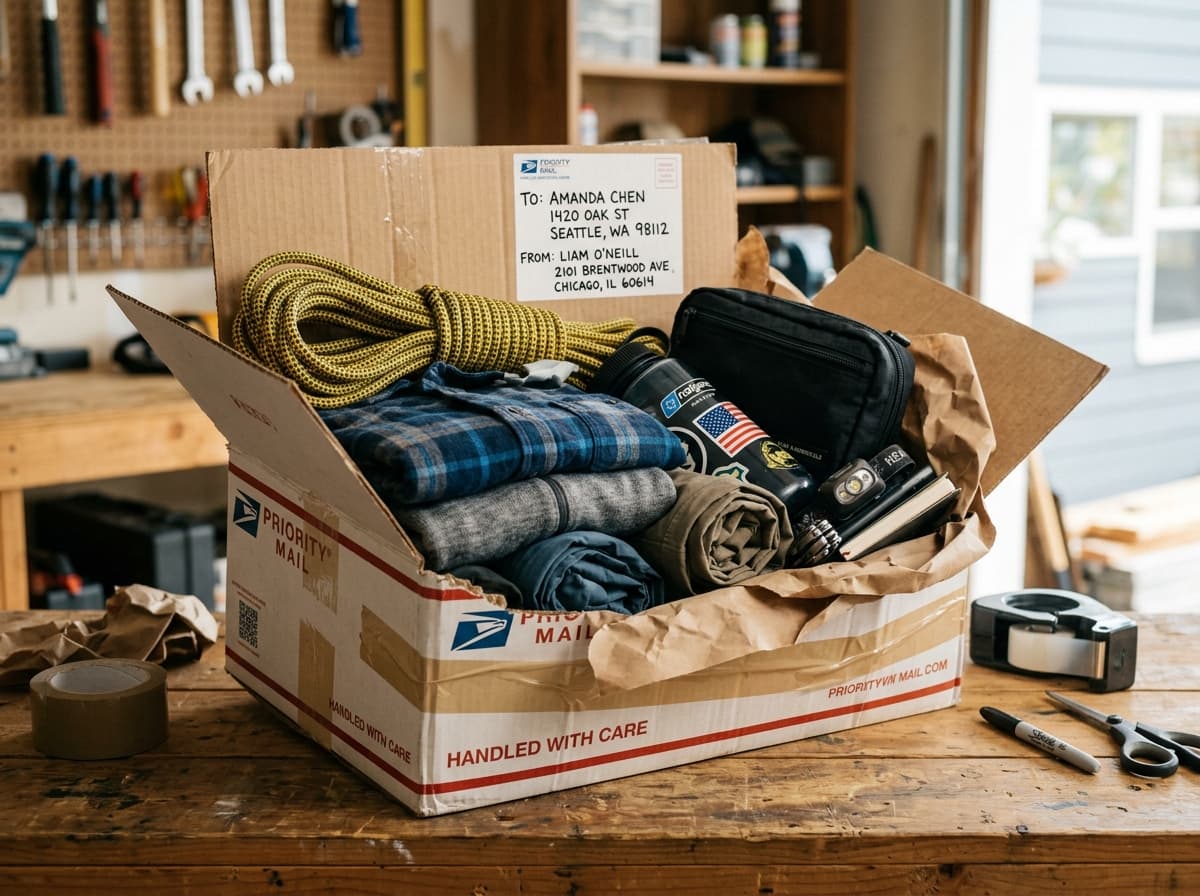
Soft goods belong in a poly mailer, because a mailer conforms to its contents and is charged on actual weight rather than volume. Dense gear belongs in a flat rate box, because dense items win when weight is ignored. Getting that one choice right is worth more than any comparison of carriers.
Domestic US shipping adds a second variable that international shipping mostly hides: zones. Distance is priced, and the difference between a neighbouring state and the opposite coast is substantial on any weight-based service.
Mailer or box
The single decision that determines the cost.
| Contents | Container | Why |
|---|---|---|
| Clothing, textiles, soft goods | Poly mailer | Charged on actual weight, not volume |
| Shoes | Box, or mailer over the shoe box | Retail box needs protecting, but adds volume |
| Bedding, cushions, soft bulk | Large poly mailer | Compresses; a box would be charged on air |
| Dense gear, tools, hardware | Flat rate box | Heavy for its size — flat rate ignores weight |
| Fragile or rigid items | Box with cushioning | Protection outweighs the volume charge |
| Mixed clothing and hard items | Box | The hard item sets the requirement |
A poly mailer avoids dimensional weight almost entirely. A box of the same T-shirts is measured, and a light bulky box is priced as though it were heavy. Our guide on calculating package dimensions explains the calculation and the divisors.
That is the whole trick with clothing. It is light, and the only way to be charged for its actual lightness is to avoid enclosing air.
Zones, and how much distance costs
Domestic weight-based pricing is zoned by distance from the origin. A parcel travelling within a neighbouring zone is priced at the bottom of the grid; one crossing the country is priced near the top of it.
The practical consequences.
Flat rate wins on long distances, because it ignores zones domestically. The further the parcel is going, the better flat rate looks against a weight-based alternative.
Weight-based wins locally. For a light parcel two zones away, the grid price is a fraction of the flat rate.
Ship from the nearest point you can. For a seller with stock in one location this is fixed, but it explains why fulfilment gets split across regions as volume grows.
Our guide on flat rate versus weight-based shipping works through where the crossover sits.
Which carrier, by what you are sending
For light soft goods, USPS is difficult to beat. Its pricing on low weights is structurally aggressive, it reaches every address including PO boxes and rural routes without a remote surcharge, and a mailer under a pound is about as cheap as domestic shipping gets.
For heavier parcels, UPS and FedEx become competitive somewhere around 5 to 10 pounds and clearly better above 20. They also scan more often, which matters if the contents are valuable. Our comparison of USPS and UPS covers the split in detail.
For regional deliveries, carriers like OnTrac and LaserShip operate in defined territories and are frequently cheaper inside them.
A useful default for personal shipping: postal for anything under 5 pounds, courier above it.
Packing clothing properly
Clothing is forgiving, which is why people underpack it and then find problems that had nothing to do with impact.
Bag it. A plastic bag inside the mailer. Mailers are water-resistant, not waterproof, and parcels sit on wet loading docks. Damp clothing arriving after three days smells of it permanently.
Compress it. Roll rather than fold, and squeeze the air out. Less volume means a smaller mailer, and on a box it means avoiding a size band.
Do not vacuum-compress delicate fabrics. Wool, structured garments and anything with a nap can be crushed permanently.
Separate anything with hardware. Zips, buckles, studs and buttons against a soft finish will mark it over three days of vibration.
Do not overfill a mailer. A mailer stretched to its limit splits at the seam. If it needs force, use the next size up.
For shoes, keep the retail box only if it is part of the value — for a resale sneaker it is, and it needs its own protection. Otherwise remove it, stuff the shoes with paper to hold their shape, and bag them.
Outdoor gear and what is restricted
Camping and outdoor equipment brings dangerous goods rules that surprise people, because the items are ordinary and legal to own.
| Item | Status |
|---|---|
| Fuel canisters, propane, butane | Prohibited |
| Camping stoves that have held fuel | Prohibited unless purged and certified |
| Lighters and matches | Prohibited |
| Bear spray and pepper spray | Prohibited on most consumer services |
| Aerosol insect repellent | Restricted, often refused |
| Spare lithium batteries, power banks | Prohibited on most consumer services |
| Headlamps and devices with batteries fitted | Usually accepted, switched fully off |
| Knives and multi-tools | Usually accepted domestically; check the destination state |
| Sleeping bags, tents, packs | No restriction |
A stove that has held fuel is the one that catches people out. Residual vapour is the hazard, not the fuel you removed, and carriers treat a used stove as contaminated unless it has been properly purged.
The general answer for a trip: ship the gear, buy the consumables at the destination. Our guides on shipping electronics safely and shipping liquids and perfumes cover the battery and flammable rules in more detail.
Moving a wardrobe or a seasonal changeover
Sending a large quantity of clothing — a student moving, a seasonal swap, a relocation — is a different problem from sending one parcel.
Use several medium boxes rather than one large one. Clothing is light and bulky, so a large box attracts dimensional weight charges. Medium boxes keep each parcel inside a reasonable band and are far less likely to burst.
Keep each box under about 30 pounds. Not for cost, but because heavy boxes are dropped and clothing boxes are usually reused cardboard.
Ground service, not express. Nothing about clothing is time-critical, and ground pricing on multiple boxes is a fraction of expedited.
Label the contents on the outside for your own benefit at the other end, and put an address slip inside each box.
Above roughly ten boxes, price a small freight consignment against the parcel total. The crossover comes sooner than people expect, and our guide on shipping large items covers how pallet pricing works.
Sending essentials to someone
Care packages, medication, replacement items to someone travelling — the practical points differ from ordinary shipping.
Confirm the address will still be current when the parcel arrives. A hotel, a campsite or a temporary address needs the arrival date checked against the stay.
Use general delivery or a pickup point for someone with no fixed address. Both let a parcel be held for collection with identification.
Ship prescription medication with the documentation. Domestic shipping of prescription medicines is legal in defined circumstances and restricted in others; keep the pharmacy labelling intact and the prescription with it.
Send tracking to the recipient, not just to yourself. Somebody travelling needs to know when to be somewhere, and our guide on what "out for delivery" means covers how much notice the status actually gives.
Sneakers, resale and high-value apparel
Resale apparel is its own category, because the box is part of the product and the transaction is usually between strangers.
Keep the retail box intact and protect it. For sneakers and collectible apparel, a crushed box reduces the value materially. Put the shoe box inside a shipping box with cushioning; never put a label directly on the retail packaging.
Photograph everything before packing — the item, any tags, the box, and the packed parcel. Condition disputes are the most common problem in resale, and photographs settle them in minutes.
Use a signature service above a certain value. A doorstep drop on an expensive pair is a claim the carrier will contest once a delivery scan lands, and their position is strong. Our guide on signature required versus no signature delivery covers the tiers.
Ship to the platform's registered address only. Buyer protection covers delivery to the address on file and nothing else, and a request to redirect mid-transaction is a familiar pattern rather than a convenience.
For authenticated categories, expect the item to route via an authentication centre, adding a leg and a second tracking number. Our guide on tracking an eBay order explains what that looks like in the tracking.
Dorms, campuses and temporary addresses
Shipping to a college or a temporary address has a failure mode of its own: the parcel arrives and nobody knows whose it is.
Use the exact format the institution specifies, including any mailroom code, box number or student identifier. Campus mailrooms handle thousands of parcels and match them by that identifier rather than by name.
Check the holding period. Many mailrooms return unclaimed parcels after a set number of days, and a parcel sent before term starts can be returned before the student arrives.
Time it against term dates rather than against the delivery estimate. The week either side of a term change is the busiest period a campus mailroom sees, and a parcel that arrives then waits regardless of when the carrier delivered it.
For anything valuable, a pickup point off campus is more reliable than a shared mailroom.
Alaska, Hawaii and the territories
Domestic in name, and priced and timed like something else entirely.
Couriers apply surcharges and longer transit times to Alaska, Hawaii, Puerto Rico and the other territories. Ground services either do not serve them or route via air at air prices, and remote area charges frequently apply on top.
Postal services usually do not surcharge them, because a universal service obligation covers every address at the same rate. For these destinations, USPS is very often dramatically cheaper than any courier, and it is one of the clearest cases where the postal option is not a compromise.
Allow extra time. Even on air-based services, expect several days longer than a mainland equivalent, and considerably longer for remote Alaskan communities.
Puerto Rico and the US Virgin Islands add a further wrinkle: while domestic for postal purposes, some shipments require additional documentation, and couriers frequently treat them as international for handling. Check before quoting a customer.
For sellers, these destinations deserve their own shipping rate rather than falling under a national flat rate. A handful of orders shipped at mainland pricing can consume the margin on many more.
Returns, because clothing is returned most
Apparel has the highest return rate of any e-commerce category, largely because people order two sizes deliberately.
For a seller, that makes return shipping a core cost rather than an exception. Use a fixed-price return label — customers repack into whatever they have, and a weight-based return invites a reweigh adjustment weeks later.
Include the return instructions in the parcel, not only in an email. A return that arrives without an authorisation reference sits unmatched at a warehouse while the customer waits for a refund, as our guide on returning a package to sender explains.
For a buyer, keep the proof of postage. It is the one piece of evidence that decides a disputed return.
Before you ship
Mailer for soft, box for hard, flat rate for dense. Bag the contents. Compress but do not crush. Check outdoor gear against the restricted list and leave the fuel behind. Keep boxes under 30 pounds. Postal under 5 pounds, courier above it. Ground unless there is a real deadline.
Then track it on our home page with the number from your receipt, and our guide on tracking that is not updating covers how long a quiet stretch should last before it means anything.
For anything valuable, add a signature service and photograph the item before it goes in the mailer.