Tracking Not Updating — 9 Reasons and What to Do
Updated 2026-08-0210 min readTracking and delivery
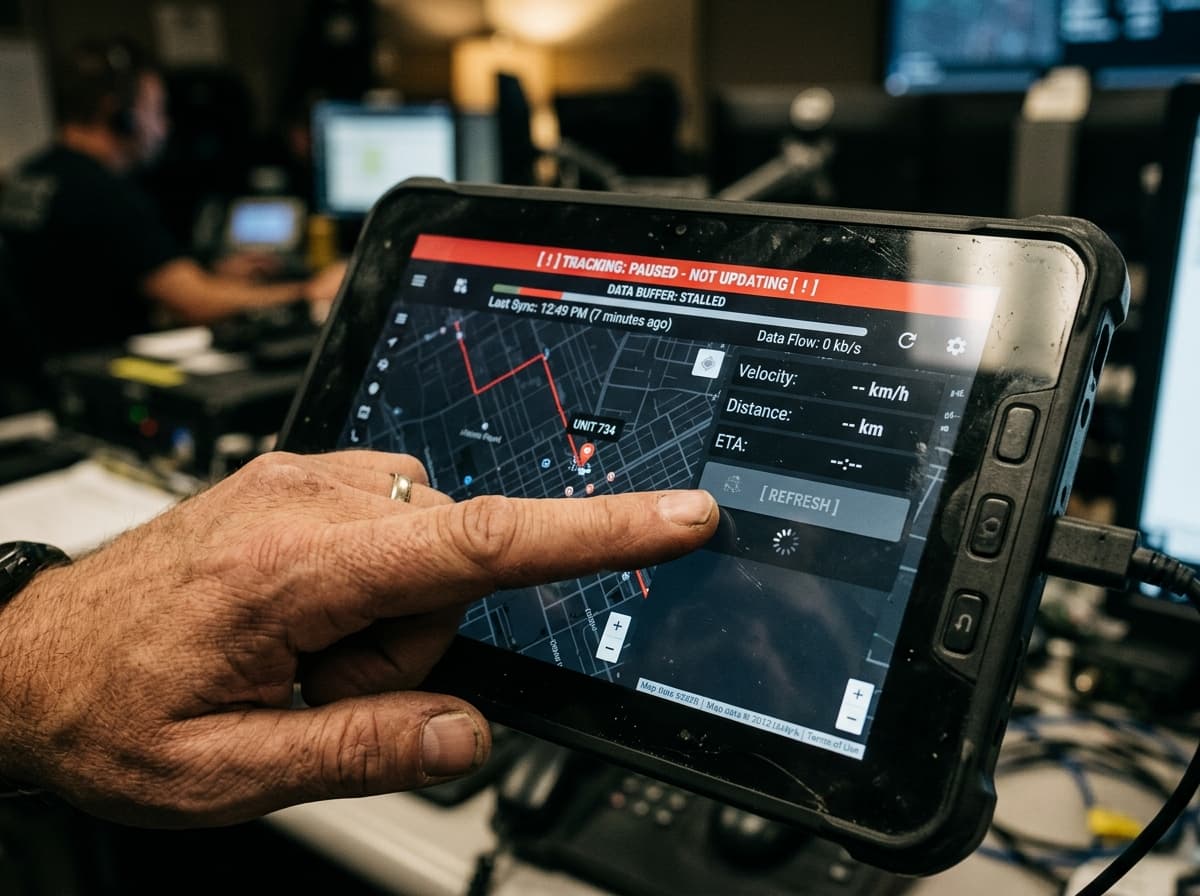
Tracking that hasn't moved for four days feels like something has gone wrong. Most of the time nothing has. Your parcel is simply somewhere between two scanners.
Parcels aren't tracked continuously. They're scanned at fixed points — collection, hub in, hub out, customs, delivery — and between those points there's no data to report. A domestic parcel picks up maybe six scans across its entire journey. An international one might get ten.
So the question isn't "why has it stopped." It's "has it been quiet longer than this route normally goes quiet." Here are the nine reasons, and the wait window for each.
1. It's between scan points
The commonest cause by far, and the one that needs no action.
A parcel sitting on a lorry between Birmingham and Glasgow generates no scans for the whole trip. On an aircraft crossing the Pacific, it generates none for a day and a half. Nothing is wrong. Nobody has passed it through a scanner because there's no scanner on the aircraft.
Normal wait: 2 to 5 days domestically, up to 10 internationally.
2. The weekend
Sorting hubs run reduced shifts on Saturdays and many run none at all on Sundays. A parcel that arrives at a hub on Friday evening can sit until Monday morning with no scan.
Add a public holiday and the gap stretches to four days. This catches people out every single Christmas and Eid.
Normal wait: the weekend plus one working day.
3. It's in a customs queue
International parcels stop at the border, and customs processing generates almost no scans. You typically get one event saying the parcel arrived at customs, then silence until it clears.
Most items clear within 3 to 5 working days. Backlogs at busy periods push that to two weeks. If duty is owed and nobody has paid it, the parcel simply waits — sometimes for weeks — until somebody does.
Normal wait: 5 working days, or 14 in a peak season. If it's longer, our guide on parcels stuck in customs covers how to find out whether a payment is holding it.
4. It's been handed to another carrier
This one produces permanent silence rather than a gap, which is why it's worth checking early.
Cross-border parcels change hands. The operator that flies it out of the origin country passes it to a domestic one for the final few miles, and the receiving carrier issues its own tracking number. Your original number freezes at the handover scan and never moves again.
The tell is the wording of the last event: "Departed origin country," "Handed over to local carrier," "Arrived at destination country." After any of those, the original number has done its job.
Look for a second number on the shop's order page rather than in your email. If there isn't one, the home page tracker will often find the destination carrier from the original number anyway, because many operators share the reference across the handover.
Normal wait: doesn't apply — this is a permanent freeze, not a delay.
5. The service you paid for barely tracks
Not all shipping products are tracked to the same depth, and cheap ones are deliberately thin.
Postal small packets — the LX and LP prefixes you get on AliExpress and eBay orders from Asia — often produce a lodgement scan, then nothing at all until delivery. That's not a fault. You bought a product that only scans twice.
Untracked and "signed for" letter services are similar. The number confirms the item exists in the system and confirms delivery, with nothing in between.
Normal wait: the whole journey. Silence is the product working as sold.
6. It's in a sorting backlog
Peak periods overwhelm hubs. Late November through December, Chinese New Year, and the week after any major sale event all produce parcels sitting in trailers waiting for a slot on the sorting belt.
Nothing gets scanned in a trailer. A parcel can lose three or four days this way and then reappear with a normal scan as though nothing happened.
Normal wait: add 3 to 5 days to the usual window during peak season.
7. A failed delivery that wasn't recorded properly
Occasionally a driver attempts delivery, can't complete it, and the failure scan doesn't register — bad signal in a rural area, a device that didn't sync, or a driver who simply didn't scan.
The parcel goes back to the depot and sits there. From your side it looks like the parcel vanished after "Out for delivery."
This one has a deadline attached, which makes it the most urgent on the list. Depots hold undelivered parcels for 5 to 10 days before returning them to the sender. If your last scan was "Out for delivery" more than two days ago with nothing since, ring the local depot rather than the national number.
Normal wait: 48 hours. Then act — the return clock is already running.
8. The parcel is genuinely mislaid
Sometimes a label is torn, unreadable, or the parcel falls behind a conveyor. It exists but can't be identified, so it can't be scanned.
Carriers do find these. Mislaid parcels often surface a week or two later when a hub does a sweep, and resume tracking as though nothing happened.
The signal is a scan trail that stops mid-network — at a hub, not at a border or a handover — and stays stopped past the normal window.
Normal wait: 5 working days domestically, 10 to 14 internationally. Then it's worth opening an investigation.
9. It never actually shipped
If there are no scans at all, rather than scans that stopped, the parcel probably never entered the network.
Labels are printed in advance and parcels wait for the next collection. Small sellers often batch this to once or twice a week. From your side it looks identical to a lost parcel, but the fix is completely different — see why a tracking number shows nothing.
Normal wait: 3 working days from the dispatch email. Then message the seller.
What counts as a scan, and what doesn't
Understanding this removes most of the anxiety, because it explains why the gaps exist at all.
A scan happens when a physical barcode passes a physical reader. That's it. There is no GPS in your parcel and no continuous monitoring.
Readers sit at fixed points: the courier's handheld at collection, the belt at a sorting hub entrance and exit, a customs gateway, and the driver's device at the door. A parcel travelling between two of those points is invisible to the system, however fast it's moving.
That produces a counter-intuitive result. A parcel moving quickly across a long distance generates fewer scans than one shuffling between local depots. A direct flight from Shanghai to London is one silent leg of fifteen hours. The same parcel then bouncing between three regional depots in England generates six scans in two days.
More tracking events do not mean better progress. Sometimes they mean the opposite.
Reading a scan trail properly
Look at the last event's wording, not just its date, because the wording tells you the category of silence:
Movement words — "departed," "in transit," "processed through" — mean the parcel was heading somewhere when last seen. Ordinary gap.
Arrival words — "arrived at facility," "received at hub" — mean it entered a building and hasn't been recorded leaving. Slightly more concerning if it's been days, since departures are usually scanned.
Border words — "arrived at customs," "import scan" — mean a queue you can't influence, unless a payment is owed.
Handover words — "handed to local carrier," "departed origin country" — mean a permanent freeze, not a delay. Look for a second number.
Exception words — "delivery attempted," "address issue," "held at depot" — mean a countdown is running and you should act today.
Telling normal silence from a real problem
Three questions sort almost every case.
Are there scans at all? No scans points at the shop. Scans that stopped point at transit.
Where did they stop? At a border means customs. At "departed origin country" means a handover. At a hub means a possible mislay. At "out for delivery" means a failed attempt, and that one has a deadline.
How long has it been, against this route's normal window? Four days on an international small packet is nothing. Four days on a domestic express courier is unusual.
When to act, and who to contact
Once you're past the window, contact the sender, not the carrier.
This surprises people, but the shipping contract is between the sender and the carrier. Only the sender can open a formal investigation, and only the sender can claim compensation. Most carriers will politely refuse to discuss a shipment with the recipient at all.
Give the sender the tracking number, the date of the last scan, and the wording of that scan. That's what they need to file. Vague messages get vague answers.
One exception: a failed delivery attempt. If the parcel is sitting at a local depot on a return countdown, you can usually arrange redelivery or collection yourself, and you should do it the same day.
How carriers decide what to show you
Carriers record far more events than they publish. A parcel might generate twenty internal scans and show you six.
The hidden ones are operational — which belt it went down, which container it was loaded into, which van it was assigned to. None of that helps a customer, so it is filtered out.
What survives the filter varies by carrier and by service level. An express product typically exposes more events than an economy one from the same company, because the customer paid for visibility as much as for speed.
That is why two parcels travelling the same route on the same day can produce completely different tracking pages. The physical journey is nearly identical; the reporting is not.
It also means a sparse tracking page is sometimes a pricing decision rather than a problem. If you want more visibility next time, that is a product to buy rather than a fault to report.
The one silence with a deadline
Eight of the nine reasons above can be waited out. One cannot, and it is worth separating.
If your last scan was "Out for delivery" or "Delivery attempted" and there has been nothing since, the parcel is almost certainly back at a local depot. Depots hold undelivered items for 5 to 10 days and then return them to the sender.
That return is not reversible from your side. Once the parcel is on its way back, you are waiting for it to reach the seller, then for them to agree to reship, then for a second journey. A two-day delay becomes a month.
So this is the case where waiting is the wrong instinct. Ring the local depot rather than the national customer service line — the depot has the parcel a few metres away, and the national line will only read you the tracking page. Depot numbers are usually on the carrier's website under a branch or location finder.
Arrange redelivery or collection the same day you notice. Everything else on this list can wait a week; this one cannot.
A note on delivery estimates
The predicted delivery date on a tracking page is generated by a model, not by anyone looking at your parcel.
Carriers estimate from historical averages for that route and service, adjusted as scans come in. When a parcel goes quiet, the model has nothing new to work with, so the date either freezes or quietly slides a day at a time.
That sliding date is the source of a lot of frustration. It looks like the carrier is repeatedly promising and missing, when in reality nobody promised anything — the estimate simply recalculated.
Treat the date as a forecast rather than a commitment, unless the service was explicitly sold as guaranteed. On a guaranteed product the date is contractual and a miss is claimable. On everything else it is weather forecasting.
What the status was telling you
Every tracking status has a normal duration, and knowing it turns a worrying silence into a boring one. The status table on our home page pairs each state with how long it usually lasts and what to do when it lasts longer.
Carrier matters too. Our courier directory has a page for every operator with its realistic transit windows — a week of silence means very different things on a DHL Express shipment than on a China Post small packet.
Check the window before you chase. Most parcels that look lost are simply travelling more slowly than the tracking page made you expect.