How to Ship Food Items Internationally
Updated 2026-08-039 min readPacking and sending
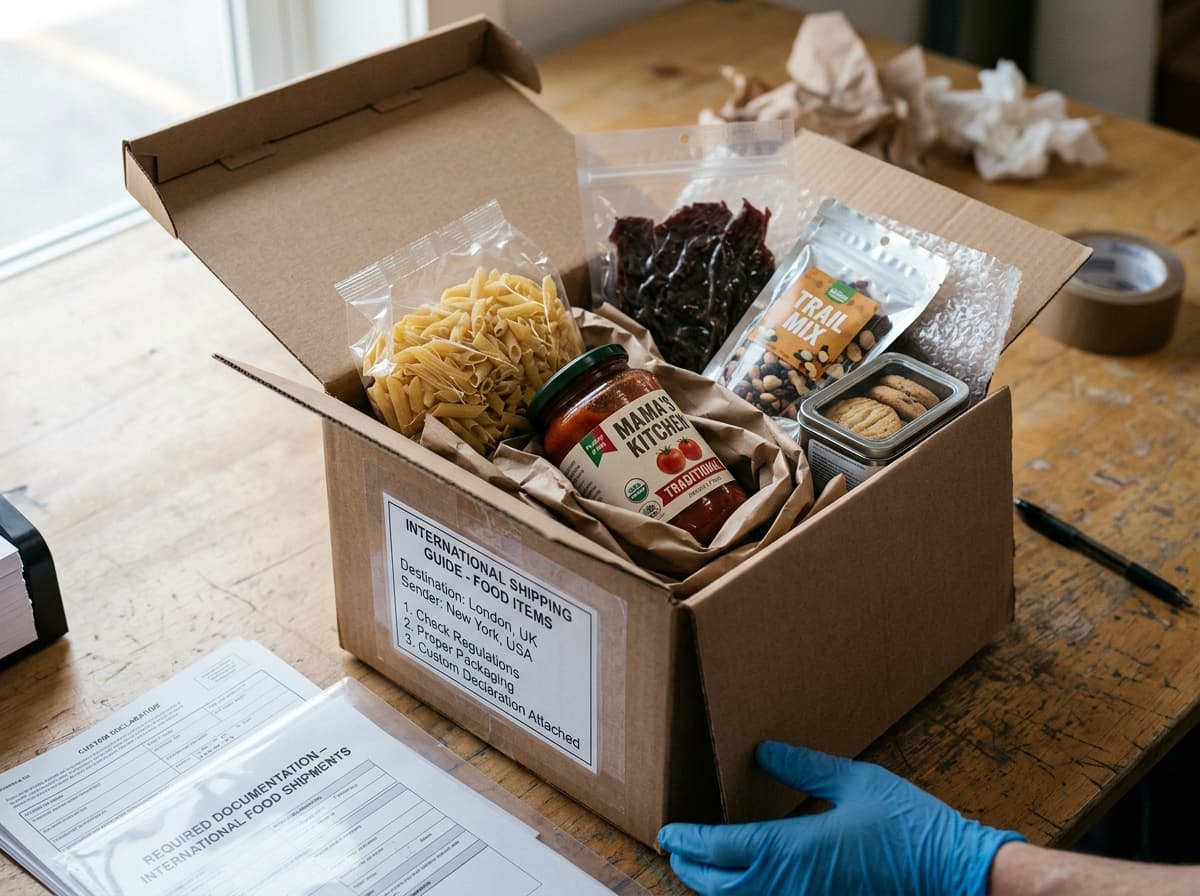
Commercially packaged, shelf-stable food with no meat or dairy content usually clears customs. Meat, dairy, fresh fruit and vegetables, seeds, plants and honey are restricted or prohibited in most destinations. Homemade food is refused almost everywhere, because nothing on it can be verified.
Food is the category where the rules are strictest and the enforcement most physical. A perfect invoice does not help when the parcel is opened and inspected.
Why food is treated differently
Customs generally cares about revenue and prohibited goods. Food adds a third authority with different priorities: biosecurity.
Biosecurity controls exist to keep pests, plant diseases and animal diseases out of a country's agriculture. A single infected seed or a piece of contaminated meat can cost a national industry enormously, so the response is deliberately disproportionate to the value of the parcel.
Two things follow. Inspection is physical, so paperwork alone does not clear it. And the default outcome for a prohibited item is destruction, not return to sender — you lose the goods and the postage.
Australia and New Zealand are the strictest, but every developed market screens food, and many developing markets do too. Our guide on countries with the strictest customs rules covers where the screening is heaviest.
What usually clears, and what does not
| Category | Usual outcome | Why |
|---|---|---|
| Commercially packaged biscuits, sweets, snacks | Usually clears | Sealed, labelled, shelf-stable, non-animal |
| Coffee, tea, dried herbs and spices | Usually clears | Processed, low biosecurity risk |
| Chocolate | Usually clears | Milk content is processed and stable |
| Tinned and jarred goods, non-meat | Usually clears | Sterilised and sealed |
| Dried pasta, rice, flour | Often clears, sometimes restricted | Grain products attract pest concerns |
| Honey and bee products | Frequently prohibited | Bee disease risk |
| Meat and meat products | Almost always prohibited | Animal disease risk |
| Dairy, cheese, milk powder | Usually prohibited or licensed | Animal disease risk |
| Fresh fruit and vegetables | Almost always prohibited | Pest risk |
| Seeds, nuts in shell, plant material | Prohibited or permit-required | Pest and invasive species risk |
| Homemade or unlabelled food | Almost always refused | Contents cannot be verified |
| Alcohol | Licensed shippers only | Excise and age controls |
Two entries surprise people. Honey is prohibited far more widely than its innocuousness suggests, because of the risk to domestic bee populations. And homemade food — the box of biscuits sent to a relative — is exactly the category with no label, no ingredient list and no verifiable origin, which makes it the easiest thing for an inspector to refuse.
The three questions to ask first
Before packing anything, resolve these in order.
Is the category permitted at the destination? Check the destination's own prohibited and restricted list, or the carrier's country guide. This is not the same as checking whether it is permitted where you are.
Does it need a certificate or permit? Health certificates and phytosanitary certificates are issued before shipment by a designated authority in the exporting country. They cannot be obtained retrospectively, so a parcel that needed one and left without it will not be released.
Is it shelf-stable at ambient temperature for the full transit time? Not the quoted transit time — the realistic one, including a customs hold. If the answer is no, ordinary parcel shipping is the wrong method.
If any answer is unfavourable, the honest conclusion is often to buy the item locally at the destination instead. For a gift, ordering from a retailer in the recipient's country is faster, cheaper and legal.
Packing food that does clear
Keep everything in its original sealed retail packaging. The label is what proves the contents, the ingredients and the origin. Removing it to save space converts a clearing item into a refused one.
Bag each item separately in a sealed plastic bag. This contains any leak and keeps items separated if the parcel is opened for inspection — an inspector who can identify everything without unpacking it repacks it faster.
Expect the parcel to be opened. Pack so that it can be resealed. A box crammed to capacity comes back badly repacked, and the contents get damaged in the process.
Protect against crushing. Food packaging is designed for a shelf, not a sorting belt. Use a rigid box with cushioning, following the method in our guide on wrapping packages for shipping.
Avoid natural packing materials. Straw, wood shavings, unprocessed fibres and untreated wood are themselves biosecurity risks and will attract attention regardless of the contents.
Declaring it properly
The customs declaration must be specific enough that an inspector can classify the contents without opening the box.
Write what it is, what it is made of, and its state. "Commercially packaged shortbread biscuits, wheat flour and butter, sealed retail packaging, 400g" clears. "Food" or "gift" does not.
Include an ingredient list for anything that could contain a restricted component, and state the country of manufacture — not the country you are posting from.
Add the HS code. Food sits in chapters 1 to 24, and a correct code speeds automated processing considerably. Our guides on what an HS code is and documents needed for international shipping cover the detail.
Never under-declare or mislabel food to avoid scrutiny. It converts a refusal into a penalty, and in strict destinations the penalty falls on the recipient.
Perishables and the cold chain
Ordinary parcel networks have no temperature control at any point. A parcel sits in unheated yards overnight, in vans in direct sun, and in depots for however long the sort takes.
Shipping anything perishable through that requires a specialist temperature-controlled service, which is a different product with a different price. For consumer quantities it is rarely economic internationally.
Insulated packaging with gel packs extends the window by hours, not days, and it does nothing for the customs hold that turns a two-day transit into a five-day one.
Dry ice is a dangerous good, because it releases carbon dioxide as it sublimates and can pressurise a sealed container. It requires declaration, specific labelling and vented packaging, and most consumer services refuse it. Our guide on shipping liquids and perfumes covers the general dangerous goods process.
For perishable food internationally, the realistic answer is a specialist food shipper or not shipping it.
Commercial food shipments
Selling food across borders is a regulated activity, and it works differently from sending a parcel.
Registration. Many countries require food importers to be registered before any consignment arrives, and some require pre-notification of individual shipments.
Labelling. Destination-market labelling rules cover language, allergens, nutritional information and country of origin. A product labelled for one market is frequently non-compliant in another, and non-compliant labelling is a common reason for a consignment to be refused entry.
Certification. Health certificates, phytosanitary certificates and, for some markets, halal or kosher certification, all issued before shipment.
Shelf life on arrival. Several countries require a minimum remaining shelf life at the point of import, which effectively rules out anything close to its date.
None of this scales down. A small seller shipping food internationally faces broadly the same requirements as a large one, which is why most start with domestic sales and add exports through a distributor who already holds the registrations.
Alcohol is its own category
Alcohol is not usually a biosecurity problem and is not usually a dangerous good at consumer strengths. It is a licensing and excise problem, which makes it harder rather than easier.
Most carriers accept alcohol only from approved shippers holding a specific agreement, and refuse it from consumers entirely. Postal services generally prohibit it.
Where it is accepted, three things apply. Excise duty is charged at the destination in addition to any customs duty, and excise rates on alcohol are typically far higher than ordinary tariffs. Age verification on delivery is mandatory, which means an adult signature service. And many destinations impose quantity limits on personal imports, above which the shipment becomes a commercial import needing a licence.
The practical answer for a gift is to order from a retailer in the recipient's country. For a business, it means working with a specialist alcohol logistics provider rather than a parcel carrier.
Timing and shelf life
Even shelf-stable food has a clock on it, and international transit consumes more of that clock than people plan for.
Assume the parcel could take twice the quoted transit time. A customs inspection adds days, a biosecurity hold adds more, and food parcels are inspected more often than average. A product with two weeks of shelf life left is a poor candidate for a route quoted at ten days.
Several destinations also apply a minimum remaining shelf life on arrival, expressed as a proportion of total shelf life or a fixed number of days. A product that arrives inside its date can still be refused entry for having too little of that date left.
Ship early in the week where you can. A parcel dispatched on Friday frequently sits at origin until Monday, losing a weekend from a window that is already tight.
And check the seasonal calendar. Chocolate and anything with a low melting point should not cross a warm climate in summer on an unrefrigerated service, regardless of what the rules permit.
Sending food as a gift
The most common reason people ship food abroad, and the one most likely to end badly.
What works: commercially packaged, shelf-stable, non-animal, non-honey items, declared honestly, in their original packaging. Regional sweets, biscuits, coffee, tea and packaged snacks travel well and clear routinely.
What does not: homemade anything, fresh produce, meat, cheese, and the assortment hamper that contains one prohibited item and therefore risks the whole parcel.
That last point is worth emphasising. A mixed hamper is assessed on its most restricted component. One jar of honey in a box of biscuits can cost the entire parcel, and biosecurity authorities are not obliged to remove the offending item and forward the rest.
Marking a parcel as a gift may qualify it for a higher duty-free allowance in some countries, as our guide on customs duties explains, but it grants no relief at all from food restrictions.
If a food parcel is held
Food holds resolve differently from ordinary customs holds, and knowing which kind you have determines whether it is worth acting.
A documentary hold — a missing ingredient list, an unclear description, a query about the manufacturer — is resolvable. Respond the same day with the detail requested and the parcel usually moves within a few days.
A biosecurity refusal is generally not resolvable. Once an item is identified as prohibited, the outcome is destruction or, occasionally, treatment at your cost. There is no appeal that returns the goods, and the parcel is rarely sent back.
A shelf-life refusal is also final. Nothing can be done about a date that has passed during transit.
For the first kind, the recipient is usually the one contacted, and the clock does not run while a query sits unanswered. For the second and third, the useful action is to stop the loss — decline any offer of treatment or return where the cost exceeds the value of the goods, which for a consumer food parcel it almost always does.
Our guide on why parcels get stuck in customs covers the general escalation path.
Before you send
Check the destination's food rules for your specific category. Obtain any certificate before shipment, never after. Keep everything in sealed retail packaging with the label intact. Bag each item. Declare specifically with an ingredient list and an HS code. Do not mix a restricted item into an otherwise clearing parcel. Avoid natural packing materials entirely.
Then track it on our home page, and expect a longer stop at the border than a non-food parcel — biosecurity screening is an extra step, and our guide on why parcels get stuck in customs covers what to do if the stop becomes a hold.