Signature Required vs No Signature Delivery
Updated 2026-08-039 min readTracking and delivery
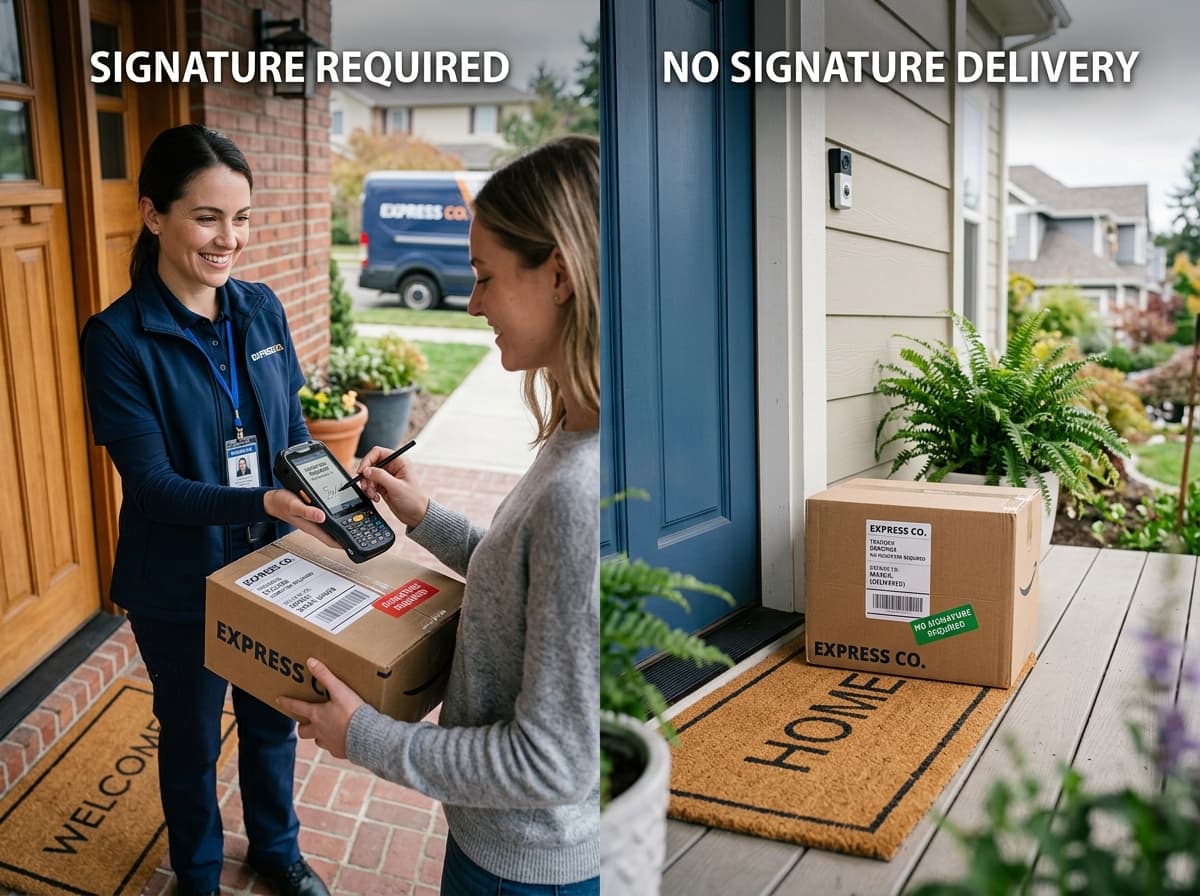
Signature required means the carrier will not release the parcel without someone signing for it, so nothing is left unattended. No signature means the driver decides where to leave it, usually photographing the spot. The first protects you against theft and disputes. The second gets the parcel delivered on the first attempt.
Which is right depends almost entirely on the value of the contents and the security of the address, and there are four tiers to choose from rather than two.
The four tiers
| Tier | Who can accept | What it proves | Left unattended? |
|---|---|---|---|
| Driver release / no signature | Nobody signs | A photo and a GPS point | Yes |
| Indirect signature | Anyone at the address or nearby | Someone in the area took it | Sometimes, on a second attempt |
| Direct signature | Anyone at the delivery address | Someone at that address took it | No |
| Adult signature | An adult at the address, with ID | An identified adult took it | No |
The gap between tier one and tier three is much larger than the price difference suggests. The gap between tier three and tier four is small unless the contents are age-restricted.
No signature, and what it actually is now
Default delivery on most services no longer involves any signature. The driver leaves the parcel at the address, photographs where they left it, and records a GPS position.
This exists because it works for the overwhelming majority of parcels. It delivers first time, it costs nothing extra, and it removes the failed-attempt cycle that used to be routine.
What it does not do is prove receipt. A photograph shows a box on a doorstep at a moment in time. It says nothing about what happened in the following ten minutes, and that gap is exactly where parcel theft lives.
Carriers treat a photographed delivery as complete. Once that scan lands, the carrier's obligation is discharged and a claim becomes difficult — the position is that the parcel was delivered as instructed. Our guide on tracking that says delivered when no package arrived covers what to do when that happens, and the honest answer is that it is much harder than it should be.
Choose no signature when the item is inexpensive, the address is secure, or nobody will be home and a redelivery cycle would be worse than the risk.
Indirect signature
A middle tier that most people never notice they are using. Someone must sign, but it does not have to be the addressee, and it does not have to be at the delivery address — a neighbour or a nearby building usually qualifies.
The driver may also be permitted to leave it without a signature on a later attempt, depending on the carrier and the service.
It is a reasonable compromise for moderately valuable items where somebody in the area will be around. It fails in two situations: flats and apartment buildings, where "nearby address" is ambiguous and parcels end up with a concierge or a stranger, and any case where you need to know specifically that the recipient received it.
Direct signature
Someone at the delivery address must sign. Not a neighbour, not the building next door. If nobody is in, the parcel is not left.
This is the tier that changes the risk profile meaningfully. The parcel is never unattended, and there is a signature tied to the address.
The trade-off is delivery attempts. Carriers typically make two or three, then hold the parcel at a depot or pickup point for a period, commonly 5 to 18 days, before returning it to the sender. If nobody is home during working hours, direct signature reliably turns a one-day delivery into a week of missed cards.
The fix is to combine it with a delivery preference — redirect to a pickup point or a locker, or schedule a specific day. Set that up when the parcel is dispatched rather than after the first failed attempt.
Adult signature
The strictest tier. An adult at the delivery address must sign, and the driver checks photographic ID to confirm age.
It is mandatory rather than optional for age-restricted goods: alcohol, tobacco, certain knives and tools, some medicines. Where it is a legal requirement, it is not something you can decline.
For everything else it is worth buying only on genuinely high-value items, where knowing an identified adult took possession matters more than convenience. The delivery experience is the most restrictive of the four tiers, and the failure rate on first attempt is correspondingly the highest.
Who can legally sign
More flexible than people assume, and worth knowing before a dispute.
Anyone physically present at the address can normally sign under direct signature, including family members, housemates, cleaners and visitors. The signature binds the delivery, not the person's relationship to you.
For flats and offices, a concierge, reception or mailroom counts as the address in most carriers' terms. Once reception signs, the delivery is complete as far as the carrier is concerned, and anything that happens between reception and your door is not their problem. This is the single most common source of a signed delivery that the recipient never received.
Under adult signature, the signer must produce ID showing they are over the relevant age. A minor cannot sign even if they live there.
Drivers are not permitted to sign on a customer's behalf, though it does happen. If a signature appears on your delivery and nobody at the address signed anything, say so when you raise it — a driver-applied signature substantially strengthens your position.
What each tier costs
Signature services are priced as accessorial charges on top of the base rate. Indirect is the cheapest, direct sits above it, and adult signature is the most expensive of the three.
Two things to check. Many express and international services include a signature in the base rate, so paying for one separately is buying something you already have. And shipping software frequently applies a signature requirement by default across every label, which quietly adds the fee to hundreds of parcels nobody chose it for.
Our guide on hidden shipping fees covers how these accessorials accumulate, including the fuel surcharge that is applied on top of them.
When it is worth paying
A rough rule that holds up: buy a signature when the item is worth more than about twenty times the fee. Below that, the expected loss from theft is smaller than the cost of protecting against it across many parcels.
Then override the rule in four situations, regardless of value.
The address is not secure. A shared entrance, a street-facing door, a building with no safe place, or an area with a known theft problem. Address security matters more than item value here.
The item is irreplaceable. A passport, documents, an item that cannot simply be reordered.
A dispute is plausible. Selling to a stranger, shipping something contested, or any situation where you may need to prove delivery to a third party rather than to the recipient.
The goods are age-restricted, where it is not a choice.
Conversely, skip it when the item is cheap, the address has a secure place to leave parcels, or the recipient is genuinely never home and a redelivery cycle would be the worse outcome.
Signature and insurance claims
Signature level directly affects how a claim goes.
For a theft-after-delivery claim, the tier decides almost everything. With no signature, the carrier's position is that delivery completed as instructed and the claim usually fails. With a direct signature, either there is a signature you can dispute or the parcel was never released, and both are stronger ground.
Some carriers require a signature service before they will insure above a certain declared value. Buying high declared value without the matching signature tier can mean paying for cover that does not apply.
The claim is filed by the sender in either case, because the shipping contract belongs to them. Our guide on lost or damaged package claims covers the process and the deadlines.
Changing the requirement mid-transit
Both directions are possible, with limits.
Adding a signature after dispatch is offered by some carriers as a paid change, usually only before the parcel reaches the delivery depot.
Waiving one is more common. Most carriers let the recipient authorise release without a signature, either through a delivery preferences account or by leaving instructions in the tracking portal. Doing so normally transfers liability to the recipient — if the parcel then goes missing, you instructed the carrier to leave it.
The sender can also block that waiver. On high-value shipments, carriers offer a setting that prevents the recipient from releasing the signature requirement, which is worth using when the parcel is expensive.
Safe place instructions and what they cost you
"Leave in the porch", "leave with a neighbour", "put it behind the bin" — these are convenient and they change your position materially.
A safe place instruction is an authority to leave. Once given, a parcel left there is delivered, and the carrier's liability generally ends at that point. If it is stolen from the safe place, the loss is normally yours.
That is a reasonable trade for an inexpensive item and a poor one for anything valuable. Set safe place instructions per parcel rather than as an account-wide default, because the default will eventually apply to the one parcel you did not want left outside.
Pickup points and lockers give the same convenience without the exposure. The parcel is held securely, you collect at your convenience, and the handover is recorded.
How it differs across carriers and countries
The four tiers are a useful model, but the names and defaults vary.
Postal operators tend to have simpler options — broadly, signed-for or not — with a smaller price gap between them. USPS, Royal Mail and Canada Post all work this way, and signed-for postal services are usually cheaper than a courier's equivalent.
Courier networks offer the full range with distinct names for each tier. UPS, FedEx and DHL each label them differently, so read what the tier actually requires rather than trusting the name.
International shipments frequently include a signature by default, because cross-border parcels are higher value on average and clearance already involves identifying the recipient. Check before adding one.
Delivery culture matters too. In much of Europe, pickup-point and locker delivery is the norm rather than a fallback, and the handover at collection is recorded regardless of what tier you bought. In markets where doorstep release is standard, the difference between tiers is much starker.
What happens when nobody is home
Understanding the attempt cycle changes how you choose, because the cost of a signature is partly measured in your time.
The first failed attempt produces a card or a notification and a second attempt the next working day. Carriers typically make two or three attempts in total. After that the parcel is held at a depot or a pickup point for a fixed period — commonly 5 to 18 days — and then returned to the sender.
Each stage has an exit. After the first attempt you can usually redirect to a pickup point, authorise release, reschedule, or nominate a neighbour, all through the carrier's tracking page.
Do it after the first attempt rather than the second. Options narrow as the parcel moves through the cycle, and once it is in the return leg there is nothing to do but ask the sender to send it again — at their cost, as our guide on returning a package to sender explains.
Choosing for a specific parcel
Ask three questions in order. How much is it worth? Is the address secure when nobody is home? Is anything about it age-restricted or legally controlled?
Cheap item, secure address, nothing restricted — no signature, and take the first-time delivery.
Valuable item or insecure address — direct signature, combined with a pickup point if nobody is home in the day.
Age-restricted — adult signature, because there is no choice.
Whichever you choose, track the parcel on our home page so you know when it is due. The parcel status meanings table explains what each scan tells you, and our guide on tracking that stops updating covers the gaps between them.