What Does "Out for Delivery" Actually Mean?
Updated 2026-08-039 min readTracking and delivery
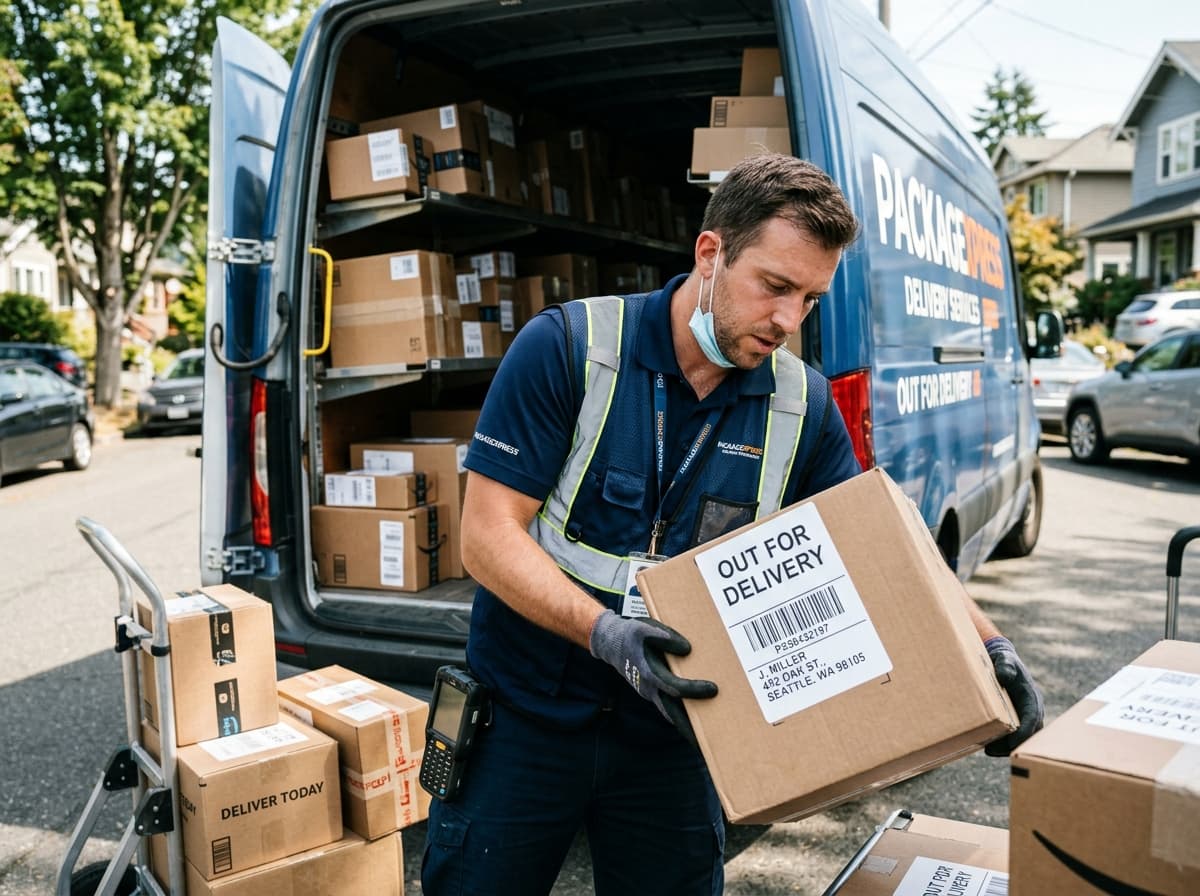
Your parcel has been scanned onto a delivery vehicle and is on the road with somewhere between 80 and 200 others. It will arrive today in the large majority of cases, at an hour determined by where your address sits in a route the software built at about 6am. What it does not mean is that anyone is on their way to you specifically.
The status is widely misread as an appointment. It is closer to a boarding announcement.
What already happened before that scan
The scan looks like the start of the journey. It is actually the end of a long night.
The parcel arrived at the local delivery depot overnight, usually between midnight and 4am, on a trunk vehicle from a regional sorting hub. It was unloaded, sorted by round, and staged in a bay.
At around 5 to 6am the routing software assigns parcels to vehicles and computes the delivery sequence. Drivers arrive, load in reverse order — last stop first, into the back of the van — and scan each parcel as it goes on. That load scan is what produces "out for delivery."
So by the time you see the status, the order of the day is already fixed. Your position in it was decided by an algorithm before anyone was awake to ask.
How the route is actually built
Understanding this explains almost every question people have about delivery timing.
Routes are optimised for total distance and total time, not fairness. The software clusters stops geographically and finds an efficient path through them. Nobody's parcel is prioritised for arriving earlier in the depot or being ordered first.
Three things override pure geography.
Timed and premium services come first. Guaranteed morning deliveries anchor the early part of the route, and everything else is fitted around them.
Business addresses are usually front-loaded, because commercial premises close at 5pm while houses do not.
Collections are interleaved, and a pickup with a stated window pulls the driver away from the delivery sequence at a fixed time.
Everything else falls where the geometry puts it. If you live at the far edge of a round, you are late every day, and there is nothing to be done about it beyond redirecting to a pickup point.
Why the estimated window moves
Many carriers now show a narrowing time window as the day progresses, and it is genuinely dynamic.
The initial window comes from the planned sequence and average stop times. It updates as the driver completes stops — actual progress replaces the estimate, and the window tightens.
It also moves backwards. A round that hits traffic, a failed access at an apartment block, or a driver covering part of an absent colleague's route all push the remaining stops later. A window that said 2pm to 4pm at nine in the morning can say 5pm to 7pm by three in the afternoon, without anything having gone wrong.
Treat the window as a live estimate rather than a promise. The only figure with a commitment attached is on a guaranteed timed service, which is a paid product.
Why it shows out for delivery two days running
This is the most common complaint about the status, and there are five real causes.
| Cause | What happened | Usually resolves |
|---|---|---|
| Route ran out of time | Volume exceeded the round; parcel stayed on the van | Next working day |
| Access failed | Gated estate, locked building, no answer at a required signature | Next attempt, or held |
| Vehicle problem | Breakdown; parcels returned to depot | Next working day |
| Misload | Parcel on the wrong van, returned unscanned | 1–2 days |
| Weather or road closure | Round curtailed | Next working day |
The signature is worth calling out. On a direct signature service the driver cannot leave the parcel, so an empty house means the parcel goes back on the van and returns tomorrow. Our guide on signature required versus no signature delivery covers how to avoid that cycle.
Two consecutive days is normal enough not to worry about. Three or more is not — at that point the parcel is probably stuck in a loop, and the sender should raise it with the carrier.
What time to expect it
Broad patterns, and they hold up reasonably well.
Postal operators run rounds that start early and finish in the early afternoon, because the round is built around letter delivery. If your post normally comes at 11am, parcels tend to arrive around then too.
Courier networks run 8am to 8pm, sometimes later. Residential deliveries skew toward the afternoon and evening because business stops are cleared first.
Gig-economy and contracted last-mile drivers run the longest days, frequently to 9 or 10pm. A parcel still showing out for delivery at 7pm on one of these networks is entirely normal.
Peak season stretches all of the above. In the busiest weeks of the year, deliveries at 9pm are routine on every network.
If you need a specific window, buy one. Timed delivery is a paid service on every major carrier, and it is the only thing that makes the arrival hour predictable.
It is 8pm and nothing came
A sequence that resolves it, in order.
Refresh the tracking. If the status has changed to attempted, delivered or returned to depot, that answers it. A delivered scan with nothing on the doorstep is a different problem, covered in our guide on tracking that says delivered but no package arrived.
Look properly. Behind gates, in porches, with a neighbour, at building reception. A large share of parcels reported missing at 8pm are found by 8:15.
Check for a card or a notification. Some drivers leave a card without the status updating for several hours.
Then wait until the next morning. Rounds genuinely run late, and depot systems reconcile overnight. The status often corrects itself by 7am.
Do not contact the carrier at 8pm. Nothing can be done that evening, and the round is not finished. If the status still says out for delivery the following morning with no change, that is the point at which it becomes a query — and the sender raises it, because the shipping contract is theirs.
Can you reach the driver?
Almost never, and it is worth understanding why rather than trying.
Drivers cannot be contacted directly by recipients on any major network. They cannot reorder the route, because the sequence is loaded into the handheld device and departing from it breaks the timing for everyone else on the round. And the van is packed in reverse sequence, so retrieving a parcel out of order means unloading the vehicle.
What does work, and works well, is acting before the van reaches you. Most carriers let you redirect to a pickup point, authorise a safe place, nominate a neighbour or reschedule, right up until the driver arrives at your stop. Those options are in the carrier's tracking page, and they are the only real control you have over the day.
Set them in the morning when the status changes, not in the evening when it has not resolved.
Out for delivery, attempted, delivered
Three statuses that get conflated, and the difference matters for what you do next.
Out for delivery means loaded onto a vehicle. No attempt has been made.
Attempted delivery means the driver reached the address and could not complete. There should be a reason attached — no answer, no safe place, access denied, signature required. This starts the attempt cycle described in our guide on what to do when a package is delayed.
Delivered means the driver scanned it as complete, usually with a photograph or a signature. Once this scan lands the carrier's obligation is discharged, which is why a false delivered scan is much harder to resolve than a late one.
An attempted scan when nobody rang the bell is worth disputing, particularly if you were home. It happens, and carriers do investigate it when told.
The last-mile handover case
Sometimes "out for delivery" appears on a carrier that is not the one you were expecting, and the parcel has changed hands.
Hybrid services move a parcel through a courier network and hand it to a postal operator for the doorstep. UPS, FedEx and DHL all sell products that work this way, typically handing to USPS or the local postal service.
What you see is a scan reading something like handed to post office, then a gap, then "out for delivery" from a different operator. The original number usually keeps working through the handover. Our guide on why a parcel changes carrier mid-journey covers the pattern, and identifying a carrier from a tracking number helps when a second number appears.
The practical effect is a day's delay and a different delivery window, because the postal round runs on a different clock from the courier round.
Why apartments and flats are harder
Multi-occupancy buildings account for a disproportionate share of failed deliveries, and the reasons are structural rather than anyone's fault.
A driver with 140 stops has roughly two to three minutes per stop. A block of flats can consume ten — finding the entrance, an intercom nobody answers, a lift, a corridor, and back to a van parked illegally on a red route. The economics of the round push against completing it properly.
That is why parcels in buildings go to reception, to a neighbour, or into a lobby far more often than they do at houses. Where a concierge signs, the delivery is complete as far as the carrier is concerned, and anything after that is between you and the building.
Three things help. Put the flat number in the first address line, not buried at the end, because that is what the handheld shows the driver. Give a working intercom code in the delivery notes. And where the building has no secure lobby, use a locker or pickup point instead — it converts the hardest stop type into the easiest.
Peak season changes all of it
Between late November and early January, every number in this article moves.
Rounds carry 30 to 60 per cent more parcels. Temporary drivers cover routes they do not know, which slows every stop and increases misloads. Delivery windows widen or disappear. Deliveries at 9 and 10pm become ordinary, and two consecutive out-for-delivery days stops being unusual.
None of this is a failure; it is the system running at capacity. What changes is the interpretation. A parcel that would warrant a query in March warrants patience in December.
If a delivery genuinely matters over peak, the answer is to order earlier rather than to pay for speed. Expedited services are subject to the same congestion, and carriers commonly suspend service guarantees during the busiest weeks.
Reducing the uncertainty next time
Four things genuinely help, in order of effect.
Use a pickup point or locker. The parcel is tracked to a fixed location, held securely, and collected when it suits you. It removes the whole question.
Set delivery preferences in advance on the carrier's account rather than per parcel. A standing safe place instruction applies before the parcel is even dispatched.
Buy a timed service when the hour genuinely matters. It is the only mechanism that binds the carrier to a window.
Deliver to a workplace if you have one. Business addresses are sequenced earlier and someone is always there to receive.
The short answer
The scan means loaded, not imminent. Your hour is set by the route geometry, the window is a live estimate rather than a promise, and two consecutive out-for-delivery days is common enough to ignore. Act in the morning if you want to change the outcome, and check the status again before 8am the next day rather than chasing it at 8pm.
You can follow the status change on our home page with any carrier's number, and the parcel status meanings table covers what each of the surrounding scans is telling you.