How to Return a Package to Sender
Updated 2026-08-039 min readTracking and delivery
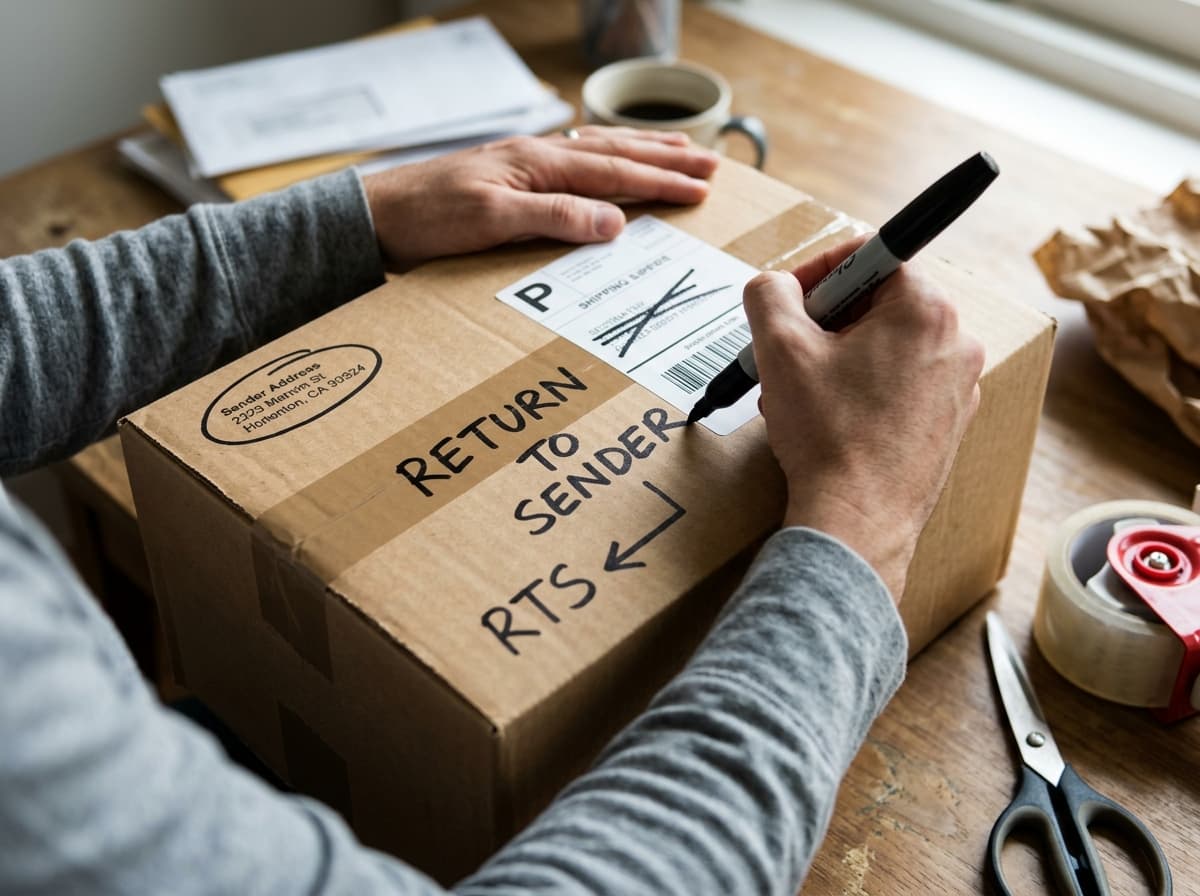
If the parcel is still with the driver, refuse it. Say you are refusing delivery, do not accept it, and it goes back at the sender's expense at no cost to you. Once you have taken it inside, returning it becomes your responsibility and your expense unless a retailer's returns policy says otherwise.
That timing distinction is the whole subject. Everything below is a variation on which side of it you are standing.
Refusing before you accept it
This is the cheapest and cleanest route, and it takes about ten seconds.
At the door. Tell the driver you are refusing the parcel and hand it back or decline to take it. They scan it as refused and it re-enters the network heading back to the sender. Do not sign anything.
At a depot or pickup point. If it is being held for collection, tell the counter staff you are refusing it, or simply do not collect it. Uncollected parcels return automatically after a holding period, usually 5 to 18 days depending on the carrier.
After a failed delivery attempt. Do not arrange redelivery. Once the attempts are exhausted and the holding period passes, the parcel returns on its own.
The condition is that the parcel must be unopened. Opening it counts as accepting it, and the carrier's position changes immediately. If you suspect you do not want what is inside, decide at the door.
Once you have accepted it
Now the parcel is yours, physically at least, and getting it back to the sender is a new shipment that somebody has to pay for.
There are three paths, and which applies depends entirely on who sent it.
A retailer with a returns policy. Use their process. Request a return in your account, print the label they issue, and drop the parcel off. This is the only path where the cost is likely to be covered, and it is the only one where the sender is expecting the parcel back and will process a refund.
A private sender — a friend, a marketplace seller, an individual. You are creating a new shipment. Buy a label, address it to them, and send it. There is no automatic mechanism; it is just a parcel going the other way.
A sender you cannot identify. More common than it sounds, and covered below.
The mistake people make is assuming there is a general "return to sender" service for parcels already delivered. There is not. Once delivery is complete, the carrier's contract is finished.
Writing "return to sender" on the box
This works in one narrow case and fails in every other.
It works for postal mail that is unopened, still sealed, and still carrying its original label. Cross out any barcode you have added, write "Return to Sender" clearly on the front, and put it in a post box or hand it in at a post office counter. The postal operator returns it as undeliverable mail.
It does not work for courier parcels. UPS, FedEx, DHL and similar networks route by scanned barcode, not by handwriting. A parcel with writing on it and a completed delivery scan will either be ignored or re-delivered to you.
It does not work on an opened box. The original packaging must be intact and unopened for the postal route to apply.
And it does not work if you have removed or damaged the original label, because the return address is on it.
Why parcels get returned automatically
Many returns happen without anyone asking. The common reasons, and who ends up paying:
| Reason | Who pays | Typical timeline |
|---|---|---|
| Recipient refused at the door | Sender | 5–10 days domestic |
| Address incomplete or wrong | Sender, plus a correction fee | 5–10 days after attempts |
| Nobody available after all attempts | Sender | After 5–18 days holding |
| Not collected from a depot | Sender | After the holding period |
| Duty or tax unpaid on an import | Sender, plus storage charges | 3–8 weeks |
| Prohibited item detected | Nobody — usually destroyed | n/a |
| Recipient moved with no forwarding | Sender | 5–10 days |
Two of these are worth noting. Unpaid duty is a slow and expensive return, because the parcel sits in a customs facility accruing storage before it starts moving. And a prohibited item may not come back at all, which is the outcome our guides on shipping liquids and perfumes and avoiding customs delays are written to prevent.
Refusing an import with duty owed
If a parcel arrives with an import charge you did not expect, you can refuse it rather than pay.
Do not pay the demand. Contact the carrier and tell them you are refusing the shipment. The parcel is held, then returned to the sender or, in some cases, abandoned to customs and destroyed.
Two warnings. Refusal does not always produce a refund from the seller — that depends on their policy and on the platform's buyer protection, not on the carrier. And storage charges may accrue while the parcel waits for a decision, so refuse quickly rather than leaving it.
If the goods are worth having, paying and then claiming the charge back from the seller is often the better outcome. Our guides on customs duties and import tax for online shoppers explain what you are actually liable for.
Parcels you did not order
An unexpected parcel with no order behind it falls into one of three categories.
A mistake. Wrong address, wrong customer, a genuine error. Contact the sender if you can identify them. Most will arrange collection.
An unsolicited good. In many jurisdictions, goods sent to you without any order are yours to keep, and you are not obliged to pay for them or to return them at your own expense. Check the rules where you live before acting on this.
A brushing scam. A seller ships cheap goods to a real address to generate a verified review under that name. The parcel is genuine, the goods are worthless, and the concerning part is that somebody has your name and address. Keep or discard the item, and check your accounts on the marketplace involved.
In none of these cases should you pay to return something you did not order.
Tracking a return
A returned parcel usually keeps its original tracking number, which means you can watch it go back.
What you will see is a reversal: the status changes to something like refused, returned to sender or undeliverable, and then the location events run in the opposite direction. Some carriers issue a new number for the return leg instead, in which case the original number simply stops after the return event.
Returns move at low priority. Expect 5 to 10 working days domestically and 3 to 8 weeks internationally, and expect long gaps between scans. A return that goes quiet for a week is behaving normally, which is not true of an outbound parcel — our guide on tracking that is not updating covers the difference.
You can follow either number on our home page, and if you are not sure which carrier is holding it, our guide on identifying a carrier from a tracking number will tell you from the format.
Returning to a retailer, step by step
Retail returns follow a pattern, and doing them in order avoids the two things that go wrong.
Start in your account, not with the carrier. Request the return through the retailer's returns portal so the return is registered against your order. A parcel that arrives at a warehouse without a return authorisation frequently sits unmatched for weeks, and no refund is issued while it does.
Use the label they give you. It routes to the correct returns facility, which is usually not the address the parcel came from. Buying your own label and sending it to the sender address on the original box is a common way to lose a return entirely.
Repack properly. The item is your responsibility until it arrives, and a return damaged in transit is normally refused or refunded at a reduction. Use the original packaging if you kept it, and follow the same rules as any outbound parcel — our guide on packing fragile items applies equally in reverse.
Keep the proof of postage. This is the one that matters. A return with no drop-off receipt and no tracking is unprovable, and the dispute that follows is one you will lose. Photograph the receipt.
Watch the tracking to the warehouse, then allow processing time on top — commonly 3 to 10 working days after arrival before a refund is issued.
Opened, used or damaged items
Condition changes what is possible.
An opened but unused item is normally returnable to a retailer within their window, though some categories are excluded once the seal is broken.
A used item generally is not returnable unless it is faulty. Consumer protection rules in many places cover faulty goods well beyond the standard returns window, and those rights sit alongside the retailer's policy rather than being limited by it.
An item damaged in transit is a different process again. That is a carrier claim rather than a return, it is filed by the sender, and the deadlines are short. Our guide on lost or damaged package claims covers it. Do not send a transit-damaged item back before photographing it and the packaging, because those photographs are the claim.
If you are the sender
A returned parcel costs you twice: the outbound rate you already paid, and a return charge that is usually close to it. Storage and address correction fees stack on top.
Three habits remove most returns.
Validate addresses at the point of sale. Incomplete addresses are the largest single cause, and address validation catches nearly all of them before the label is printed.
Send the tracking number immediately so the recipient knows a parcel is coming and can be there for it. A large share of failed deliveries are simply people who did not know.
Be explicit about import charges on international orders. A recipient who is surprised by a duty demand refuses the parcel far more often than one who was told at checkout. Our guide on hidden shipping fees covers what those charges include.
When a parcel does come back, inspect it before restocking. It has now made two journeys and been handled twice as much.
When the sender will not take it back
Occasionally a return fails too — the sender has moved, refused it in turn, or the address on the label was never valid.
The parcel then becomes undeliverable in both directions. Carriers hold undeliverable items for a period, typically 30 to 90 days, then dispose of them. Postal operators generally run a dead mail process that opens the parcel to look for identifying information before disposal.
If a parcel you sent is stuck in this state, contact the carrier before the holding period expires. Once it is disposed of, there is no recovery and generally no claim, because nothing was lost or damaged — it simply had nowhere to go.
The decision, in short
If the driver is still holding it and you do not want it, refuse it. That costs nothing and needs no paperwork.
If you have accepted it and it came from a retailer, use their returns process. If it came from a person, buy a label and send it back as a new parcel.
If it is unopened postal mail with the original label intact, write "Return to Sender" and hand it in.
And if a charge is attached that you did not expect, refuse it promptly rather than letting it sit accruing storage. Our guide on what to do when a package is delayed covers the related case where the parcel is stuck rather than unwanted.
Whichever route applies, keep the tracking number and any drop-off receipt until the matter closes. A return with no proof is the one situation where you have no position at all.