USPS vs UPS — Which Should You Actually Use?
Updated 2026-08-029 min readCourier comparisons
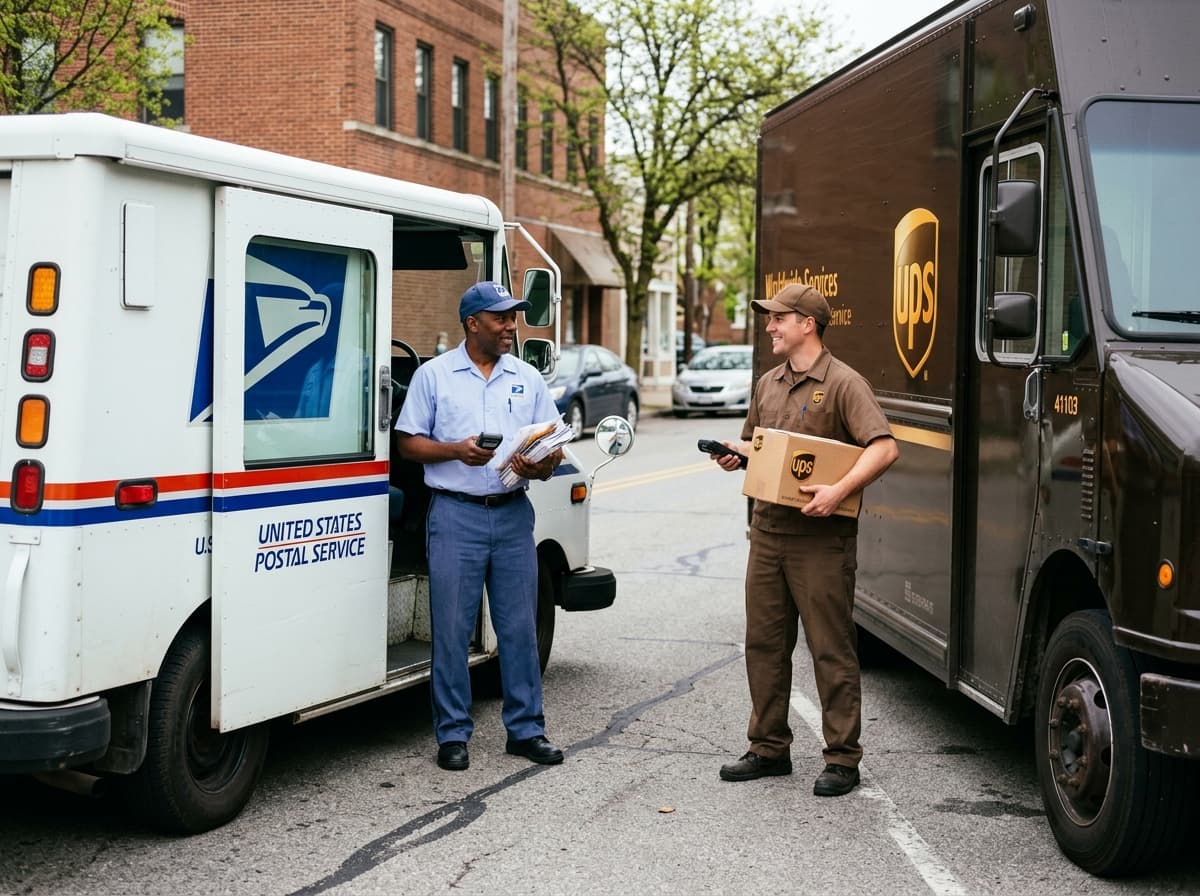
Pick the wrong one and a five-pound parcel costs twice what it should. The two carriers are built for genuinely different jobs, and the dividing line is mostly about weight.
USPS is a universal postal service required to deliver to every address in the country, funded partly by the fact that it moves enormous volumes of small, light items. UPS is a private logistics company that grew up moving business freight and prices accordingly.
That difference in origin explains almost every practical difference between them.
The short answer
Choose USPS for parcels under about five pounds, for anything going to a PO box or a rural address, and when the price matters more than a guaranteed date.
Choose UPS for anything heavy, anything valuable, anything where a missed date costs you money, and anything you need visible at every step.
Most people ship the wrong one because they default to whatever the shop's checkout offers rather than picking deliberately.
Cost: where the crossover sits
USPS prices low weights aggressively and UPS doesn't try to compete there. Below roughly two pounds, USPS is usually meaningfully cheaper for the same journey.
The gap narrows through the middle weights, and somewhere around five to ten pounds — depending on distance and dimensions — UPS starts winning. Above twenty pounds it isn't close.
Two pricing mechanics matter more than the headline rate.
Dimensional weight. Both carriers charge on size as well as actual weight, so a big light box is priced as though it were heavy. UPS applies dimensional pricing more aggressively across its network. If you're shipping something bulky and light — pillows, packaging materials, empty containers — get a real quote from both rather than assuming.
Flat rate. USPS sells fixed-price boxes where the weight is irrelevant up to a limit. For dense heavy items that fit, this is often the cheapest shipping in the country by a wide margin. The rule of thumb: if it is heavy for its size and fits the box, flat rate wins.
UPS has no equivalent for small parcels, though it does offer flat-rate style products for some lanes.
Speed and the guarantee question
This is where the two genuinely differ, and it's not really about how fast the parcel moves.
UPS sells guaranteed services. Next Day Air, 2nd Day Air and Ground to many destinations come with a committed delivery date, and if UPS misses it for a reason within their control, the shipper can claim the shipping cost back.
USPS sells estimates. Priority Mail typically arrives in one to three days and often matches UPS Ground for speed, but nothing is promised. Priority Mail Express is the exception — it carries a genuine guarantee with a refund attached.
In day-to-day practice the transit times are closer than the pricing suggests. The difference shows up when something goes wrong. A missed UPS guaranteed date is a refundable service failure. A missed USPS estimate is just a slow week.
Practical rule: if a late delivery costs you money — a court filing, a wedding gift, a customer who'll cancel — buy the guarantee. If it just costs you patience, don't pay for it.
Tracking depth
Both track everything now, but they don't track it equally.
UPS scans more often. A UPS Ground parcel typically produces eight to twelve events across its journey, including departure and arrival at each hub. You can usually see the parcel physically moving across the country.
USPS produces fewer events on standard services — often four to six — with longer gaps between them. Priority Mail scans more than First Class. The parcel is moving at the same rate; you're simply told about it less often.
Neither pattern is a fault, but it changes what a silence means. Three days without a UPS scan is unusual. Three days without a USPS scan on a cross-country parcel is ordinary. Our guide on tracking that stops updating covers how to read the gaps.
UPS also gives recipients more control mid-journey through its delivery preference tools — redirect to a pickup point, reschedule, authorise a leave-safe. USPS offers similar features but with fewer options and less consistency across services.
Delivery days and reach
USPS delivers six days a week as standard and reaches every address in the country, including PO boxes, military addresses and remote rural routes, at no surcharge. That universal obligation is its structural advantage.
UPS delivers Monday to Saturday for most residential addresses, with Sunday available in selected areas at extra cost. It cannot deliver to a PO box at all — a fact that catches out a surprising number of senders — and it applies a delivery area surcharge to remote addresses that can add several dollars.
If your recipient is rural, or uses a PO box, the decision is made for you.
Claims, insurance and deadlines
Both carriers include a modest amount of cover and sell more, but the deadlines differ and both are shorter than people assume.
USPS includes limited insurance on Priority Mail and Priority Mail Express. Claims for a domestic parcel generally have to be filed within 60 days of mailing, and the sender files them.
UPS includes a base declared value on most services with additional cover available. Claims are typically filed within 60 days of the scheduled delivery date, again by the shipper.
Two things are true of both and worth stating plainly. The sender files the claim, not the recipient, because the shipping contract belongs to the sender. And the deadline is real — a well-founded claim filed late is refused regardless of merit.
Screenshot the tracking page before it disappears. Both carriers purge tracking events well within a year, often within a few months of the last scan.
Our guide on lost or damaged package claims covers the process for both.
The hybrid services that confuse everyone
Both carriers sell products where the parcel changes hands partway, and the tracking behaviour surprises people.
UPS SurePost and UPS Mail Innovations move the parcel through the UPS network and hand it to USPS for the final delivery. It's cheaper than UPS Ground and roughly a day slower. Your parcel gets a UPS tracking number, then appears to stall on a scan like "handed to post office," then completes with a USPS delivery scan.
USPS Parcel Select works in the other direction, with commercial shippers injecting parcels deep into the USPS network.
Neither is a fault. If your UPS parcel has gone quiet at "delivered to agent" or similar, it's almost certainly on a USPS truck now, and the SurePost number usually works on the USPS side too.
Service by service
The carrier names get confusing because each sells half a dozen products. Here's roughly what maps to what.
| Need | USPS product | UPS product |
|---|---|---|
| Cheapest, small and light | Ground Advantage / First Class | SurePost |
| Standard parcel, few days | Priority Mail | UPS Ground |
| Guaranteed two days | Priority Mail Express | 2nd Day Air |
| Guaranteed next morning | Priority Mail Express | Next Day Air Early |
| Heavy or oversized | Retail Ground (limited) | UPS Ground / Freight |
| Fixed price by box | Flat Rate | no direct equivalent |
The rows aren't exact equivalents — USPS Priority and UPS Ground often deliver in similar times, but only one of them promises it.
For most everyday shipping the real choice is just three products: USPS Ground Advantage for light and cheap, USPS Priority for a quick parcel at a fair price, and UPS Ground for anything heavy.
Going international
Both carriers ship abroad, and the difference is sharper than it is domestically.
USPS hands your parcel to the destination country's postal service. A parcel to Britain becomes a Royal Mail item on arrival; one to Australia becomes Australia Post. That's cheap and reaches everywhere, but tracking depth depends entirely on the receiving operator, and it varies a great deal.
UPS carries the parcel on its own network end to end in most major markets. Tracking stays consistent, transit is faster and more predictable, and customs clearance is handled in-house. It costs considerably more.
That handover is also why a USPS international parcel appears to go quiet after "departed the United States." It hasn't stopped — it's been handed over, and the receiving carrier may be scanning it under a different number. Our guide on identifying a carrier from a tracking number explains how to spot the format change.
For international shipping, the rule of thumb is simple: USPS if the price matters and the recipient can wait, UPS if the delivery date matters or the contents are valuable.
Which to pick, by situation
Small light item, cost matters most. USPS First Class or Ground Advantage.
Dense heavy item that fits a box. USPS Flat Rate, and it isn't close.
Anything over ten pounds. UPS.
Must arrive by a specific date. UPS guaranteed service, or USPS Priority Mail Express.
Going to a PO box or a remote rural address. USPS, by necessity.
High value, needs real insurance and a visible trail. UPS.
Business shipping regular volume. UPS negotiated rates start to bite at volume in a way USPS pricing doesn't. Our guide on how to choose a courier covers the account-level decision.
What people get wrong
The most common mistake is paying for speed nobody needs. A guaranteed next-day service costs several times a standard one, and most parcels aren't time-critical. The guarantee is insurance, and insurance is only worth buying against a loss you'd actually feel.
The second is ignoring dimensional weight. People weigh the parcel, get a quote, and are then surprised by the invoice because the box was large. Measure the box as well as the contents — dimensional weight is length times width times height divided by the carrier's divisor, and it is charged whenever it exceeds actual weight.
The third is assuming the tracking page tells you how the parcel is doing. It tells you what's been scanned. USPS scanning less often than UPS does not mean a USPS parcel is moving more slowly.
Business accounts change the maths
Everything above describes counter and retail pricing. Volume shipping works differently enough to be worth a mention.
Both carriers discount heavily for committed volume, but they discount differently. UPS negotiates account-level rates that can move a long way from the published price, and the discount scales with how much you ship and how predictable it is. Businesses shipping consistent daily volume often find UPS lands well below what the retail comparison suggests.
USPS offers commercial pricing through approved platforms rather than individual negotiation. The discounts are smaller in percentage terms but available immediately, without a sales conversation or a volume commitment.
That produces a rough split. Occasional and small-volume sellers usually do better on USPS commercial rates through a shipping platform. Businesses shipping heavier items in steady volume usually do better negotiating with UPS.
Our guide on how to choose a courier walks through the decision.
So which one wins?
Neither, and that is the honest answer rather than a dodge.
They are built for different jobs. USPS exists to reach every address in the country at a price ordinary people can pay, and it is exceptionally good at moving small light things cheaply. UPS exists to move commercial freight reliably against a clock, and it is exceptionally good at that.
Asking which is better is like asking whether a van beats a bicycle. The answer is entirely about what you are carrying and how far.
Where people go wrong is defaulting. They use whichever carrier the checkout preselected, or whichever they used last time, and end up paying courier rates for a paperback or waiting on postal timescales for something that needed to arrive Tuesday.
Two minutes deciding deliberately — weight first, deadline second, destination third — is worth more than any amount of comparing headline rates.
Checking either one
Both carriers' numbers work in the tracker on our home page — paste it and leave the carrier field empty, since a 1Z prefix or a 20-digit USPS number identifies itself. The USPS carrier page and UPS carrier page list each one's number formats and realistic transit windows.
Pick on weight first, guarantee second, and reach third. Get those three right and the rest of the comparison rarely matters.