Flat Rate vs Weight-Based Shipping — Which Saves More?
Updated 2026-08-0310 min readShipping costs
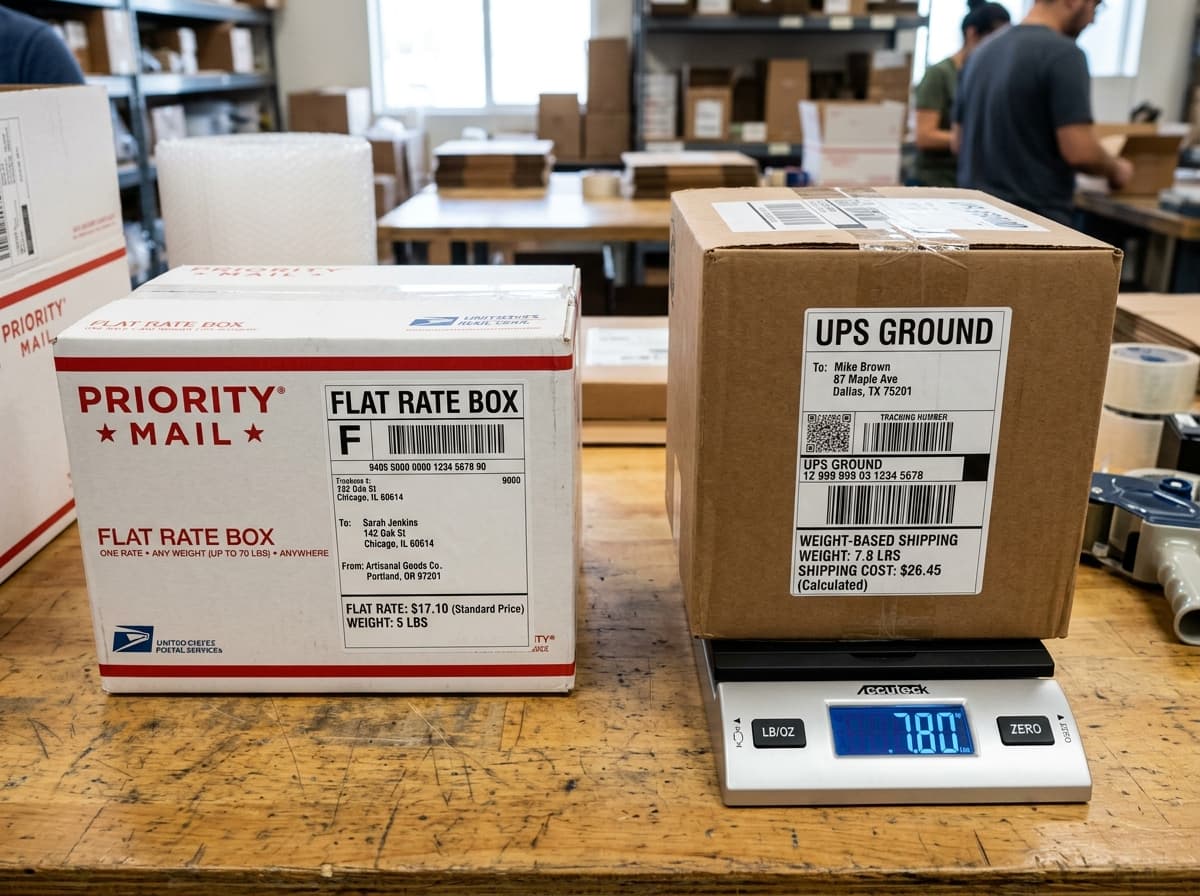
Flat rate wins when the item is dense and heavy for its size, and loses when it is light and bulky. The crossover sits at roughly the point where the item's weight matches what the same box would cost under weight-based pricing — typically somewhere between 3 and 7 pounds, depending on the destination.
That single sentence answers most cases. What follows is how to work out the crossover for your own parcels, rather than guessing at the counter.
How the two models actually price
Weight-based pricing multiplies three variables: how heavy the parcel is, how far it travels, and how fast it needs to arrive. Every carrier publishes a rate grid with weight bands down one axis and delivery zones across the other. Your parcel lands in one cell.
Crucially, weight here means billable weight — the higher of the scale weight and the dimensional weight calculated from the box size. A large light box is priced as though it were heavy, which our guide on calculating package dimensions works through in detail.
Flat rate pricing removes two of the three variables. You buy a specific box, fill it with anything up to a stated weight limit, and pay one price regardless of contents or, domestically, distance. Size is fixed because the box is fixed.
The two models are not competing versions of the same thing. Flat rate is a bet the carrier makes that most people will underfill the box. When you fill it properly with something heavy, you win the bet.
The one calculation that decides it
Forget rate cards for a moment. The question is only ever: does this item weigh more than the flat rate box's break-even weight?
Find the break-even in three steps.
One. Note the flat rate price for the box you would use.
Two. Look up the weight-based rate grid for your destination zone, and find the weight band where the price matches that flat rate figure.
Three. That weight is your break-even. Anything heavier ships cheaper on flat rate. Anything lighter ships cheaper on weight-based.
The break-even shifts with distance. Because flat rate ignores zones domestically while weight-based does not, the same parcel can be a poor flat-rate choice going 100 miles and an excellent one going 2,500 miles. If you ship to one region constantly, calculate the break-even once for that region and reuse it.
Density is the shortcut
Rather than checking rate cards for every parcel, use density as a proxy. Density is weight divided by volume, and it predicts the answer reliably.
| Item type | Rough density | Usually cheaper on |
|---|---|---|
| Books, printed material | High | Flat rate |
| Tools, hardware, fasteners | Very high | Flat rate |
| Tinned or bottled goods | High | Flat rate |
| Ceramics, glassware | Medium-high | Flat rate if it fits |
| Electronics in retail boxes | Medium | Calculate both |
| Shoes | Medium-low | Weight-based |
| Clothing, textiles | Low | Weight-based |
| Cushions, bedding, soft toys | Very low | Weight-based, in a mailer |
The rule that follows: if you can lift the full box comfortably with one hand, flat rate is probably the wrong choice. If it is heavy enough that you notice, it is probably the right one.
Where flat rate genuinely wins
Four situations, and they are worth recognising on sight.
Dense items travelling a long way. This is the classic case. A box of hardware crossing a continent under weight-based pricing hits both the heavy weight band and the distant zone. Flat rate cancels both at once.
Predictable budgeting. A business shipping a consistent product benefits from one number it can quote to customers without a rate lookup. The operational simplicity is worth real money even when the per-parcel cost is slightly higher.
Free carrier packaging. Flat rate boxes are supplied at no cost. For a small seller shipping a few hundred parcels a year, that removes a genuine line item and the storage that comes with it.
Awkward weight bands. Weight-based grids step up in bands, so a parcel that lands one ounce into the next band pays the full band. Flat rate has no bands to fall foul of.
Where flat rate loses badly
Light items. A 1-pound parcel in a flat rate box costs the same as a 20-pound one. You are subsidising every heavy shipper who uses the service.
Short distances. Weight-based pricing to a neighbouring zone is often a fraction of the flat rate. The whole advantage of ignoring distance disappears when the distance is small.
Bulky items. They do not fit, and forcing them means the flaps do not close. Carriers re-rate any flat rate box that cannot be sealed normally, and you pay weight-based pricing after having packed for flat rate.
Volume shippers with negotiated rates. A business account discount applies to the published weight-based grid and often does not apply to flat rate at all. Past a certain volume, the negotiated rate beats flat rate on almost everything.
Two worked scenarios
Scenario one — 8 pounds of books, coast to coast. Under weight-based pricing this is a heavy band in a distant zone, which is close to the worst combination the grid produces. Flat rate charges one price and ignores both. Flat rate wins comfortably, and it is not close.
Scenario two — 1 pound of T-shirts, two zones away. Under weight-based pricing this is the cheapest band in a near zone. In a poly mailer it is charged on actual weight, not volume. Flat rate would cost several times as much. Weight-based wins.
The difference between the two scenarios is entirely density and distance. Nothing about the carrier changed.
The middle ground: regional and zoned flat rate
Between the two models sits a third option that solves flat rate's biggest weakness.
Regional flat rate applies a fixed price within a limited set of nearby zones rather than nationally. Because the carrier is not underwriting a coast-to-coast journey, the price is considerably lower than national flat rate while still ignoring weight.
For a seller whose customers cluster geographically, this is frequently the cheapest option available and it is routinely overlooked. The catch is that it only works if the destination falls inside the qualifying zones, so it needs to be applied per order rather than as a blanket policy.
Cubic pricing is a related idea working from the other direction. Instead of charging on weight, it charges on volume alone, in fixed bands, provided the parcel stays under a weight ceiling. Dense small items do extremely well on it. It is usually only available through commercial accounts and shipping platforms rather than at a counter.
If your parcels are consistently small and dense, ask about cubic pricing specifically. It is not advertised prominently and it is often the best rate on the sheet.
Using flat rate for returns
Returns are where flat rate earns its keep for a reason unrelated to price.
A return label has to be created before you know what condition the item comes back in or how it will be repacked. Weight-based pricing on a return is therefore a guess, and customers repack badly — a shoe box goes back inside a much larger carton, and the reweigh adjustment lands on your account weeks later.
A flat rate return removes that uncertainty entirely. You know the cost before the customer has even printed the label, and the customer cannot inflate it by choosing a bigger box, because the box is fixed.
For a store with a predictable return rate, that certainty is usually worth more than the few percent you might save quoting each return individually.
The mistakes that cost most
Defaulting to one model. Sellers pick flat rate on day one for simplicity and never revisit it. The catalogue then broadens into lighter products and every one of them ships at a loss relative to weight-based.
Ignoring the box weight limit. Flat rate boxes have a maximum, and exceeding it does not produce a small penalty — it produces a full re-rate at weight-based pricing on a heavy parcel, which is close to the worst outcome available.
Forcing the fit. A box whose flaps will not close is re-rated at the counter. If you have to lean on it, it is not a flat rate shipment.
Comparing against the wrong rate. People compare flat rate against retail weight-based pricing while holding a commercial discount that applies to the latter. Compare against the rate you actually pay.
Forgetting dimensional weight on the alternative. Weight-based does not mean scale weight. If the alternative box would be charged on volume, flat rate looks much better than a naive comparison suggests.
The hybrid most businesses end up with
Sellers rarely pick one model permanently. What works is a rule applied per order.
Set a weight threshold from your break-even calculation. Below it, ship weight-based in your own packaging. Above it, ship flat rate in the carrier's box. Most order management and shipping platforms will apply that rule automatically once you set it.
Then review the threshold quarterly, because rate cards change annually and always upward. A threshold that was right last year is usually slightly wrong this year.
For a store front-end, this is separate from what you charge the customer. You can bill customers a single flat fee while shipping on whichever model is cheapest per order, and the gap between the two is margin. Our guide on offering free shipping without losing profit covers how to set that customer-facing number.
What neither model protects you from
Both are quoted prices, and both are subject to the same surcharges added afterwards.
Residential delivery, remote area delivery, fuel, address correction and signature charges apply on top of flat rate exactly as they do on weight-based. Flat rate fixes the base rate, not the invoice.
The one thing flat rate genuinely does remove is the reweigh adjustment, because there is nothing to reweigh. That is worth something if your parcels vary in size and you have been billed back for under-declared dimensions before.
Our guide on hidden shipping fees lists the surcharges that survive both models.
What the customer sees is a separate decision
The pricing model you buy on and the price you show at checkout do not have to match, and for most sellers they should not.
Customers respond badly to variable shipping costs. A rate that changes by a few pounds between two similar orders reads as arbitrary, even when it precisely reflects the carrier's price. A single figure, or free above a threshold, converts better.
So the common structure is to charge customers one predictable amount while shipping each order on whichever model is cheapest that day. The difference across the whole order book nets out, and it nets out in your favour if the customer-facing figure was set from your average landed cost rather than your cheapest.
That only works if you know the average. Calculate it from actual invoices over 90 days, including surcharges, rather than from the rate card.
International changes the answer
Domestically, flat rate ignores distance. Internationally, it usually does not.
Most international flat rate products are still priced by destination group, so you get a fixed price per zone rather than one price everywhere. The weight advantage remains; the distance advantage largely does not.
International shipping also adds customs charges that are entirely outside the shipping model. Duty and tax are assessed on the goods, not the service, and are billed to whoever the incoterm names — usually the recipient. Our guides on customs duties and the import tax rules for online shoppers cover how those are calculated.
If you ship internationally in volume, compare a flat rate international product against a negotiated weight-based rate on the same lane. The gap is frequently large in both directions depending on the destination.
Choosing, in one pass
Weigh the item. Measure the box. If the item is heavy for its box and the journey is long, use flat rate. If it is light, or the journey is short, or it will not fit properly, use weight-based.
Then check the break-even once for your most common destination, write the number down, and stop recalculating it per parcel.
Both models are available from USPS, UPS, FedEx and DHL, though the flat rate products differ in name and generosity. Our comparison of USPS and UPS covers where each one's flat rate offering sits, and how to choose a courier works through the account-level decision.
Once the label is bought, the tracking number works on our home page whichever pricing model you chose.