Why Your Parcel Changed Carrier Mid-Journey
Updated 2026-08-039 min readTracking and delivery
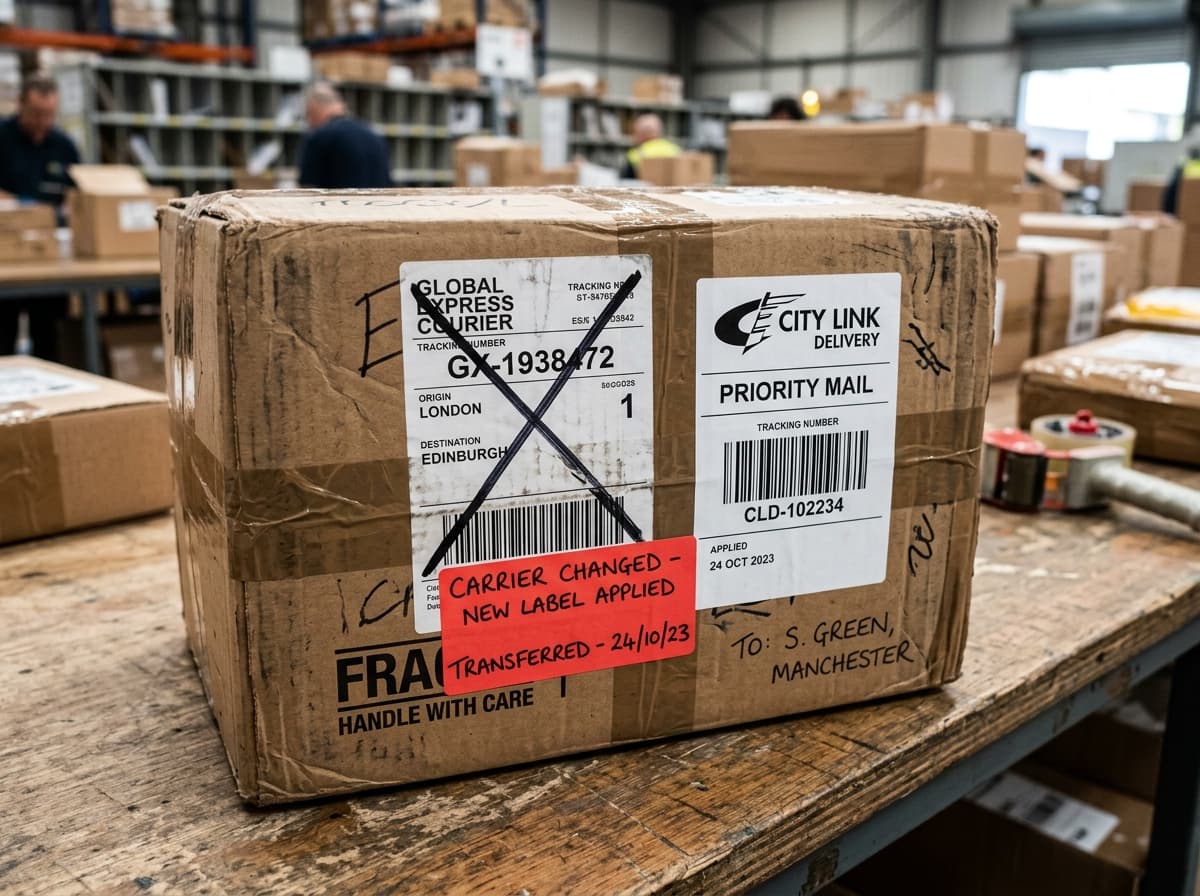
Your parcel left China with Cainiao and arrived with the local post office. Or it started with UPS and finished with USPS. From the outside that looks like something went wrong. It's actually the service working exactly as sold.
Handovers are how international and economy shipping is built. Understanding the mechanics tells you when a frozen tracking number is normal and when it's a genuine problem.
Why carriers hand parcels over
No carrier has its own vans on every street in the world. Building that network is enormously expensive, so most operators do what they're good at and buy the rest.
A consolidator like Cainiao or 4PX is excellent at collecting thousands of small parcels in China and flying them somewhere cheaply. It has no delivery drivers in Manchester. So it hands the parcel to an operator that does.
The same logic applies domestically. A parcel travelling five hundred miles is cheap to move in bulk on a lorry and expensive to deliver to one address at the end. Hybrid services split the journey between whoever is cheapest at each leg.
Quick fact: the final mile accounts for a large share of the total cost of delivering a parcel, despite being a tiny share of the distance. That imbalance is the whole reason handovers exist.
The four kinds of handover
International to national post
The commonest by far. A consolidator flies the parcel to the destination country and hands it to that country's postal operator.
An AliExpress order might travel with Cainiao to Britain and finish with Royal Mail. The same order to the United States finishes with USPS; to Australia, with Australia Post; to Canada, with Canada Post.
The consolidator's number usually freezes on a scan like "Arrived at destination country" or "Handed over to local carrier."
Courier to post office
UPS SurePost and Mail Innovations, and FedEx SmartPost, all move the parcel through the courier's network and hand it to USPS for the doorstep.
These are cheaper than the courier's standard ground product and roughly a day slower. Your tracking shows courier scans, then a handover, then a postal delivery scan.
Post to courier
Less common but real. Some postal operators contract out delivery in areas where they lack density, particularly for bulky items that don't suit a postal round.
Courier to a local last-mile operator
In several markets, large carriers subcontract final delivery to regional firms. In Britain, parcels routinely finish with operators like Evri or Yodel regardless of who the retailer originally booked.
This is the one that surprises people most, because the carrier that turns up bears no relation to the one the shop named at checkout.
Why your tracking number stops
Every carrier's scanners read their own numbering. When a parcel enters a new network, that network assigns its own number, because its systems can't process someone else's format.
Your original number isn't broken. It has simply reached the end of what it covers. The first carrier's job finished at the handover, and their record ends there.
That's why the last scan often reads like an ending rather than a problem: "Departed origin country," "Handed to local carrier," "Transferred to destination agent," "Delivered to post office."
None of those mean the parcel stopped moving. They mean the reporting stopped.
Our guide on tracking that stops updating covers the other reasons a trail goes quiet, several of which look similar but need different responses.
Finding the second number
Four places, in order of how often they work.
The shop's order page. Marketplaces frequently add the onward number automatically once the destination carrier scans the parcel. Check the account page rather than your email — the email was a snapshot, the account page is current.
The original number, tried again. Many destination operators keep the sender's reference in their own system. Paste the original into the tracker on our home page with the carrier field empty; the lookup often finds the onward journey under a different carrier name.
A delivery card. If the second carrier has already attempted delivery, the card carries their reference and names them.
Ask the sender. They can see both legs in their shipping account. Ask specifically for "the destination carrier's tracking number," not just "the tracking number," or you'll get the one you already have.
Telling a handover from a real problem
The wording of the last scan does most of the work.
Handover language names a transfer: departed, handed over, transferred, delivered to agent, arrived at destination country. After any of these, expect the original number to be finished.
Problem language names a location or an exception: arrived at hub with nothing following, delivery attempted, address issue, held at depot. Those need action rather than a second number.
Timing helps too. A handover freeze happens at a predictable point — the border, or the transition from long-haul to local. A parcel that goes silent in the middle of a domestic network hasn't been handed anywhere.
How much delay a handover adds
Usually one to two days, and it's a queue rather than a journey.
The parcel arrives at the second carrier's facility and waits to be inducted — scanned into their system, sorted into their network, assigned to a round. Induction happens in batches, so a parcel arriving after the cut-off waits for the next one.
International handovers add more, because customs sits in the same gap. A parcel can be handed over, queue for customs, clear, then queue for induction, producing a week of silence with three separate causes stacked on top of each other.
Wait window: 3 days domestically after a handover scan, 10 to 14 internationally. Past that, treat it as a stalled parcel rather than a handover — our guide on what to do if a package is delayed covers the next move.
Who to contact when a handover goes wrong
This gets awkward, and it's worth knowing before you spend an afternoon on it.
The first carrier will tell you the parcel left their network and is no longer their responsibility. The second carrier will tell you they have no record of your original number, which is true — they never issued it.
Neither is being obstructive. The parcel genuinely sits in a gap between two systems, and only the sender can see both sides, because they hold the contract with the first carrier and the first carrier holds the arrangement with the second.
So the answer is the same as it usually is: go to the sender, give them the original number and the exact wording of the handover scan, and ask them to trace it with the original carrier.
Why two numbers is normal, not a red flag
People occasionally worry that a second tracking number means the parcel was reshipped, or that something went wrong and a replacement was sent.
It almost never does. A second number is a second carrier's record of the same physical parcel, created because their systems cannot use the first carrier's reference. The parcel did not change; only the paperwork did.
You can usually confirm it by the timing. A handover number appears within a day or two of the original number's last scan, and its first event is an induction or receipt scan rather than a collection from a shop. A genuine reshipment would start with a fresh collection scan days or weeks later, and the seller would normally have told you.
If the dates line up across the handover, you are looking at one parcel and two records.
Following a parcel across a handover
It is possible to watch the whole journey rather than losing sight of it halfway, if you know what to look for.
Note the handover scan when it happens. The wording and the date are the two things you will need later, and the original tracking record eventually expires — most carriers purge events 30 to 120 days after the last one.
Identify the likely second carrier from the destination. International parcels into the United States overwhelmingly finish with USPS. Into Britain, with Royal Mail or a last-mile operator. Into Australia, with Australia Post. Knowing which one to check narrows the search immediately.
Try the original number on the destination carrier. Success rates vary, but many operators index the sender's reference alongside their own, so a number that looks dead on the origin carrier sometimes resolves on the destination one.
Expect the clock to restart. The second carrier's transit estimate begins at induction, not at the point the parcel left the origin country. A parcel that has already been travelling three weeks may still show "2 to 3 days" when the local operator picks it up, and both figures are correct.
The delivery estimate resets too
One small consequence catches people out. The second carrier's estimated delivery date is calculated from its own induction scan, not from the day the parcel first shipped.
So a parcel three weeks into its journey can show a fresh "arriving in 2 to 3 days" the moment a local operator picks it up. Both figures are honest; they are measuring different things.
Domestic handovers you may not notice
Not every handover crosses a border, and the domestic ones are easier to miss because the tracking often looks continuous.
Injection into the postal network. Large retailers pre-sort their own parcels and hand them to the postal operator deep in its network, skipping the collection stage entirely. The parcel appears in postal tracking already halfway through its journey, with no origin scan at all.
Regional subcontracting. A national carrier may cover cities itself and subcontract rural rounds. Your parcel travels on the brand you expect and is delivered by a van with a different name on the side.
Overflow during peak. In the weeks before Christmas, carriers hand surplus volume to whoever has capacity. A parcel booked with one operator in November can be delivered by a competitor in December purely because the first ran out of drivers.
None of these change what you should do, but they explain a common confusion: the tracking says one carrier and the person at the door works for another. Both records are correct.
When a handover goes wrong
Handovers fail rarely, but the failures have a distinct signature worth recognising.
No second scan ever appears. The origin carrier says handed over, the destination carrier has no record, and weeks pass. This usually means the parcel was manifested but not physically transferred, or it was transferred and lost during induction.
The parcel is returned without explanation. Occasionally the second carrier rejects a consignment — bad address data, a restricted item, or a service the destination operator does not offer — and the parcel goes back with a scan that says little.
Two numbers both show activity. Rare, but it happens when a consolidator keeps updating from the destination carrier's feed. Trust the destination carrier's number; it is closer to the parcel.
In every case, the sender is the one who can act. They hold the contract with the origin carrier, and the origin carrier holds the relationship with the destination one. That chain is the only route back to the parcel.
Reading it in advance
You can often tell at checkout that a handover is coming, which sets expectations properly before anything goes quiet.
Service names hint at it. Anything called eCommerce, SurePost, SmartPost, Global Mail, Economy or Standard on an international lane almost certainly involves a handover. Anything called Express, Priority or Worldwide usually doesn't.
Price is the other tell. End-to-end express on one network costs considerably more than a hybrid product, and that gap is precisely what you're paying for — a single number, consistent scans, and one company owning the whole journey.
If a parcel absolutely must arrive by a date and you need to watch it the whole way, the extra cost buys visibility as much as speed. If it's a $9 phone case, the handover and its two quiet weeks are a perfectly sensible trade.
Every carrier in our courier directory lists its realistic transit windows, and the status guide on our home page tells you how long each state normally lasts. Check those once and a frozen tracking number stops being alarming — it becomes the thing you expected on day one.