DHL vs FedEx for International Shipping
Updated 2026-08-039 min readCourier comparisons
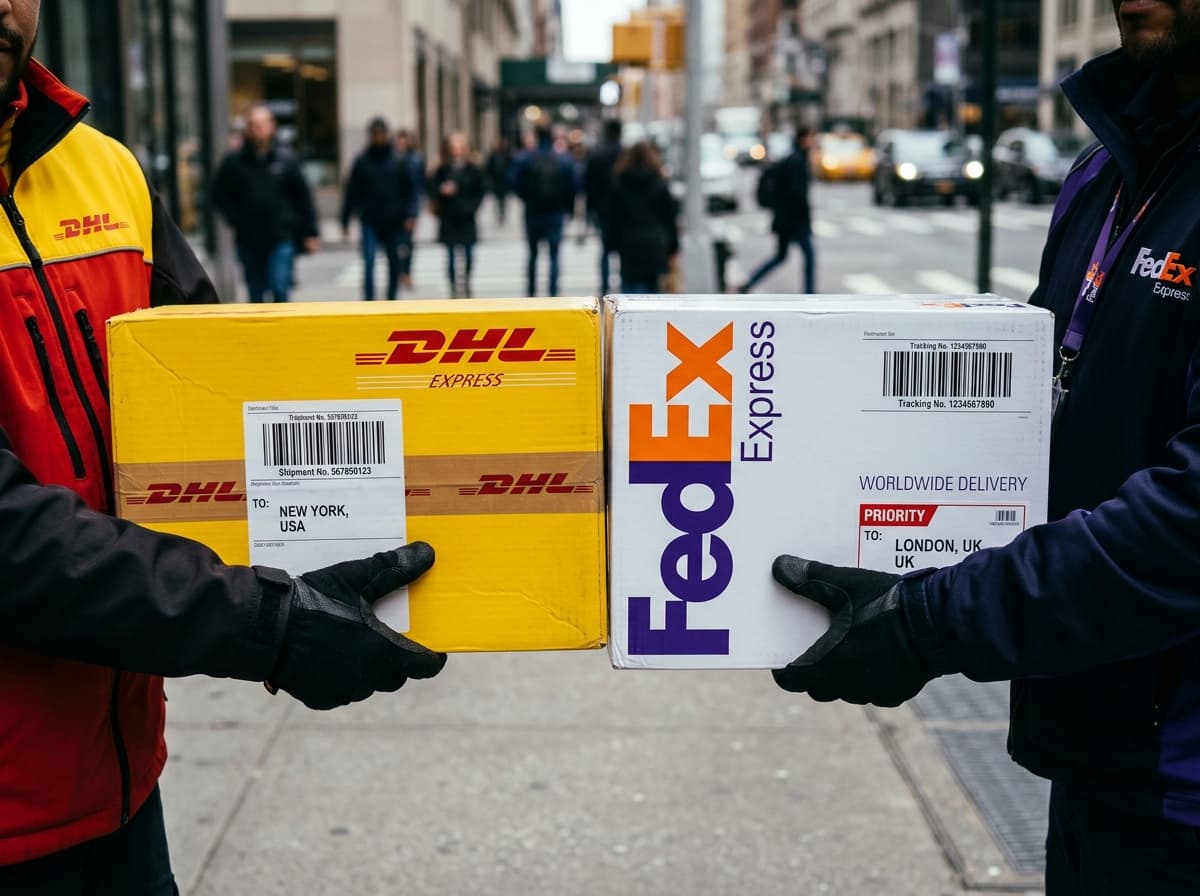
On paper these two look interchangeable. In practice the right answer usually depends on which continent your parcel is going to, because their networks were built in different places and still reflect it.
Pick on the lane rather than the brand and the decision becomes straightforward.
The geography that decides most cases
DHL is German, founded in 1969, and grew into a network built around Europe, then extended aggressively across Asia and the Middle East. That is where its density is, and density is what determines both speed and price.
FedEx is American, founded in 1971, and built around a domestic hub-and-spoke air network before expanding outward. Its strongest lanes remain within the Americas and across the Atlantic into the United States.
Both serve essentially every country. The question is not whether they reach a destination but how directly.
Rule of thumb: into Europe, the Middle East, and much of Asia, DHL usually has the shorter path. Into the United States, Canada and Latin America, FedEx usually does. On a direct lane between two major hubs, they are close.
Why the shorter path matters
A parcel travelling a carrier's own dense route makes fewer transfers, gets fewer handling events, and spends less time waiting for connections.
On a lane where a carrier is thin, the parcel may fly to a hub in the wrong direction, wait for a connection, then fly back across the region. The transit time absorbs it and the tracking looks strange — a parcel from Karachi to Berlin appearing in Dubai and then Leipzig is normal routing, not an error.
That is also where the price difference comes from. Density lowers cost per parcel, so each carrier is cheapest exactly where it is strongest.
Transit times, realistically
Both sell a genuine express product with a committed delivery date and a money-back guarantee.
DHL Express Worldwide typically delivers major city to major city in 1 to 3 working days, and reaches most commercial destinations in 2 to 4.
FedEx International Priority is comparable on the lanes it serves well, and International Economy trades a day or two for a lower price.
The published figures are similar. The lived difference is consistency: on a carrier's strong lane, the committed date is hit reliably. On a weak lane, both are more likely to slip.
Add customs to any of these. A parcel that clears automatically adds nothing; one that gets flagged adds three to five working days regardless of who carries it. Our guide on avoiding customs delays covers what causes the flag.
Customs handling: the real advantage over postal
This is where both carriers earn their price, and it is worth understanding.
Both employ their own customs brokers and clear shipments in-house. Declarations are prepared by people who file thousands a day, submitted electronically before the aircraft lands, and mostly cleared before the parcel physically arrives.
A postal shipment, by contrast, is handed to the destination country's postal operator, which processes it in bulk with far less individual attention. That is why the same parcel can clear in a day with a courier and sit for a fortnight with the post.
DHL has a slight edge in markets where it has operated brokerage for decades — much of Europe and several Asian markets. FedEx has the equivalent depth in North America.
Both will also handle DDP, paying duty on the sender's behalf so the recipient gets no bill. That option removes the most common cause of a long international hold, and our guide on import tax explains the charges it covers.
Cost
Neither is consistently cheaper, and the same two mechanics decide it as always.
Dimensional weight applies to both, with different divisors, so a bulky light parcel can flip the answer entirely.
Surcharges — fuel, remote area, residential, oversize — accumulate and vary by lane. A quote that ignores them is not a quote.
Broad tendencies, worth testing rather than trusting: DHL often prices documents and lighter parcels competitively on European and Asian lanes. FedEx frequently wins on heavier shipments into North America.
Quote both for your specific route and parcel. On international shipping the spread between the two on a given lane can be substantial in either direction.
The product names that catch people out
Both sell products under their brand that behave nothing like express, and this causes more confusion than any other aspect.
DHL Express is the end-to-end courier product. DHL carries the parcel the whole way, scans frequently, and delivers it itself.
DHL eCommerce and DHL Global Mail are different services entirely. DHL carries the parcel to the destination country and hands it to the national postal operator for final delivery. Cheaper, slower, fewer scans, and the tracking number often changes at the handover.
FedEx International Priority and Economy are both end-to-end. FedEx International Connect Plus and similar e-commerce products involve postal handover in several markets.
A customer expecting DHL Express behaviour from a DHL eCommerce parcel will think something has gone wrong when tracking freezes at the border. Nothing has — our guide on parcels changing carrier mid-journey explains what to look for.
Check the product name, not just the carrier name. It is the single most useful thing to know before you set expectations.
Tracking
Both express products scan densely — eight to fifteen events on a typical international shipment, including departure and arrival at each hub and the customs milestones.
DHL numbers on Express are a plain 10 digits. FedEx uses 12 or 15 digits. DHL eCommerce uses JD plus 18 digits, which is a useful tell that you are on the postal-handover product rather than Express.
Our reference on tracking number formats by carrier covers the full set.
Both give you a delivery window on the day and both allow the recipient some control over redirection, though the options vary by market.
Claims and cover
Broadly similar, and both smaller than people expect.
Each includes a base declared value with additional cover purchasable at booking. Each expects claims within roughly 60 days, filed by the shipper. Each rejects damage claims where the packaging was discarded.
On international shipments there is an extra trap: if the declared value was reduced to lower a customs bill, the insurance is capped at that reduced figure. A $900 item declared at $50 is worth $50. Our guide on lost or damaged package claims covers the mechanics.
What a week of transit actually looks like
Setting expectations properly is easier with a realistic sequence rather than a headline figure.
Day 0. Collected in the afternoon, scanned at a local depot the same evening.
Day 1. Origin hub, export customs cleared, loaded to a flight. Two or three scans clustered together.
Day 1 to 2. In the air. No scans — this is the first genuine silence and it is entirely normal.
Day 2. Arrived destination country. Import customs begins.
Day 2 to 4. Customs. Usually one scan on arrival, then quiet. Most express shipments clear inside a day because the broker filed in advance; flagged ones take three to five working days.
Day 3 to 5. Destination hub, out for delivery, delivered.
The two silences — the flight and the customs queue — account for nearly all of the waiting. Neither is a fault, and neither responds to being chased. Our guide on tracking that stops updating covers how to tell them apart from a genuine problem.
What each does better, concretely
Stripping out the marketing, the durable differences are fairly short.
DHL does better:
Reach into Europe, the Middle East, Africa and much of Asia, where its network density means fewer transfers and shorter transit. Customs brokerage in markets where it has decades of local operation. Smaller and lighter international shipments, where its pricing tends to be sharper. Document shipping, which is a long-standing strength.
FedEx does better:
Reach within the Americas and transatlantic into the United States. Heavier international shipments, where its freight heritage shows. Integration with US domestic services, so a parcel arriving from abroad continues on the same network rather than being handed over. Early-morning delivery commitments in markets where it offers them.
Neither has an advantage in:
On-time performance on a well-served lane, tracking depth on express products, claim handling, or the base level of included cover. Those are genuinely comparable.
Reading an international tracking page
International shipments produce more confusing scan trails than domestic ones, and knowing the pattern helps on both carriers.
You will typically see: collection, origin hub, export customs cleared, departed origin country, arrived destination country, import customs cleared, destination hub, out for delivery, delivered.
The two customs events are the ones worth watching. A parcel that shows "arrived destination country" but no import clearance is in the customs queue, and the silence between those two scans is normal — often three to five working days, longer at peak.
A parcel that clears customs and then goes quiet is in the domestic delivery network and behaving like an ordinary parcel. Different problem, different wait window. Our guide on tracking that stops updating covers both.
Which to choose
Shipping into Europe, the Middle East or most of Asia: start with DHL Express.
Shipping into the United States, Canada or Latin America: start with FedEx International Priority.
Between two major hubs on a busy lane: quote both; they will be close.
Price matters more than speed: compare each carrier's economy product, and check whether it involves a postal handover — that is where the saving comes from and it is also where the extra days come from.
Recipient must not receive a bill: ship DDP with either.
High value: either, with declared value cover to match. This matters more than the carrier choice.
Documents versus parcels
A distinction worth knowing, because the rules and pricing differ more than people expect.
Documents — contracts, certificates, passports, printed materials with no commercial value — are handled as a separate category by both carriers. They ship cheaper, clear customs faster because there is nothing to value, and often move on a dedicated product.
DHL has a long-standing strength here; document shipping is close to where the company started. FedEx competes but the pricing gap on light documents is frequently in DHL's favour.
The catch: anything with commercial value is a parcel, not a document, even if it is made of paper. Printed marketing material, books for resale and product catalogues are all goods. Declaring goods as documents to save on shipping and customs is a misdeclaration, and it is one customs officers spot easily.
If you are shipping paperwork with no resale value, use the document service and save the money. If it is stock, declare it properly.
When neither is the right answer
Worth saying plainly: for a low-value item where nobody is waiting, a postal service is often the sensible choice.
A courier costs several times a postal small packet. That premium buys speed, dense tracking and in-house customs clearance. For a $15 item going to a patient recipient, none of those are worth paying for.
The courier decision makes sense when the contents are valuable, the deadline is real, or the customs situation is complicated enough that professional brokerage saves more than it costs.
Both carriers have a page in our courier directory with their number formats and realistic transit windows — DHL and FedEx. Check the one you booked, and check which product you actually bought, because that matters more than the logo on the van.
Before you book
Three checks, in this order.
Which product are you actually buying? Express and eCommerce carry the same brand and behave completely differently. This matters more than the carrier choice.
Is the lane one the carrier serves densely? Into Europe or Asia, DHL usually. Into the Americas, FedEx usually. On a thin lane either will route the parcel awkwardly.
Who is paying the duty? DDP means the recipient gets no bill and no hold. DAP means they do, and that is the most common cause of a long international delay.
Get those three right and the difference between the two carriers becomes a rounding error.