How to Identify a Carrier From a Tracking Number
Updated 2026-08-0210 min readTracking numbers
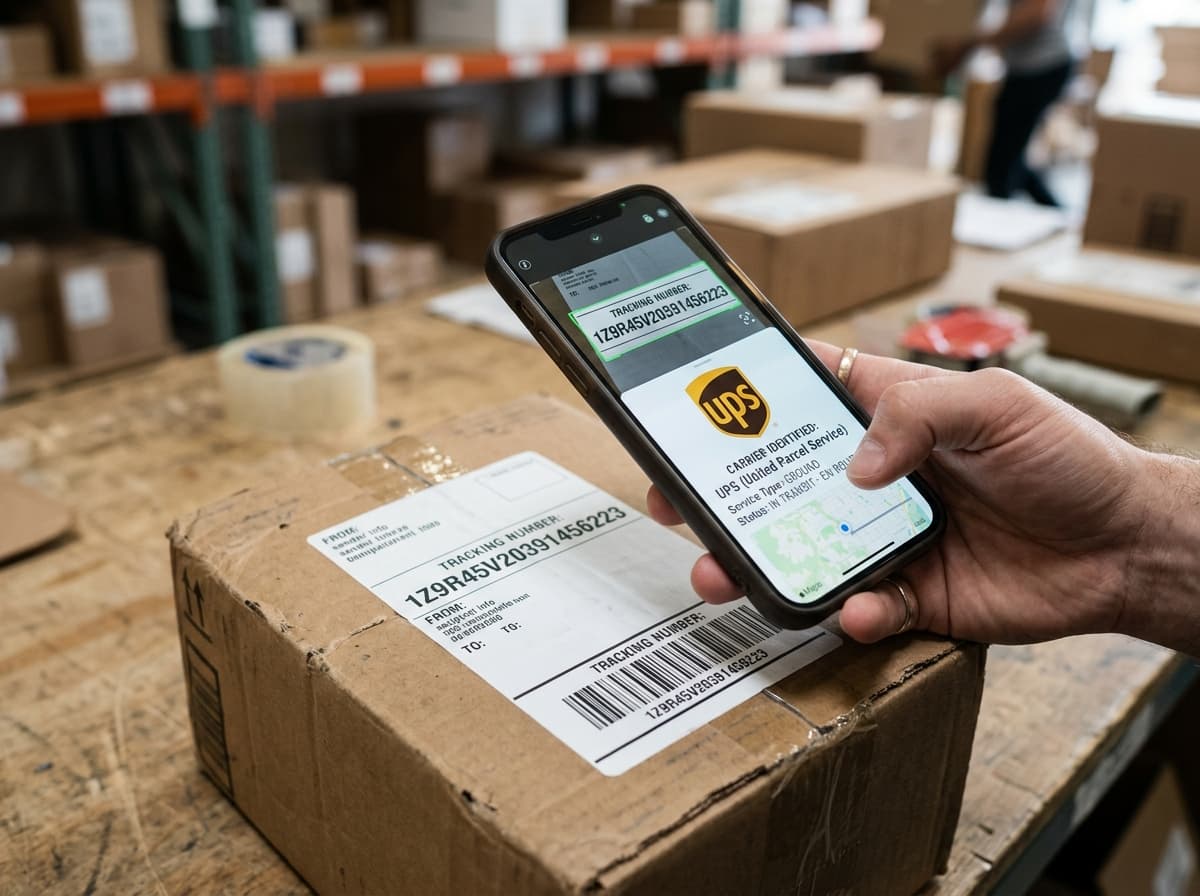
You can usually name the carrier just by looking at a tracking number. The prefix and the length give it away, because carriers each built their own numbering system and then never changed it.
That's genuinely useful when a shop emails you a bare string of digits and no carrier name, which happens more often than it should. Here's how to read the shape.
Start with the first two characters
Most of the identification work happens in the first two characters. They tell you whether you're dealing with a courier, a postal operator, or a Chinese e-commerce line.
1Z is the easy one. That's UPS, always, followed by 16 more characters for a total of 18. Nothing else looks like it, so this is the one case where you can be completely certain.
Two letters then nine digits then two more letters — something like RA123456789CN — is a postal item that crossed a border. That's a global standard, and the last two letters name the country it left. More on reading those below.
JD followed by 18 digits belongs to DHL eCommerce, and confusingly also to Parcelforce in Britain, because Parcelforce runs on DHL's numbering for some services.
LP and 14 digits is Cainiao, the logistics arm behind AliExpress. YT is YunExpress. A number that literally starts with the characters 4PX is 4PX.
Then count the digits
If there are no letters at all, length does the work.
| Length | Likely carrier | Example |
|---|---|---|
| 12 digits | FedEx Express or Ground | 123456789012 |
| 15 digits | FedEx Ground | 123456789012345 |
| 16 digits | Canada Post domestic | 1234567890123456 |
| 13 digits | Australia Post domestic | 3456789012345 |
| 20–22 digits starting 92, 93 or 94 | USPS | 9400111899223033005282 |
| 22 digits starting 92 | UPS SurePost or Mail Innovations | 9274890100130088888888 |
| 34 digits starting 420 | USPS with a ZIP prefix | 4201234569400111899223033005282 |
That last row trips people up. A 420 at the front isn't part of the tracking number — it's the destination ZIP code, added by the shipping software that printed the label. Delete the 420 and the five digits after it, and what remains is a normal USPS number.
Pro tip: Before you compare anything, strip spaces and dashes. Carriers print them for readability and they carry no meaning. 1Z 999 999 99 9999 9999 and 1Z9999999999999999 are the same number.
Reading international postal numbers
The 13-character format is worth knowing properly, because it encodes real information. It's called S10, agreed between national postal operators so their scanners can read each other's parcels.
The structure is always the same: two service letters, nine digits, two country letters.
The last two letters name the country of origin. CN is China, GB is Britain, US the United States, DE Germany, IN India, AU Australia. If you bought something from a seller who was vague about where it ships from, those two letters answer the question.
The first letter describes the service level:
- R — registered, signed for on delivery, with compensation if it goes missing
- E — express, usually the EMS network, the fastest postal option
- C — an ordinary parcel
- L or U — economy or small packet, cheapest and with the lightest tracking
- V — insured
So EA123456789CN is an EMS express item leaving China. LX123456789DE is a small packet from Germany, which tells you in advance that tracking will be sparse and the journey slow. That's genuinely useful information before the parcel has moved at all.
The second letter is the operator's own product code and varies by country, so it's not worth memorising.
The Chinese e-commerce carriers
If you shop on AliExpress, Temu or Shein, you'll meet a family of carriers most people have never heard of. They're worth recognising because their tracking behaves differently from a courier's.
Cainiao handles the bulk of AliExpress volume. Numbers usually start LP with 14 digits, though the AliExpress Standard Shipping product sometimes uses an AE prefix instead.
YunExpress starts with YT and runs 16 digits or so. 4PX either starts with 4PX outright or uses a two-letter code like FT. Both operate as consolidators — they collect thousands of small parcels, fly them together, and hand them to a local operator at the other end.
That handover matters. Once a parcel enters the postal system for its flight, it often picks up a China Post number in the LX or RA family, and the original consolidator number goes quiet. Neither number is wrong. They cover different legs of the same trip.
Regional carriers worth recognising
Outside the big four, a handful of operators account for most of the world's parcel volume, and their formats are just as consistent.
Royal Mail uses two patterns. International and signed-for items follow the S10 standard ending in GB — RR123456789GB for Signed For, AA123456789GB for Tracked. Domestic Tracked 24 and 48 use a 16-character alphanumeric string instead, like AB1234CD5678EF90. Parcelforce, its parcel arm, uses JD plus 18 digits, which is why Parcelforce numbers look like DHL ones.
Canada Post uses a plain 16-digit number domestically and the S10 format ending CA for international mail.
Australia Post runs 13 digits domestically, often starting with 3, and S10 ending AU for registered international post.
Japan Post uses S10 ending JP, with EJ for EMS and RR for registered items — clean and predictable.
Singapore Post uses S10 ending SG, and its e-commerce arm issues longer alphanumeric references.
India Post uses S10 ending IN, with EE and EN prefixes common on Speed Post. TCS in Pakistan uses a plain numeric consignment number, usually 10 to 12 digits, with no letters at all.
Aramex uses an 8 to 12 digit numeric reference across the Middle East and South Asia, which overlaps with several other operators — this is one where the format alone won't settle it.
The pattern behind the pattern
Once you've seen a few, the logic is obvious. National postal operators nearly all use S10, because they have to hand parcels to each other. Private couriers use whatever they invented before anyone standardised, which is why their formats look arbitrary — they are.
That means a rough rule holds: letters at both ends means post, pure digits or a branded prefix means courier. It's right often enough to be useful as a first guess.
When the number isn't a tracking number
Some codes that look trackable aren't, and recognising them saves a pointless search.
Order references from a shop — ORD-88213, or Amazon's 112-4829471-2201856 pattern — belong to the retailer's system. No carrier has ever seen them.
Booking or manifest numbers appear on commercial shipments and identify a consignment, not an individual parcel.
Return authorisation codes are issued by the shop to approve a return. The actual return label carries a separate, real tracking number.
If a code contains letters scattered through the middle rather than grouped at the start and end, or includes characters like a slash or a hash, it's almost certainly internal to a shop rather than a carrier reference. Our guide on why a tracking number shows nothing covers what to do when you've been given the wrong code.
When the shape doesn't decide it
Plain numeric formats overlap. A 13-digit number could be Australia Post, or a dozen smaller regional operators, or a shop's own internal reference. Counting digits won't settle it.
This is the situation the tracker on our home page is built for. Leave the carrier field empty and paste the number — the lookup tests it against the carriers whose formats match, rather than you guessing from a list of nearly two thousand names. You'll usually get the carrier name back along with the scan history.
Set the carrier manually only when you already know it and the automatic match is picking the wrong one, which happens occasionally with short numeric formats.
Why your parcel might have two carriers
A number that stops updating halfway through a journey usually hasn't failed. The parcel has changed hands.
International shipments almost always involve at least two operators: one that carries the parcel out of the origin country, and a domestic one that does the final few miles. The receiving carrier scans the parcel into their own system with their own number, because their scanners can't read the original format.
The same thing happens domestically with hybrid services. FedEx SmartPost and UPS SurePost both travel most of the way with the courier and are handed to USPS for the doorstep delivery. Two carriers, two numbers, one parcel.
When this happens, the original number typically freezes on a scan like "Handed over to local carrier" or "Departed origin country." That's your signal to look for the second number, usually in the shop's order page rather than your email. Our guide on tracking that stops updating covers what to do when there's no second number to find.
A quick identification routine
Run through this when you're staring at an unidentified number:
- Strip spaces and dashes, then look at the first two characters.
- Letters at both ends, 13 characters total? It's international post. Read the country from the last two letters.
- Starts
1Z? UPS, guaranteed. - All digits? Count them and check the table above.
- Still ambiguous? Paste it into the tracker with the carrier field empty.
Most numbers are identified in the first ten seconds by that routine.
Why the format sometimes lies
Two situations produce a number whose shape points at the wrong carrier, and both are worth knowing.
White-label services. Some shipping platforms buy capacity from a carrier and resell it under their own brand. The number follows the underlying carrier's format even though the customer-facing name is different. You identify the format correctly and get a carrier name you have never heard of, which is confusing but harmless.
Reused reference formats. Smaller regional operators sometimes adopt a numbering style that resembles a larger carrier's, either by coincidence or deliberately. A plain 12-digit number is not exclusively FedEx, however strongly it suggests it.
The practical response to both is the same: treat the format as a strong hint rather than proof, and let the lookup settle it. Format reading is fast and free; it just is not final.
Confirming your guess
Reading the format gives you a strong hypothesis. Confirming it takes ten seconds.
Paste the number into the tracker on our home page with the carrier field empty. If the format matches a known carrier, the result comes back with that carrier's name attached — which is your confirmation, and you get the scan history at the same time.
If the result comes back empty, that does not mean your identification was wrong. A brand-new number returns nothing regardless of carrier, because nothing has been scanned yet. Our guide on tracking numbers that show nothing separates the two cases.
If the result comes back with a carrier you did not expect, trust the result over the format. Overlapping numeric ranges are real, and the lookup is testing against live data rather than a pattern.
A note on barcodes versus numbers
The number printed on a label and the barcode above it are not always the same data.
Shipping labels often carry two or three barcodes: one for the carrier's sorting system, one for the destination postcode, and sometimes one for the sender's own warehouse. Only one of them encodes the tracking number you can look up.
If you are reading a number off a physical parcel rather than an email, use the one printed in human-readable text under the main barcode, usually labelled with the carrier's name or the word "tracking." Numbers printed elsewhere on the label are routing data and will not resolve to anything.
What identification actually gets you
Knowing the carrier changes what you should expect, which is the real point.
An express courier scans frequently and commits to tight windows, so a two-day silence on a domestic courier shipment is unusual. A postal small packet might scan three times across four weeks and be entirely on schedule. Same silence, completely different meaning.
Every carrier page in our courier directory carries that carrier's realistic transit windows and the problems it's actually known for. Once you've named the carrier, that's where the useful detail lives — and it's the difference between waiting sensibly and chasing something that was never late.