What to Do If Your Package Is Delayed
Updated 2026-08-029 min readTracking and delivery
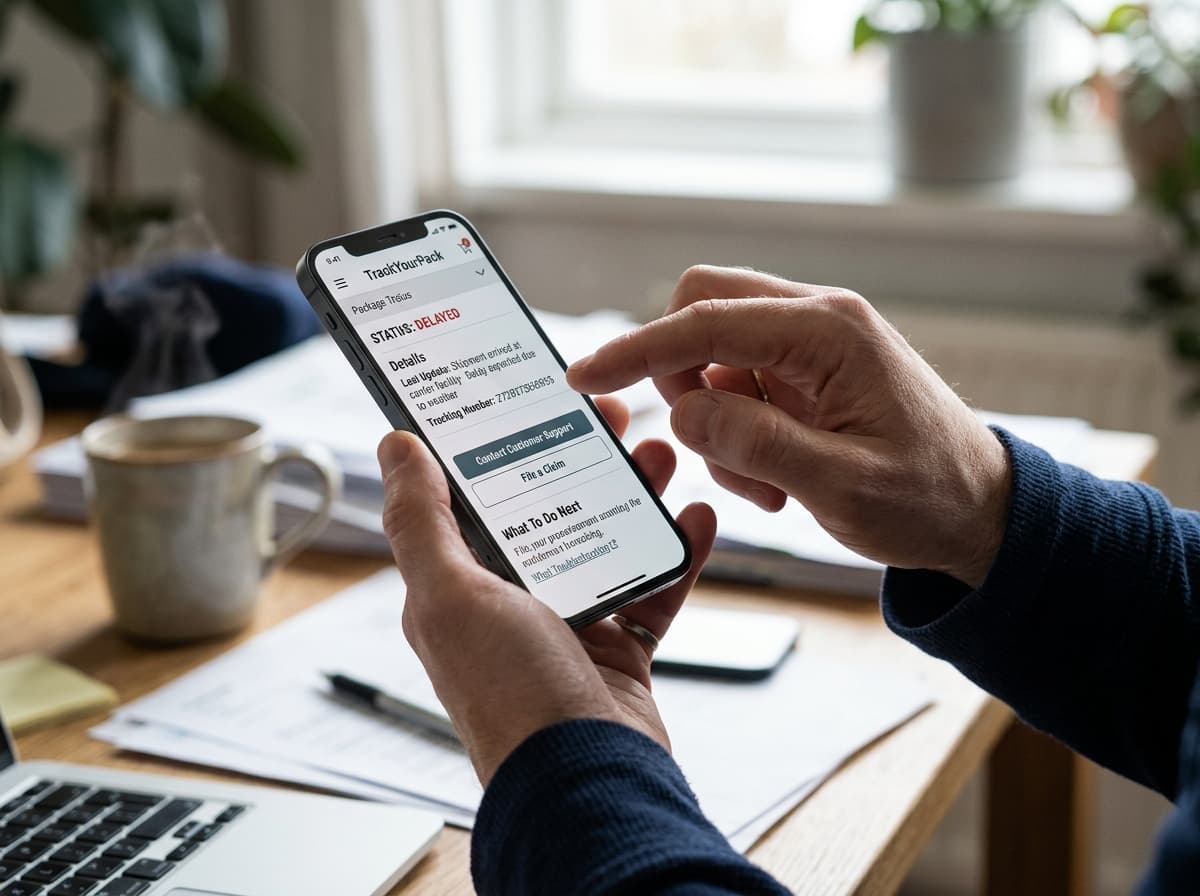
Refreshing a tracking page doesn't move a parcel. What moves it — sometimes — is contacting the right person with the right information, and that means working out what kind of delay you're actually dealing with first.
There are only three, and they need completely different responses. Ten minutes spent identifying which one you have beats a week of checking the page every morning.
Step one: is it actually late?
Most "delayed" parcels aren't. They're travelling normally against an estimate that was never a promise.
Carriers sell two very different things. A guaranteed service commits to a date, and missing it means the sender can claim the shipping cost back. FedEx Priority Overnight, UPS Next Day Air and DHL Express Worldwide work this way.
A standard or economy service gives an estimate. Missing it by two or three days isn't a failure, it's variance. Most e-commerce shipping is this kind, including everything that arrives from an Asian marketplace.
Check what the sender actually paid for before deciding anything is wrong. If the shop's checkout said "estimated delivery 5–9 working days" and it's day 11, that's mild variance, not a service failure.
Wait windows before a standard service is genuinely late:
- Domestic courier: 2 days past the estimate
- Domestic post: 4 days past the estimate
- International express: 3 days past the estimate
- International post or economy: 10 days past the estimate
Step two: read where the trail stopped
The last scan tells you what kind of delay this is. The wording matters more than the date.
"Out for delivery" and nothing since. The most urgent case. A delivery was attempted and failed, or the parcel came back to the depot at the end of the round. Depots hold undelivered parcels 5 to 10 days before sending them back to the sender, so there's a countdown running. Act today.
"Arrived at customs" or "Held at customs." The parcel is in a queue, and often waiting for a payment nobody has told you about. Our guide on parcels stuck in customs covers how to find out.
"Departed origin country" or "Handed to local carrier." Not a delay at all. The parcel moved to a different carrier who issued a new number, and the old one has frozen permanently. Find the second number on the shop's order page.
Stopped at a sorting hub. The genuine unknown. Could be a backlog, could be a mislaid parcel. This is the one where the wait windows above actually apply.
No scans at all, ever. The parcel probably never left the shop — see why a tracking number shows nothing.
Our guide on tracking that stops updating goes through each of these in more detail.
Step three: contact the right person
Here's the part that saves the most time, and it's counter-intuitive.
Contact the sender, not the carrier.
The shipping contract is between the sender and the carrier. The sender paid, so the sender is the customer. Only they can open a formal investigation, and only they can claim compensation. Most carriers will politely decline to discuss a shipment with the recipient beyond reading you the same tracking page you already have.
That's frustrating when you're the one waiting, but arguing with a call centre about it burns an hour and changes nothing.
What to actually say
Vague messages get vague replies. Give the sender everything they need to file, in one message:
"Tracking number [X]. Last scan was [exact wording] on [date], [N] days ago. The estimated delivery was [date]. Please open an investigation with [carrier] and let me know the case reference."
Asking for the case reference is the important part. It turns a customer service reply into a tracked action. A seller who has genuinely opened an investigation can give you a number in a day or two. One who hasn't will change the subject.
The one time to contact the carrier yourself
Failed delivery attempts. If the parcel is sitting at a local depot on a return countdown, you can usually arrange redelivery or collection directly, and you should do it the same day.
Call the local depot, not the national number. The national line reads you the tracking page. The depot has the parcel in a cage twenty feet away. Depot numbers are usually on the carrier's website under a branch or location finder.
Step four: know the claim deadlines
If the parcel is genuinely lost, there's a window for claiming, and it's shorter than most people expect.
Carriers typically require a claim within 21 to 60 days of the shipping date, depending on the operator and the service. Marketplaces run their own clocks — most buyer protection schemes expect a dispute within 30 to 90 days of the estimated delivery date.
Miss the window and the claim is refused regardless of merit. So while you're waiting patiently, keep an eye on the date. Patience past a deadline stops being patience and becomes a write-off.
Screenshot the tracking page before it goes. Carriers purge tracking events 30 to 120 days after the last scan, which frequently means the evidence disappears just as the dispute gets serious.
Our guide on lost or damaged package claims covers the filing process properly.
What an investigation actually involves
People imagine someone going to look for the parcel. That isn't what happens, and knowing the real process sets sensible expectations.
When a sender opens a case, the carrier raises a trace. The parcel's number is flagged across the network so that if it's scanned anywhere, the system alerts the case handler. Staff at the last-known facility are asked to check for unscannable items — parcels with torn or unreadable labels sitting in an overflow area.
That check is genuine but not exhaustive. A hub processes hundreds of thousands of items a day, and the overflow area is a cage, not a filing system.
Traces run 5 to 10 working days. During that time the tracking page usually shows nothing new, which feels like nothing is happening. Chasing the case daily doesn't accelerate it.
Roughly speaking, three things happen at the end. The parcel is found and resumes its journey — this is the most common outcome by a distance. Or it's confirmed lost and the claim moves to compensation. Or the trace closes inconclusively, and the sender has to escalate.
Pro tip: ask the sender for the case reference number when they open it. Without one, you have no way to tell whether a trace was actually raised or the seller simply said it was.
What compensation you can actually expect
Compensation depends entirely on what service was bought, and it's usually less than people assume.
Guaranteed services refund the shipping cost when the carrier misses a committed date for a reason within their control. Not the value of the goods — just what was paid to ship. Weather, customs, incorrect addresses and recipient unavailability are excluded from almost every guarantee.
Lost parcels are covered by whatever declared value or insurance was purchased. Most services include a small base amount — often equivalent to £20 to £100 depending on carrier and country — and anything above that needed buying up front.
Damaged parcels need the packaging kept. Carriers routinely reject damage claims where the box was discarded, because they can't assess whether the packing was adequate.
Two constraints apply to all of it. The sender claims, because they hold the contract. And the deadline is short — typically 21 to 60 days from shipping, depending on carrier and service.
If you bought through a marketplace, its buyer protection is usually the faster and more generous route. Platforms refund from the seller's account rather than fighting the carrier, and the process takes days rather than weeks.
What actually speeds a parcel up
Honestly? Very little. But three things genuinely help.
Paying an outstanding customs charge. A parcel held for unpaid duty moves within a day or two of payment. This is the single most common fixable delay on international shipments, and the notification often lands in spam.
Correcting a bad address. If a scan says "address incomplete" or "delivery exception," the carrier is waiting for information. Supply it through the carrier's website — most have a self-service form — and delivery resumes on the next round.
Arranging depot collection. If the parcel is sitting after a failed attempt, going to get it beats waiting for a third attempt that may never come.
Everything else is waiting. Investigations take carriers 5 to 10 working days, and asking twice doesn't accelerate them.
What not to bother doing
Some responses feel productive and achieve nothing. Skipping them saves real time.
Refreshing the tracking page repeatedly. Carriers push updates when a scan happens, not on a schedule. Checking six times a day gives you the same information as checking once.
Calling the carrier's national line as the recipient. They will read you the tracking page. They cannot open an investigation for you, because you are not their customer.
Chasing an open trace daily. Traces run on a fixed cycle of five to ten working days. Asking again on day three does not move it up a queue.
Contacting customs directly. Border agencies handle policy and enforcement, not individual parcel enquiries, and will redirect you to the carrier.
Opening a second investigation. Two cases on the same tracking number usually results in one being closed as a duplicate, which can reset the clock rather than speeding it up.
The short list of things that genuinely work follows.
Reducing the odds next time
Most delays are decided before the parcel ships, which means a few habits genuinely lower your exposure.
Check the address before confirming. Missing apartment numbers and wrong postcodes cause a large share of delivery exceptions, and they are entirely preventable. A parcel that reaches the right street and the wrong flat still counts as a failed delivery, with the return clock attached.
Buy the service that matches the deadline. If something has to arrive by a date, an estimate will not do. The extra cost of a guaranteed service is the price of the deadline being someone else's problem.
Prefer sellers who ship DDP on international orders. When duty is prepaid, the parcel cannot be held for an unpaid charge — which removes the single most common international delay entirely.
Give a phone number. Carriers use it for delivery exceptions and customs charge notifications. An order placed without one is an order where nobody can reach you when something needs a decision.
Note the deadlines at the start, not the end. Write down the claim window and the marketplace dispute deadline when the parcel ships. People discover both at the moment they need them, which is always too late.
If the parcel was a gift or time-sensitive
A delay matters more when there is a date attached, and there are two practical moves worth making early.
Tell the recipient. A gift that arrives late with a warning is far better received than one that simply does not turn up. Forward the tracking number so they can see it themselves rather than relying on your updates.
Have a fallback by the halfway point. If something has to arrive by a date and the tracking has gone quiet with half the window gone, start arranging an alternative rather than waiting to see. A locally bought replacement ordered in time beats a perfect gift that arrives a week late.
Neither move speeds the parcel up. Both remove the part of the stress that is actually about the deadline rather than the parcel.
Setting expectations properly next time
A lot of delay stress comes from expecting a parcel to behave like a courier when it's travelling as post.
Every carrier page in our courier directory lists that operator's realistic transit windows — including how long a normal silence lasts on their network. Checking that once, before you order, is worth more than checking the tracking page ten times afterwards.
And when the parcel does start moving again, read the status against what it means rather than what it sounds like. The status table on our home page pairs each state with its normal duration, which is usually all you needed to know in the first place.