Countries with the Strictest Customs Rules
Updated 2026-08-039 min readCustoms and duties
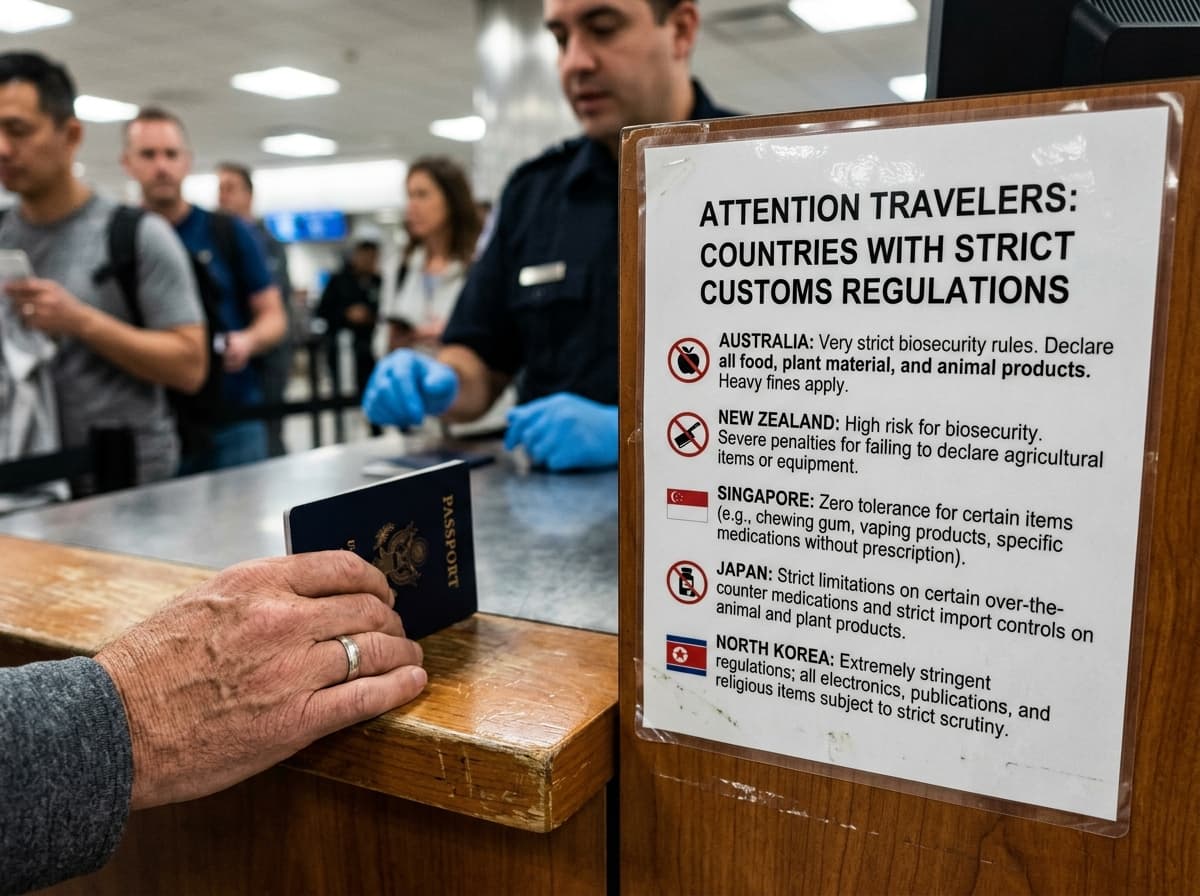
There is no single strictest country, because strictness takes five distinct forms: recipient identity requirements, biosecurity screening, documentation bureaucracy, low tax thresholds, and prohibited categories. A destination that is easy on one is often severe on another, and shipping successfully means knowing which kind you are facing.
Australia will not care about your invoice and will care enormously about a wooden crate. Brazil will not care about the wood and will hold the parcel for a missing tax number. Both are strict; neither is strict in the same way.
The five kinds of strict
| Type | What it checks | Fails on |
|---|---|---|
| Identity | Who the recipient is, verified against a national register | A missing ID or tax number |
| Biosecurity | Organic material, pests, disease vectors | Food, wood, seeds, soil, animal products |
| Documentation | Completeness and formality of paperwork | A missing field, an unsigned invoice, no pre-registration |
| Threshold | Value at which tax becomes payable | Almost nothing — tax applies from a very low value |
| Category | Whether the goods are permitted at all | Content, materials or type of product |
Work out which types apply to your shipment and destination, and the preparation follows directly.
Identity: the recipient has to be identifiable
A growing number of countries require the importer to be verified against a national register before goods are released. This is the type that catches senders most often, because nothing about the goods is wrong.
Brazil requires the recipient's tax identification number on the declaration. Without it, the parcel waits — indefinitely, in practice, since nobody at customs will chase it. Brazil also applies personal import limits and inspects heavily, which is why it has a reputation for slow clearance that is entirely deserved.
Russia requires recipient identification for personal imports and applies limits on the value and frequency of goods an individual may receive.
China requires a verified national ID for cross-border e-commerce imports, matched against the payment used for the purchase. A mismatch between the payer and the recipient stops the parcel.
South Korea requires a personal customs clearance code for individuals importing goods, issued on registration and reused thereafter.
India applies identification and verification requirements to courier imports, and restricts what can arrive as a gift.
The rule for all of these: collect the identifier at checkout, before the order ships. Chasing it afterwards means emailing a customer whose parcel is already sitting in a facility accruing storage charges.
Biosecurity: Australia and New Zealand
Both countries run the most rigorous biosecurity regimes in the world, and for a defensible reason — island ecosystems with agricultural economies and no land borders to leak through.
What triggers attention: food of any kind, seeds, plants and plant material, wood and wooden packaging, straw and natural fibre packing material, soil on anything, animal products including leather and wool, and used outdoor or camping equipment.
Two things make this different from ordinary customs strictness. Inspection is physical rather than documentary, so a perfect invoice does not help. And the default outcome for a prohibited item is destruction or treatment at your cost, not return to sender.
Practical consequences for anyone shipping there. Declare food and organic material honestly, because undeclared items attract penalties rather than a polite refusal. Avoid straw, wood shavings and unprocessed natural packing materials entirely. Clean any used equipment thoroughly, particularly footwear and anything that has touched soil.
Several other countries apply serious biosecurity screening — Japan, Taiwan, Chile and Norway among them — but Australia and New Zealand are the benchmark.
Documentation: where formality is the obstacle
Some countries are not restrictive about what you send, but demand paperwork that is complete and correct to a degree others do not.
Brazil appears here too, with a documentation burden that compounds its identity requirement.
Argentina applies personal import restrictions, limits on the number of shipments an individual may receive in a year, and formal processes for anything above a low value.
Egypt requires pre-registration of commercial shipments before they arrive, with the importer and the goods registered in advance. A shipment arriving unregistered cannot be cleared retrospectively without significant difficulty.
Nigeria and several other markets combine documentary requirements with foreign exchange controls, which adds an approval step outside the customs process itself.
Turkey applies personal import limits and specific restrictions on used goods.
For all of these, the fix is the same and it is upstream: complete the commercial invoice properly, with an HS code, an accurate description, a real value, a stated country of origin and a working phone number for the recipient. Our guides on documents needed for international shipping and what an HS code is cover the detail.
Thresholds: where tax starts at almost nothing
A different kind of strict — nothing is refused, but almost nothing arrives untaxed.
Norway and Switzerland sit outside the EU customs union and apply value-added tax from very low thresholds, so most parcels attract a charge plus the carrier's handling fee. On a small purchase the fee frequently exceeds the tax.
The European Union removed the low-value VAT exemption on imported goods, so consumer imports are taxable from the first unit of value. The United Kingdom operates similarly since leaving the EU.
Several other markets have moved the same way, and the direction of travel is consistent — de minimis thresholds are falling everywhere as governments close the gap between imported and domestic retail.
This is not a delay problem; it is a cost and expectation problem. A recipient who was not told will refuse the parcel, which triggers a return at the sender's expense. Our guides on import tax for online shoppers and customs duties cover what is actually owed, and shipping on delivered-duty-paid terms removes the surprise entirely.
Categories: goods that are simply not permitted
Some destinations prohibit categories that are unremarkable elsewhere, on cultural, religious or security grounds.
The Gulf states — Saudi Arabia, the United Arab Emirates, Kuwait, Qatar and neighbours — prohibit alcohol, pork products and materials considered offensive to local standards. Several also require conformity certification for regulated product categories before import.
Israel applies extensive security screening, which adds inspection time rather than restricting categories.
Indonesia, Vietnam and Thailand each maintain licensing requirements across broad product categories, so goods that need no permit elsewhere need one there.
Many countries restrict used goods, medicines, supplements, cosmetics, drones, radio equipment and anything with encryption. None of these are exotic categories in e-commerce, which is why the list is worth checking against your catalogue rather than against your intuition.
What strict actually costs in days
Rough expectations, assuming complete paperwork.
| Destination profile | Typical clearance | With a problem |
|---|---|---|
| Inside your own customs union | None | n/a |
| Western Europe, Canada, Japan, Singapore | Hours to 2 days | 3–7 days |
| United States, most of Asia | 1–3 days | 5–10 days |
| Australia, New Zealand | 1–4 days | 1–3 weeks if inspected |
| Brazil, Argentina, Russia, India | 3–10 days | 3–8 weeks |
| Egypt, Nigeria, and similar | 5–15 days | Open-ended |
The right-hand column is the point. In an easy destination a problem costs days. In a strict one it costs weeks, and sometimes the parcel never clears at all. Our guide on why parcels get stuck in customs covers what to do when one is already held.
Shipping into a strict destination successfully
Six things, in order of how much they help.
Collect whatever identifier the destination requires at the point of sale. This is the single highest-value change for Brazil, Russia, China, South Korea and India.
Use an express carrier with in-house clearance. DHL, FedEx and UPS clear on their own broker licence and have local staff who know the requirements. Postal services hand over at the border and the parcel joins a slower, less supported queue.
Ship delivered duty paid where the destination taxes aggressively. It costs more and it prevents refusals.
Write a specific description with an HS code. A vague description is the leading cause of manual review everywhere, and manual review in a strict destination is where weeks disappear.
Check the prohibited list before you list the product, not before you ship it. Discovering a restriction after an order is placed means cancelling a sale.
Respond to any customs contact the same day. The clock does not run while a query is unanswered, and storage charges do.
Personal import quotas
A rule that surprises people because it has nothing to do with the individual parcel.
Several countries limit how much an individual may import in a period — by total value per year, by number of shipments, or both. Argentina, Russia and a number of other markets operate some version of this.
The consequence is that a perfectly compliant parcel can be refused because the recipient has already received their allowance. Nothing about the shipment is wrong, and nothing the sender does can fix it.
For a seller, this is a reason to be sceptical of a repeat customer in one of these markets suddenly ordering frequently. For a buyer, it is a reason to know your own allowance before ordering, because the parcel that exceeds it is returned or abandoned at your cost.
Gift allowances work similarly and are widely misunderstood. Where a higher duty-free threshold exists for gifts, it generally requires that both sender and recipient are private individuals and that the shipment is genuinely unsolicited. A business marking a commercial shipment as a gift is making a false declaration, not using a loophole.
Where it is easy
Worth stating for contrast, because the difficulty is not uniform.
Shipping within a customs union involves no clearance at all. Movement inside the EU single market, or between countries in other unions, is domestic in practice.
Western Europe, Canada, Japan, Singapore and Hong Kong clear consumer parcels quickly and predictably when the paperwork is complete. Automated clearance handles the large majority without human involvement.
The United States clears efficiently at the parcel level, though category restrictions on food, agricultural products and regulated goods are enforced firmly.
The common factor in every easy destination is not leniency. It is that automated clearance works when the data is good — which means the difference between an easy destination and a hard one is often the difference between good paperwork and bad.
Strictness is not fixed
One caution worth stating plainly: none of this is stable.
De minimis thresholds are being lowered across most major markets. Identity requirements are being added rather than removed. Product conformity regimes are expanding, and categories that needed no certification five years ago need one now.
Trade agreements move in the other direction, occasionally, and a lane that was expensive becomes cheap when an agreement enters force — but only for shippers who claim it with the right origin evidence.
The practical consequence for a seller is that a destination list checked two years ago is out of date. Review the markets you actually ship to annually, and check any new market before you enable it at checkout rather than after the first order arrives.
Carriers publish destination guides covering restrictions, thresholds and required documents, and they are updated far more often than anything else available. That is the source to use, not a general search.
Before you ship
Identify which of the five kinds of strictness applies. Collect any recipient identifier at checkout. Complete the invoice properly. Check the prohibited and restricted lists for the specific destination. Decide who pays duty and say so. Use a carrier with local clearance capability for the harder markets.
Then track it on our home page, and expect a longer quiet period at the border than you would see on an easy lane — our guide on how long international shipping really takes sets out realistic ranges by route.