How to Ship a Gift
Updated 2026-08-039 min readPacking and sending
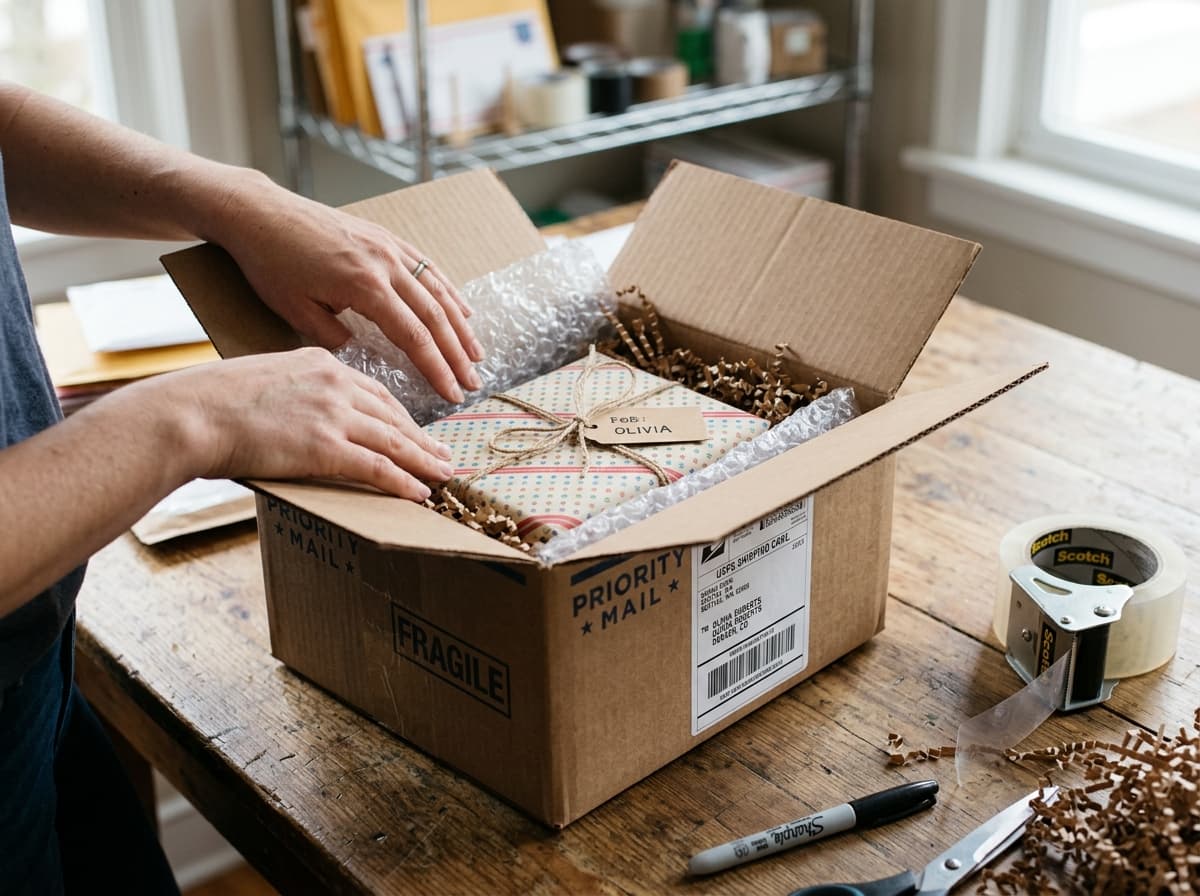
Wrap the gift, then put it inside a plain shipping box with cushioning — wrapping paper does not survive a sorting belt. Remove any price from the contents. If it is crossing a border, declare it honestly as a gift with a realistic value, because the gift allowance is narrower than most people assume.
The rest is ordinary parcel shipping with a deadline attached, and the deadline is where most gift shipping goes wrong.
Wrapping that survives
Gift wrap is designed to be admired on a table, not thrown into a chute.
Wrap the gift, then box it. The wrapped item goes inside a plain corrugated outer box with cushioning around it. The wrapping arrives intact because it never touched the outside world.
Do not ship a wrapped item bare. Paper tears, ribbon snags on conveyor rollers, and the label falls off when the paper it was stuck to comes loose. Some carriers refuse decoratively wrapped parcels outright for exactly this reason.
Use a rigid gift box inside for anything with a shaped bow or delicate wrapping, so nothing presses against it.
Skip loose decoration. Glitter, loose ribbon and anything that can shed will spread through the box and, in extreme cases, foul sorting equipment.
If the wrapping matters more than the surprise of unwrapping it, an alternative worth considering is sending it plain with the wrapping materials included, and letting someone at the other end do it.
Hiding the price
Three routes, depending on how you are sending it.
Order from the retailer and ship direct. Most offer a gift option that omits the price from the packing slip, and many will add a message. This is the simplest answer and it also removes a shipping leg.
Ship it yourself. Remove the receipt, the price sticker and any promotional insert. Retail boxes frequently carry a printed price on the packaging itself, which is easy to miss.
Include a gift receipt where the retailer offers one. It lets the recipient exchange without showing a price, which is worth more than concealment.
One thing you cannot hide: on an international parcel the customs declaration shows the declared value, and it is attached to the outside of the box. There is no way around this, because under-declaring to conceal a price is a false declaration. If the value would be awkward, sending from a retailer inside the recipient's own country avoids the issue entirely.
The gift allowance across borders
Widely misunderstood, and worth being precise about.
Many countries apply a higher duty-free threshold to genuine gifts than to purchases. Where it exists, three conditions normally apply together: the sender and recipient must both be private individuals, the shipment must be unsolicited, and the value must be under the stated allowance.
What that excludes. A business sending "a gift" to a customer does not qualify. Neither does a purchase the recipient asked for, nor a retailer shipping direct on a buyer's behalf — that is a commercial import regardless of the occasion.
Above the allowance, duty applies to the full value, not just the excess, in most systems. And the carrier's advancement fee is charged on top of the duty, which on a modest gift frequently exceeds the duty itself.
Our guides on customs duties and import tax for online shoppers cover how the charges are calculated.
Declare honestly. A gift declared at a fraction of its value caps any insurance claim at that figure, and a customs officer who disagrees with a valuation reassesses it upward with the parcel held while they do.
Why hampers and mixed gifts get refused
The single most common international gift failure.
A mixed hamper is assessed on its most restricted component. One jar of honey, one packet of meat snacks, one bottle of perfume, and the entire parcel is at risk — customs and biosecurity authorities are not obliged to remove the offending item and forward the rest.
The usual offenders in a gift box: honey, cheese, meat products, fresh fruit, homemade food, alcohol, perfume, aerosols and anything with a lithium battery packed loose.
Our guides on shipping food internationally and shipping liquids and perfumes cover what falls foul of which rules.
The safe international gift is commercially packaged, shelf-stable, non-animal, non-flammable and battery-free. Regional biscuits, coffee, tea, chocolate, books, textiles and homeware all travel well.
Timing
The deadline is what makes gift shipping different, and it is consistently underestimated.
| Route | Send by |
|---|---|
| Domestic, standard | 5–7 days ahead |
| Domestic, peak season | 2–3 weeks ahead |
| International, express | 7–10 days ahead |
| International, standard | 3–4 weeks ahead |
| International, peak season | 5–6 weeks ahead |
Peak season — roughly late November through December — stretches every one of these. Networks run at capacity, temporary drivers cover unfamiliar routes, and carriers commonly suspend service guarantees during the busiest weeks. Paying for express during peak buys less than it does in March.
Our guide on how long international shipping really takes sets out realistic ranges by lane, and what "out for delivery" means covers how much notice the final day actually gives.
If a date genuinely matters, buy a guaranteed service and send early. Those are the only two things that help.
Shipping direct from the retailer
Usually the best option for a gift going any distance, for four reasons.
It removes a leg — the item goes from warehouse to recipient instead of warehouse to you to recipient. Faster, cheaper and one fewer chance of damage.
The price is omitted from the packing slip automatically.
For international gifts, ordering from a retailer inside the recipient's country removes customs entirely. No duty, no advancement fee, no declaration, no delay. This is almost always the right answer for an overseas gift and it is routinely overlooked.
And returns are simpler, because the item is already in the retailer's own returns network.
The trade-off is that you never see the item, and you cannot add anything personal beyond whatever message the retailer supports.
Flowers, plants and perishable gifts
The gift categories most likely to fail, and each has a better route than shipping it yourself.
Flowers are shipped by specialist florists with cold chain handling and same-day or next-day networks. A bouquet sent through an ordinary parcel service arrives dead. Use a local florist at the destination, or a service that fulfils through one.
Plants face biosecurity restrictions almost everywhere across a border, and soil in particular is prohibited in most destinations. Domestically they are shippable with care; internationally, assume the answer is no without a phytosanitary certificate.
Cakes, chocolates and hampers are shelf-stable only in some forms. Chocolate should not cross a warm climate on an unrefrigerated service regardless of what the rules permit, and a hamper is assessed on its most restricted component.
Wine and spirits need a licensed shipper, an adult signature and, internationally, excise duty at the destination. Ordering from a retailer in the recipient's country is nearly always simpler and cheaper.
The general principle for perishable gifts: buy at the destination rather than shipping to it. It arrives fresher, faster and usually cheaper. Our guide on shipping food internationally covers the rules where you do need to send something edible.
Sending to someone whose address you do not have
More common than it sounds — a colleague, a new partner's family, someone who has just moved.
A pickup point or locker works if you know their town. The parcel is held for collection with a code, and they collect at their convenience.
A workplace is usually reliable and has the advantage of being sequenced earlier on delivery rounds.
A digital gift — a voucher, an experience, a subscription — sidesteps the problem completely and arrives instantly.
What does not work is guessing at an address. An incorrect address produces an address correction fee, a failed delivery, and eventually a return at your cost, as our guide on returning a package to sender explains.
Protecting the surprise
Tracking notifications are the usual leak. A dispatch email to a shared address, or a carrier notification with the retailer's name on it, gives it away before the parcel arrives.
Three fixes. Ship to your own address and re-send if the timing allows. Use a pickup point so nothing arrives unexpectedly. Or accept it — a parcel arriving is not the same as knowing what is inside.
For a surprise that genuinely matters, sending to a third party who can hold it is the only reliable method.
Making returns possible
A gift the recipient cannot exchange is half a gift, and the mechanics need setting up before you send.
Include a gift receipt where the retailer provides one. It carries the order reference without the price, which is exactly what an exchange needs.
Note the return window. Most retailers count it from purchase rather than from the occasion, so something bought in early November may be out of window by January. Several extend the window over the peak season, and it is worth checking rather than assuming.
Write the order number somewhere the recipient can find it. Without a reference, an exchange becomes a negotiation.
For an international gift, returns are usually impractical. The recipient would pay outbound shipping back across the border, and any duty already paid is not generally recoverable through a straightforward return. This is another argument for buying from a retailer inside their country.
Corporate and bulk gifting
Sending many gifts at once is a logistics job rather than a shopping one, and three things go wrong at scale.
Address quality. A list assembled from several sources will contain incomplete addresses, and each one produces an address correction fee plus a probable failed delivery. Run the list through address validation before creating any labels.
The gift allowance does not apply. A business sending gifts is making a commercial shipment regardless of intent, so international recipients will be charged duty. Ship delivered duty paid or expect refusals — a recipient billed for an unsolicited gift frequently declines it.
Timing across zones. A single send date produces arrivals spread over two weeks internationally. Stagger the dispatch by destination so arrivals cluster instead.
For any volume, a flat rate or negotiated account beats retail pricing considerably, and our guide on the best courier for e-commerce sellers covers where the thresholds sit.
Insurance and what to do if it breaks
Gifts are frequently under-insured because people ship them casually.
Declare the real value if the item is worth anything, because the declared figure is the ceiling on any claim. Photograph the item and the packed box before sealing, as with any shipment.
Two things to remember. The sender files the claim, so a recipient with a broken gift has to come back to you. And carriers refuse claims for inadequate packing, which for a gift means the wrapped item must have been properly boxed and cushioned. Our guide on lost or damaged package claims covers the process and the deadlines.
For a fragile gift, the method in our guide on packing fragile items applies in full: 2 inches of cushioning on every side, and a second box for anything that would be upsetting to lose.
Before you send
Wrap it, then box it plainly with cushioning. Remove every price. Declare honestly on an international parcel and check the destination's rules for anything edible or flammable. Avoid mixed hampers across borders. Send well ahead of the date, and further ahead during peak. Consider ordering from a retailer in the recipient's own country instead.
Then send the recipient the tracking number if the surprise permits it — they can follow it on our home page with any carrier's number.
And if the date is genuinely fixed, send early on a cheap service rather than late on an expensive one. Speed bought at the last minute is the least reliable thing you can buy.