Tracking Says Delivered but No Package — 7 Steps
Updated 2026-08-039 min readTracking and delivery
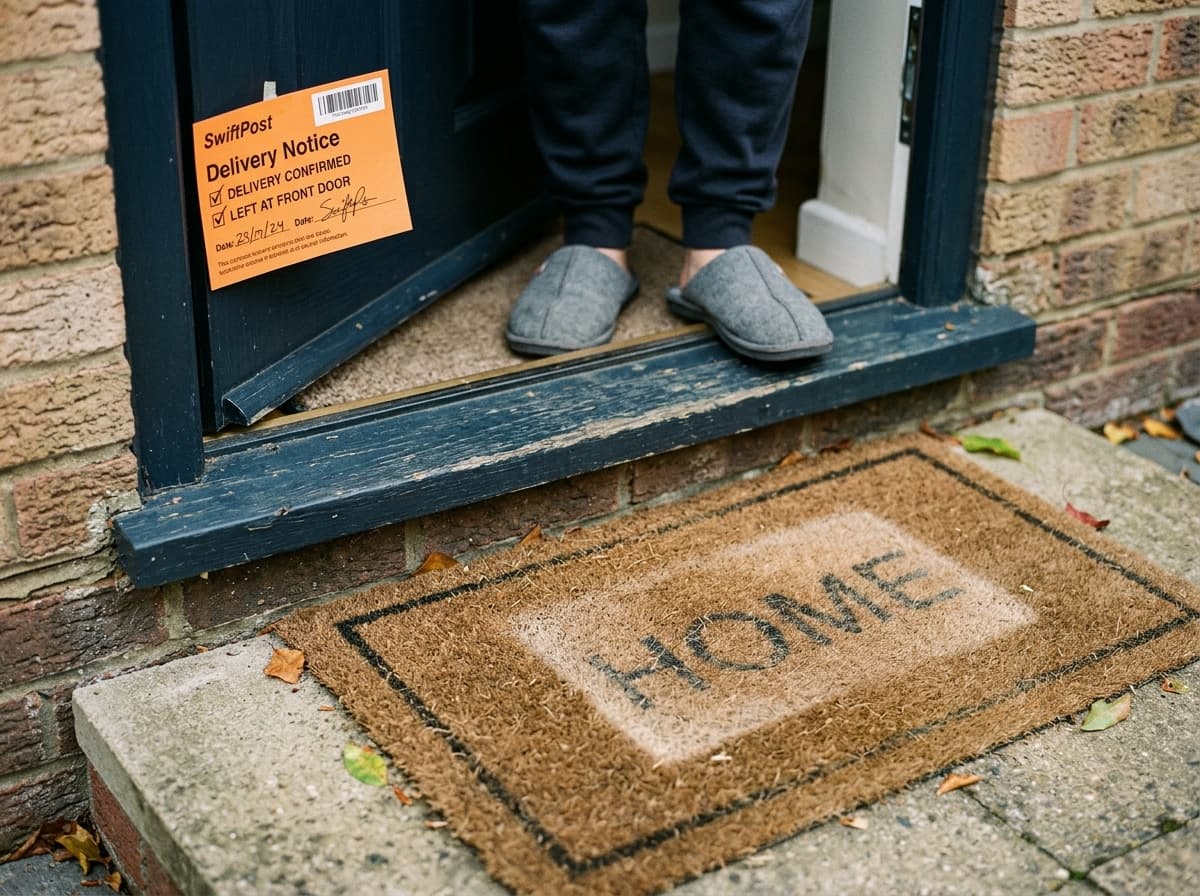
A delivered scan and an empty doorstep is one of the more unsettling things a tracking page can show you. The good news is that theft is not the most likely explanation, and a decent share of these parcels turn up within two days.
Work through the following in order. The first four steps are free, take about twenty minutes, and resolve most cases.
Step 1: Wait 24 hours before doing anything
This feels wrong when you're standing at an empty door, but it's genuinely the highest-value step.
Drivers scan in batches. A driver who marks twenty parcels delivered at the start of a street finishes that street forty minutes later, and yours might be the last drop. Some scan the whole van at the depot before setting off, which can put the delivered stamp several hours ahead of the actual delivery.
Occasionally the scan is simply premature — a parcel loaded for today, scanned, then not delivered because the round ran long. It goes out again tomorrow.
Wait window: 24 hours, or 48 if the scan landed on a Friday evening. Most carriers won't accept a report before this anyway.
Step 2: Check every plausible safe place
Drivers leave parcels in more places than people expect, and "safe place" is interpreted generously under time pressure.
Look behind bins, in a porch, under a doormat, behind a plant pot, inside an unlocked outbuilding, over a side gate, and in any recycling box. If you have a letterbox large enough, check that the parcel hasn't been forced partway through and is sitting inside the door.
In a flat or shared building, check the lobby, the post room, the concierge desk, and outside the door of a flat with a similar number. Delivery apps show a flat number in small text, and a 2B read as 28 is an easy mistake.
Step 3: Ask the neighbours
Roughly a third of "delivered but missing" parcels are with a neighbour who hasn't come round yet.
Carriers deliver to neighbours far more freely than they used to, and the card notifying you sometimes blows away or gets missed under other post. Ask both sides and directly opposite before assuming anything.
If you're in a building with a concierge or reception, ask there before ringing the carrier. Parcels signed for at a front desk show as delivered immediately, even though they're sitting in a cupboard two floors down.
Step 4: Read the delivery scan properly
The scan detail carries more information than the word "delivered."
Look for the time — if it's before you left for work or after you got home, and you were in, that's a real inconsistency worth citing. Look for the location text, which often says "front porch," "with neighbour," "in mailbox" or names a reception desk. And look for a signature name, which occasionally names a neighbour you can go and ask.
Many carriers now attach a photo to the delivery scan. That photo is the single most useful piece of evidence available, because it usually shows a door — and it's often not your door.
If the photo shows a house that isn't yours, you have a misdelivery rather than a theft, and that's a much easier case to resolve.
Our guide on reading tracking statuses covers what the other scan wordings mean.
Step 5: Contact the carrier's local depot
If steps 1 to 4 came up empty, this is the first call worth making — and it's the depot, not the national line.
The national number reads you the tracking page you've already read. The depot has the driver's manifest, can ask the driver directly, and can see the GPS point attached to the delivery scan. Drivers usually remember the odd ones, and a same-day query is far more likely to jog a memory than one raised a fortnight later.
Depot numbers are on the carrier's website under a branch or location finder. Have the tracking number and the delivery scan time ready.
Warning: carriers will often decline to discuss the shipment with you rather than the sender. If you hit that wall, don't argue — move to step 6.
Step 6: Tell the sender and ask them to open a case
The shipping contract belongs to the sender, which means only they can formally raise a lost-parcel case and only they can claim compensation.
Message them with everything in one go:
"Tracking number [X] shows delivered on [date] at [time], location text [exact wording]. It was not received. I have checked safe places, neighbours and the building reception. Please request the delivery photo and GPS data from [carrier] and open a case."
The photo and GPS request is the part that matters. Carriers hold that data for a limited window — often 30 to 90 days — and it either supports your account or resolves the question immediately.
Ask for the case reference. Without one you can't tell whether anything was actually filed.
Step 7: Use buyer protection if the seller stalls
If the parcel came from a marketplace, its dispute process is usually faster and more generous than a carrier claim.
Platforms refund from the seller's held funds rather than fighting the carrier, so the decision takes days rather than weeks. Open the dispute with the tracking detail, the delivery photo if you have it, and a short factual account of what you checked.
Watch the clock. Buyer protection typically closes 60 to 90 days after dispatch, and card chargeback windows are finite too. Filing early costs nothing — you can withdraw a dispute if the parcel appears.
Our guide on handling lost or damaged package claims covers the process in detail.
Why drivers mark parcels delivered early
Understanding the pressure explains most of these cases without anyone behaving badly.
A delivery round is measured in stops per hour. Drivers on tight schedules develop habits that save seconds — scanning several parcels at once when they park, scanning at the van rather than the door, scanning a whole street before walking it.
None of that is malicious and most of it is invisible, because the parcels do get delivered. It only becomes visible when something else goes wrong and the timestamp turns out to be an hour early.
There is also a harder version. Rounds that cannot be completed sometimes get closed out anyway, with the parcel returning to the depot and going out the next day. The scan says delivered; the parcel is in a cage.
This is why the 24-hour wait is not just politeness. A meaningful share of these parcels arrive the following day with no further explanation, and a claim filed on day one has to be withdrawn.
Flats, offices and shared buildings
Multi-occupancy addresses generate more of these cases than anywhere else, and for predictable reasons.
Reception signs for everything. A parcel signed for at a front desk shows as delivered instantly, even though it may sit in a cupboard for days before anyone tells you. Always ask reception before ringing the carrier.
Flat numbers get misread. Delivery apps show them in small text. 2B read as 28, or Flat 3 delivered to No. 3 next door, are the two commonest errors.
Post rooms have their own rhythms. Some buildings sort once a day, some once a week. The parcel is in the building and simply has not reached your floor.
Couriers leave with any neighbour. In a block of forty flats that is a large search area, and the card telling you which one frequently goes missing.
If you live in a shared building and this happens repeatedly, a parcel locker or a collection point solves it permanently — the parcel cannot be handed to the wrong person if it needs a code to release.
Keep a short record while you check
Write down what you checked and when, as you go. Four lines is enough: the time you first looked, the safe places checked, which neighbours you asked, and what reception said.
That record is what turns a claim from an assertion into a report. Carriers and marketplaces both weigh a specific account far more heavily than "it never arrived," and you will not remember the details accurately a fortnight later.
What the evidence usually shows
Cases resolve into a handful of patterns, and knowing them helps you argue the right one.
Misdelivery to a similar address. The photo shows a door that isn't yours, or the GPS point is a few houses off. The carrier usually recovers the parcel or pays the claim without much resistance.
Left in a safe place that isn't safe. The photo shows your porch, and the parcel is gone. This is the hardest category, because the carrier's position is that they delivered it. Whether it's covered depends on whether the sender authorised leave-safe.
Signed for by someone unknown. A signature exists but the name means nothing to you. Ask for the signature image — sometimes it's a concierge, sometimes a neighbour, occasionally it's illegible enough to undermine the carrier's case.
Genuinely never delivered. The scan was wrong. These usually surface when the parcel reappears on a later round or is found at the depot.
The 48-hour reappearance
Worth its own note, because it is the single most common ending to these cases and people rarely expect it.
A large share of parcels marked delivered but missing turn up within two days. They arrive on the next round, or a neighbour brings them over, or the building's post room finally sorts its backlog.
That is why carriers ask you to wait, and why filing a claim on the first afternoon usually means withdrawing it on the third.
It is also why the four free steps at the top of this page matter more than the escalation ones. Checking safe places, asking neighbours and reading the scan detail costs twenty minutes and resolves most cases before anyone has to open a file.
Give it the 48 hours. Then escalate properly, with evidence, rather than escalating early with nothing.
What to say, and what not to
The wording of the first message shapes how the case is handled, so it is worth a moment's thought.
Be factual and specific. "Tracking shows delivered at 14:12 on Tuesday with location text 'front porch'. I was at home from 13:00 and nothing arrived. I have checked both neighbours and the porch." That is a report somebody can act on.
Avoid accusing the driver. Even if you are certain, an accusation moves the conversation to a formal complaint process that is slower than a delivery query. State what the record says and what you observed, and let the evidence do the work.
Do not say the parcel was stolen unless you know. Theft moves some claims into an exclusion category, and it closes off the far more likely explanations before anyone has checked them.
Ask for two specific things: the delivery photo and the GPS coordinates attached to the scan. Naming them tells the handler you know what exists, and both are far more persuasive than any argument.
Reducing the odds next time
Three habits remove most of the risk.
Set a delivery preference with the carrier. Most let you nominate a safe place, a neighbour, or a collection point in advance. A parcel you directed to a locker cannot be left on a doorstep.
Use a collection point for anything valuable. Parcel shops and lockers require a code to release the item, which eliminates the whole category of problem.
Register for the carrier's address notifications. Knowing a parcel is arriving today lets you be there, and our guide on tracking without a tracking number explains how to set that up.
Most missing parcels are found in the first four steps of this list, usually behind something or with someone. Work through them in order before you escalate — it's faster than a claim, and it's what the carrier will ask you about first anyway.