How to Track a Parcel Without a Tracking Number
Updated 2026-08-039 min readTracking numbers
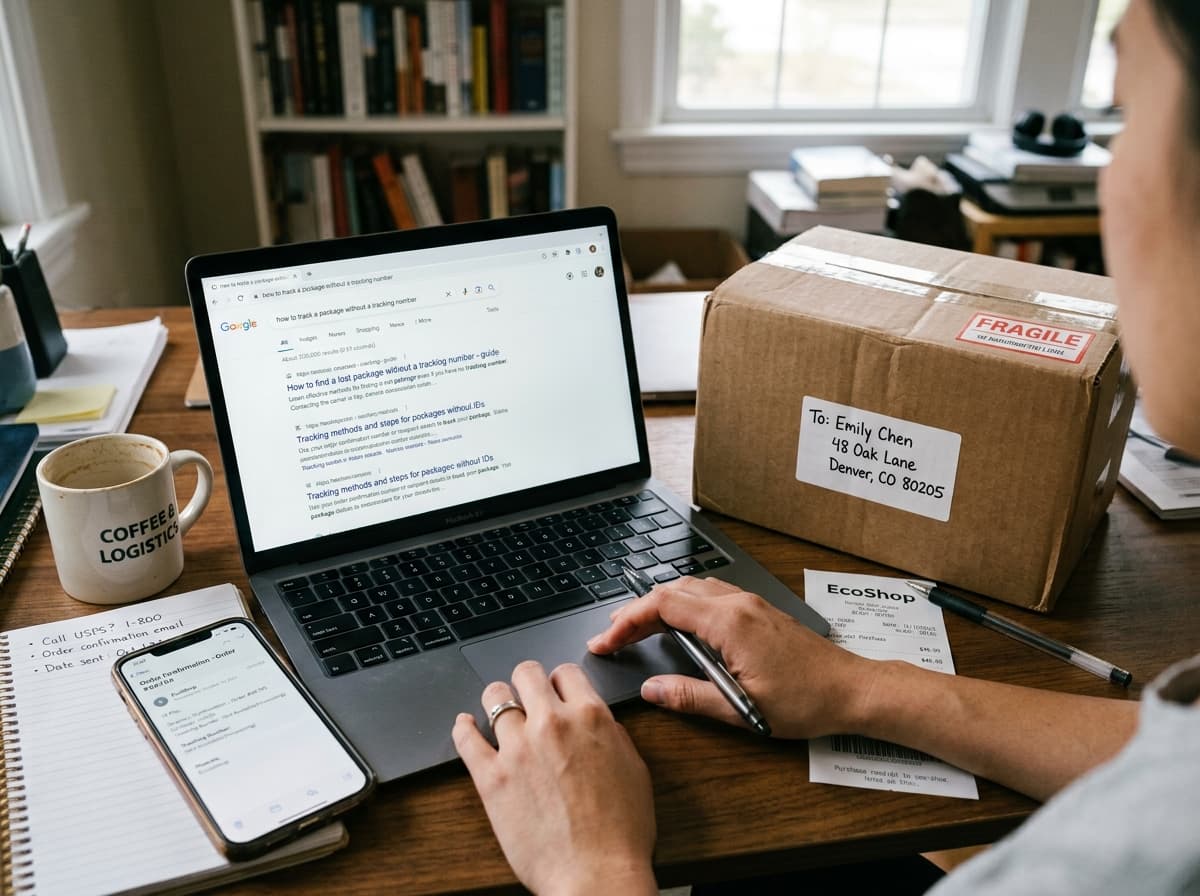
A missing tracking number feels like a dead end. It usually isn't. The number exists somewhere in the chain, and there are seven reasonable ways to find it or work around it.
Which one applies depends on whether you're the buyer, the sender, or the person waiting at the door for something someone else posted.
First: the number probably exists
Before hunting for workarounds, rule out the ordinary explanation. Most "no tracking number" situations are actually "the number was issued and you haven't seen it yet."
Shipping software generates a number when the label prints. If the parcel has genuinely been dispatched, a number exists — the question is who has it.
Three places to check that people usually skip:
The order page in your account, not the confirmation email. Marketplaces update the number there when a shipment is rebooked and often don't email about it. The account page is the current version.
The spam folder. Dispatch notifications from unfamiliar logistics domains get filtered constantly, especially from Chinese consolidators.
A second email address. If you checked out as a guest, or the shop used the address on your payment method rather than the one you typed, the notification went somewhere you're not looking.
Option one: ask the sender properly
If you're the recipient of something a person or shop sent, they hold the answer. The trick is asking a question that can't be answered vaguely.
Don't ask "has it shipped?" — that gets "yes, it's on its way" and you're no further forward.
Ask instead: "Can you send me the tracking number from the postage receipt, and the date it was handed over?"
That phrasing does two things. It asks for a specific artefact rather than an assurance, and it quietly tests whether the parcel was actually posted. A sender who genuinely posted something has a receipt. One who hasn't will change the subject, and that answer is useful too.
Option two: use the retailer's own order lookup
Most retailers can find a parcel from the order number even when you can't.
Their system holds the mapping between your order reference and the carrier's tracking number. Customer service can read it out in seconds, and many sites have a self-service order lookup that needs only the order number and the email address used.
This is the fastest route for a normal shop purchase, and it's worth trying before anything more elaborate.
Option three: register with the carrier for address-based alerts
Several major carriers offer a service that notifies you about parcels arriving at your address, whether or not you know the tracking number in advance.
You register, prove you control the address — usually with a code posted to it — and from then on incoming parcels appear in your account automatically.
USPS runs Informed Delivery in the United States, which additionally emails scans of incoming letter mail. Royal Mail and several European operators have comparable schemes.
The verification step is why this can't be abused, and it's also why it's no help for a parcel arriving tomorrow. Set it up now and it works for everything afterwards.
Pro tip: this is the single best answer to "I keep missing deliveries and never know what's coming." It's a five-minute setup that prevents the problem permanently.
Option four: work out the carrier and use their reference tools
If you know roughly what was sent and from where, you can sometimes narrow the search enough to be useful.
Carriers let you search by reference number as well as tracking number. A reference is whatever the sender typed into the shipping software — often an invoice number, a purchase order, or the buyer's name. If you know the sender's internal reference for your order, FedEx, UPS and DHL all support looking it up.
You'll usually also need the destination postcode as a second factor, which is what keeps it from being a privacy hole.
Option five: check whether it was tracked at all
Worth ruling out early, because it saves a lot of pointless searching.
Ordinary letter post is untracked by design. There's no barcode, so there's nothing to scan and nothing to look up. The same applies to the cheapest parcel services in several countries.
If the sender paid the base rate at a post office counter and didn't ask for anything extra, there may genuinely be no tracking to find. Ask what service they bought. "I just posted it" usually means untracked.
Tracked, signed-for, registered and express services all generate scans. Everything else is a gamble that usually pays off but leaves no trail.
Option six: use the delivery notification
If the carrier has already attempted delivery and left a card, that card carries a reference — and that reference works on the carrier's site.
The card also tells you which carrier has it, which is often the missing piece. A card from a company you don't recognise usually means a last-mile operator took over from whoever the shop originally used, which our guide on parcels changing carrier mid-journey explains.
Act quickly on these. Depots hold undelivered parcels 5 to 10 days before returning them, and the countdown starts at the failed attempt rather than when you find the card.
Option seven: escalate through the payment
When the seller won't help and there's no number, the payment is what you still control.
On a marketplace, open a dispute. The seller has to produce proof of dispatch, and a tracking number is the standard proof. If they can't, the case usually resolves in your favour — buyer protection schemes treat missing proof of postage as the seller's problem.
On a card or PayPal payment outside a marketplace, a chargeback works similarly, though it's slower and worth reserving for real losses rather than slow deliveries.
Watch the deadlines. Marketplace protection typically expires 60 to 90 days after dispatch, and card chargeback windows vary but are finite. Our guide on what to do if a package is delayed covers the timing.
One thing worth doing today
Whatever the outcome of the current parcel, register for your national carrier's address notification service.
It takes five minutes, needs a one-off verification code posted to your address, and from then on every incoming parcel appears in your account whether or not anyone gave you a number. That converts the whole problem from a search into a list you already have.
It is the only item on this page that fixes the situation permanently rather than solving it once.
If you are the sender
Everything above assumes you are waiting for something. If you posted it, the position is different and generally better.
You have the receipt, or you should. Every tracked service produces one, and the number is printed on it under the barcode. Photograph it at the counter — thermal ink fades within weeks and a faded number is unrecoverable.
Your shipping account holds the history. If you booked online through a carrier or a shipping platform, every consignment you have ever created is in that account with its number, date and destination. That is the fastest lookup available to anyone.
The carrier can search by your account and date. Even without a receipt, a business account holder can usually ask the carrier to list shipments booked on a given day. Consumers posting at a counter have no equivalent, which is why the receipt matters so much.
You are also the one who must claim. The shipping contract is yours, so if the parcel is lost, the recipient cannot file — you can. Our guide on lost or damaged package claims covers what that involves and how long you have.
What to do while you wait
If none of the routes above produce a number today, a few things are still worth doing rather than simply refreshing an empty page.
Write down the dates. When the order was placed, when the seller said it shipped, and when you first asked. Nearly every dispute later turns on a timeline nobody recorded at the time.
Screenshot the order page. Marketplace listings change and orders archive. A screenshot showing the item, the price and the promised delivery window costs nothing and is the evidence a dispute is decided on.
Note the protection deadline. Buyer protection typically closes 60 to 90 days after dispatch. That date is the only one that genuinely cannot be recovered.
None of that finds the parcel. All of it means that if the parcel never appears, the next conversation goes quickly instead of turning into an argument about what was said in week two.
When there is genuinely nothing to find
Some parcels are untrackable, and accepting that early saves a week of searching.
Ordinary letter post, the cheapest international surface services, and several economy products in developing postal markets simply have no barcode. There is no number because nothing was ever designed to be scanned.
In those cases the only meaningful information is the posting date and the service's typical window, which for international surface mail can run to eight weeks. Nothing is wrong; there is just nothing to watch.
The practical response is to agree a review date with the sender rather than checking daily. Pick a point past the service's normal window, and if the parcel has not arrived by then, treat it as lost and deal with it as a loss rather than continuing to search for tracking that never existed.
What doesn't work, and why
A few approaches sound plausible and reliably fail.
Searching by name and address alone. No carrier allows this, and the reason is obvious once you think about it — anyone could look up a neighbour's deliveries, or an ex-partner's. Address-based services exist but require verifying you control the address first.
Guessing tracking numbers. Formats are predictable enough that people try. Beyond being useless, systematically probing a carrier's tracking system is likely to breach their terms of use.
Third-party sites promising to find any parcel. If a site claims it can locate a parcel without a number or an account, it's harvesting data rather than tracking parcels.
Gifts and third-party senders
A parcel sent by someone else creates an awkward gap: the person with the tracking number is not the person waiting for the parcel.
Ask for a screenshot rather than the number typed out. Transcription errors are the single commonest cause of a lookup failing, and a photo of the receipt removes them entirely.
Ask what service they used, not just whether they posted it. "Signed for," "tracked," "express" and "just a stamp" produce completely different expectations, and only the first three generate any tracking at all.
Ask for the date of posting. Almost every question about whether a parcel is late reduces to knowing when it actually left, and senders rarely volunteer it.
If the sender is a family member abroad, be gentle about the answer you may get. A great many international parcels are posted on the cheapest untracked service available, because the tracked option can cost several times as much. In that case there is genuinely nothing to look up, and the only realistic option is patience — international surface post can take two months without anything being wrong.
Once you have the number
The moment you get it, paste it into the tracker on our home page with the carrier field empty. The format identifies the carrier on its own, which saves you picking from a list of nearly two thousand.
If it returns nothing, that isn't a dead end either — a number is normally silent for the first 24 to 48 hours after the label prints, and our guide on tracking numbers that show nothing walks through the other causes.
And if you got the number by asking the sender, note the dispatch date at the same time. Almost every question about whether a parcel is late comes down to knowing when it actually left, and that's the detail people forget to write down.
The workarounds above solve the immediate problem. Setting up carrier address notifications solves it permanently, and it takes five minutes — which is the one thing worth doing today rather than the next time a parcel goes missing.