Best Packaging Materials for E-commerce Sellers
Updated 2026-08-039 min readPacking and sending
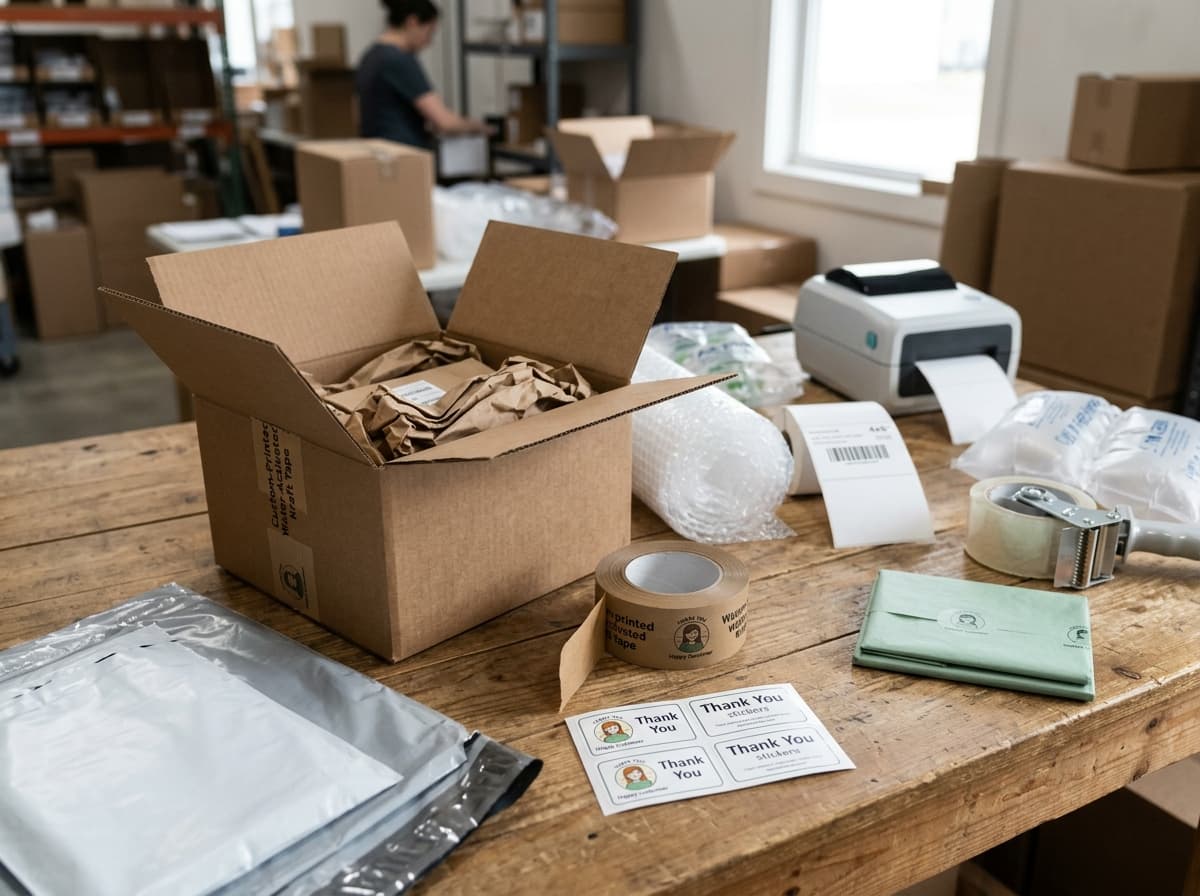
Standardise on three box sizes, two mailer sizes, one tape and one void fill. Buy in the largest volume you can store. Measure cost per parcel including labour, not unit price. That covers almost everything worth knowing about packaging as an operating cost.
Variety is what makes packaging expensive. Every additional size raises the unit price of all the others, consumes shelf space, and adds a decision to each order that a packer has to make.
Cost per parcel is the only useful metric
Unit price is misleading, because packaging cost has four components and only one appears on the invoice.
Material cost — what you paid per unit.
Shipping cost caused by the packaging — a box one size too large moves the parcel into a higher weight band. This is frequently larger than the material cost itself, as our guide on calculating package dimensions explains.
Labour — how long it takes to pack. A packaging system that needs assembly, cutting or a decision costs more in time than it saves in material.
Damage and returns — under-packing shows up as claims, replacements and refunds rather than as a packaging line item.
Optimising the first while ignoring the other three is the most common packaging mistake, and it is why the cheapest box is rarely the cheapest choice.
Boxes
Single-wall corrugated for items under about 10 kilograms. The default for most e-commerce, and the cheapest per unit at volume.
Double-wall corrugated above that, and for anything valuable crossing a border. An international parcel is handled by two or three networks and spends longer in stacks.
Rigid mailer boxes — the flat-pack style that folds without tape — for small flat items. More expensive per unit and considerably faster to pack, which usually nets out favourably at volume.
Check the box maker's certificate on the base flap. It states a maximum gross weight, and shipping above it means the box will not hold its shape when something is stacked on it.
Three sizes covers most catalogues if you choose them from your actual order data rather than by guessing. Take a month of orders, measure the contents, and pick the three that leave the least air.
Mailers
Poly mailers for soft, unbreakable goods: clothing, textiles, foam. They conform to their contents, so they are charged on actual weight rather than volume — the single biggest packaging saving available for apparel.
Padded poly mailers for small items needing light protection. Convenient, and note that the padding adds volume and therefore dimensional weight.
Paper padded mailers for the same job with a recyclable single material. Slightly heavier and slightly more expensive.
Rigid document mailers for anything flat that must not bend.
Two mailer sizes usually suffice. The risk with mailers is overfilling — a mailer stretched to its seam splits, and the failure is total rather than partial.
Void fill compared
| Material | Cost per parcel | Labour | Recyclability |
|---|---|---|---|
| Crumpled kraft paper | Low | Fast | Kerbside |
| Paper void fill on a dispenser | Low at volume | Fastest | Kerbside |
| Air pillows | Very low | Fast, needs a machine | Store drop-off |
| Bubble wrap | Medium | Medium | Store drop-off |
| Foam sheets and planks | High | Slow, needs cutting | Poor |
| Loose fill peanuts | Low | Messy | Varies by type |
| Corrugated inserts | Medium | Slow to make, fast to use | Kerbside |
For most sellers the answer is paper on a dispenser for general void fill, plus a small stock of foam or corrugated inserts for the specific items that need them.
Air pillows are cheaper per parcel than almost anything else, and they need an inflation machine and floor space. That trade works at a few hundred parcels a month and not below it.
Loose fill peanuts are worth avoiding despite the low price: items migrate through them on long journeys, customers dislike them, and they spread across a packing bench.
Tape
Pressure-sensitive plastic tape, 2 inches or 48 millimetres wide, is the default. Not masking tape, not cellophane, not duct tape — duct tape loses adhesion in cold cargo holds and the seam opens.
Water-activated paper tape is stronger, tamper-evident and kerbside recyclable, and it needs a dispenser and a slightly slower process. It is the right choice for heavy boxes and for sellers who want a fully paper parcel.
Buy a tape gun. Hand-tearing tape is slower, uses more tape and produces worse seals, and the gun pays for itself within a few hundred parcels.
Whatever you use, apply three strips to the top and three to the bottom in the H pattern described in our guide on wrapping packages for shipping. The bottom seam is what fails.
Sustainability, honestly
Customers say they care about packaging waste, and a meaningful proportion genuinely do. Three things are worth knowing before spending money on it.
Kerbside recyclability is what matters. Plain corrugated cardboard and paper void fill go in a household recycling bin in most systems. Poly mailers, bubble wrap and mixed-material padded envelopes require store drop-off or specialist collection, and most customers will not do it. A material that is technically recyclable and practically binned is not solving anything.
Right-sizing beats material choice. The largest environmental cost in a parcel is usually the transport, and transport scales with volume. A smaller box reduces material and emissions at once, and it saves money rather than costing it.
Compostable plastics need industrial composting in most cases, which very few households have access to. They are not a drop-in improvement.
The honest low-cost position is plain recycled corrugated, paper void fill, paper tape and right-sized boxes. It is cheaper than most alternatives, genuinely recyclable, and needs no explanation on the box.
Branded packaging
Printed boxes and mailers look good and carry three costs that are easy to underestimate: high minimum order quantities, storage for that quantity, and the loss of flexibility when a product line changes.
For most sellers a printed sticker or a stamp on a plain box captures the majority of the effect. It costs a fraction, has no minimum worth worrying about, and can be changed next week.
Branded packaging earns its place in repeat-purchase categories with a strong brand identity and predictable volume — subscription goods, cosmetics, premium consumables. Below a few thousand parcels a year it rarely does.
A tissue wrap and a printed card cost very little and are noticed more than a printed box, in most categories.
Standardising is the biggest lever
Reducing packaging variety improves every one of the four cost components at once.
Unit price falls, because volume per SKU rises and price breaks depend on quantity per line, not total spend.
Storage falls, because you hold fewer lines.
Packing speeds up, because there is no decision to make.
Errors fall, because the wrong box cannot be chosen from a set of three as easily as from a set of twelve.
The method is straightforward. Export a month of orders with their dimensions, cluster them, and pick the smallest set of sizes that fits 90 per cent of orders with acceptable void. Handle the remaining 10 per cent with a cut-down box.
Cutting a box down — scoring the corners, folding the walls in, re-taping — takes under a minute and often saves a size band. It is the cheapest right-sizing tool available.
Buying and storing
Packaging prices drop sharply with quantity, and the break points are steep. Buying a pallet rather than a bundle frequently halves the unit price.
Against that: cash tied up in stock, storage space, and the risk of holding a size you stop using. The practical rule is to buy three to six months of usage on your top two or three lines, and smaller quantities on everything else.
Order before you run out with enough lead time to absorb a delay. Running out of the right box means shipping in the wrong one, which costs more in freight than the rush order saved.
Testing your packaging
Worth doing once, properly, rather than learning from claims.
Pack a representative parcel and drop it onto a hard floor from about a metre, on a corner, an edge and a face. Then stack 25 kilograms on it for an hour. Then open it.
That approximates what the network does. If the contents survive, the packaging is adequate. If they do not, better to find out with one item than with a month of claims — and remember that carriers refuse damage claims for inadequate packing, as our guide on lost or damaged package claims explains.
Repeat the test whenever you change box supplier. A box sold as the same specification often is not.
Packaging for returns
Returns are packed by customers, which means they are packed badly, and a damaged return is a loss you absorb entirely.
Two approaches work. Resealable mailers and boxes with a second adhesive strip let the customer close the original packaging without tape or a new box. They cost a little more per unit and remove most return damage in categories where returns are common.
Included return packaging — a flat mailer inside the parcel — works where the item is small and the return rate is high enough to justify it.
Either way, put the return instructions in the parcel, not only in an email. A return that arrives without a reference sits unmatched at a warehouse while the customer waits for a refund.
For a store with a high return rate, resealable packaging is usually the highest-return packaging investment available, ahead of anything branded.
A starter list, by volume
Under 100 parcels a month. Three box sizes, two poly mailer sizes, one plastic tape with a gun, kraft paper for void fill, printed stickers. Buy in bundles rather than pallets.
100 to 500. Add a paper void fill dispenser, a second tape gun, and buy your top two box sizes by the pallet. Consider resealable mailers if returns are frequent.
500 to 2,000. Add air pillows with an inflator if your items are bulky, water-activated tape for heavier boxes, and a packing bench laid out so nothing is more than an arm's reach away. Review box sizes against order data quarterly.
Above 2,000. Cartonisation software that picks the box size automatically, a second packing station, and supplier agreements with scheduled deliveries rather than reorders. At this point right-sizing becomes a system rather than a habit.
The progression matters more than the specifics. Adding equipment before the volume supports it ties up cash and floor space; adding it late costs labour every day.
Mistakes worth avoiding
Too many sizes. The most common and the most expensive.
Oversized boxes with generous fill. Costs more to ship and protects less than a right-sized box.
Reusing boxes for outbound orders. A used box has lost much of its compression strength, and it signals carelessness to a customer.
Buying on unit price alone. Ignores the three larger cost components.
Branded packaging too early. Cash and storage committed before the volume justifies it.
No inside address slip. One sheet of paper prevents a destroyed label becoming an undeliverable parcel.
Where to start
Three box sizes chosen from real order data, two poly mailer sizes, one tape with a gun, paper void fill on a dispenser, printed stickers rather than printed boxes, and an address slip in every parcel.
Measure cost per parcel monthly, including the freight your packaging choices cause. Our guides on hidden shipping fees and the best courier for e-commerce sellers cover the rest of the shipping cost that sits around it.
Review the whole set once a year against a fresh sample of orders. Catalogues drift, average order size changes, and a box range chosen two years ago is usually one size wrong by now.