What Is a Tracking Number and How Do You Read It?
Updated 2026-08-029 min readTracking numbers
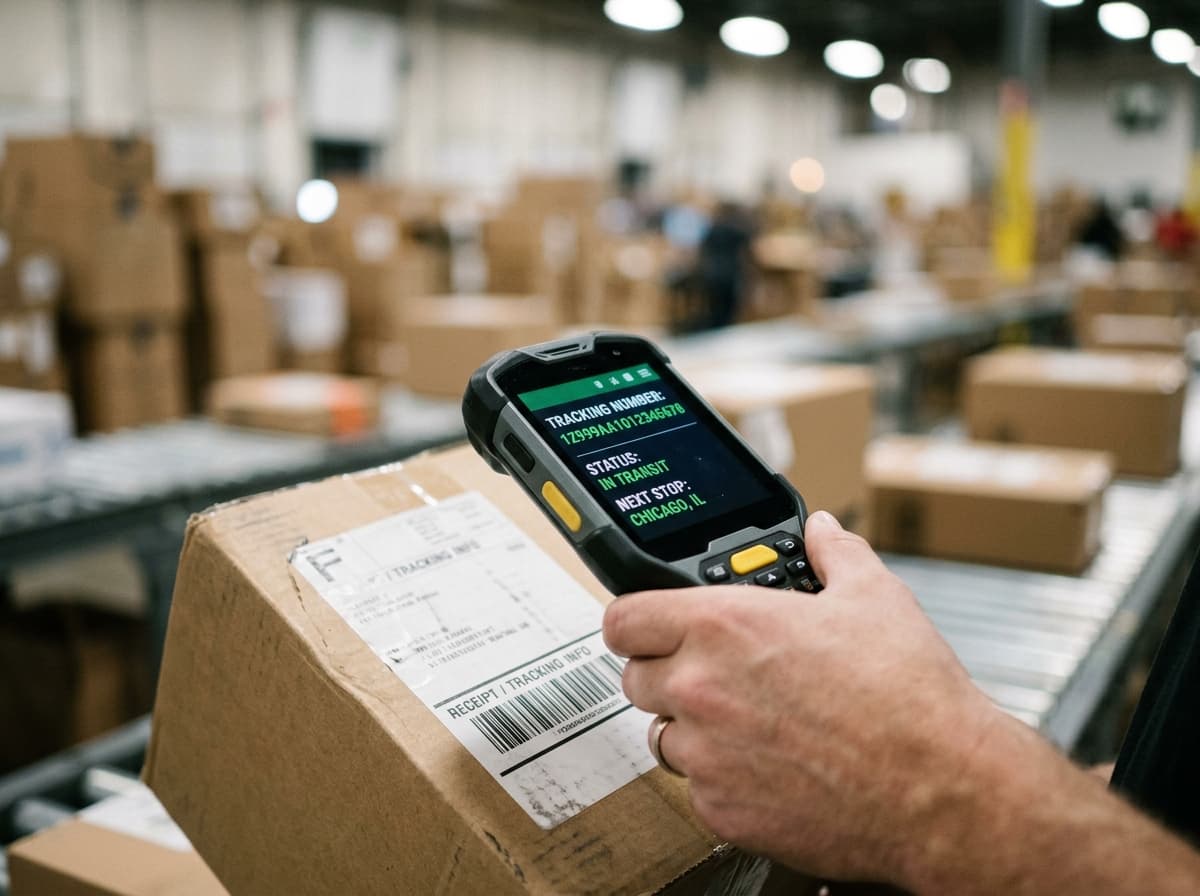
A tracking number is not a code that tells anyone where your parcel is. It is a label. The parcel carries it, scanners read it, and every scan writes one line into a database. That is the whole system.
Once you understand that, a lot of tracking frustration makes sense. The number does not "know" anything. It only shows what somebody has scanned so far, which is why a perfectly valid number can sit there returning nothing for two days.
Here's what the digits actually mean, and how to tell a real tracking number from the other codes cluttering your confirmation email.
What a tracking number actually is
Think of it as a name tag at a large event. The tag doesn't follow you around. But every time you walk through a door with a scanner, someone notes down "this tag, this door, this time." String those notes together and you get a rough picture of where you went.
Your parcel works the same way. It picks up a scan when it's collected, when it enters a sorting hub, when it leaves that hub, sometimes at customs, and finally at the door. Between those points, nothing happens. No scan, no update, no news.
This is why the gaps in tracking are normal rather than alarming. A parcel moving from Shenzhen to Manchester might genuinely go eight days without a scan while it sits on an aircraft and then in a queue. Nothing is wrong. Nobody has passed it through a scanner.
Quick fact: A typical domestic parcel gets between 4 and 8 scans across its whole journey. An international one might get 6 to 12. That's it — a dozen data points for a trip across the world.
Where to find your tracking number
The number arrives after the shop prints the shipping label, not when you place the order. That gap catches people out constantly. You order on Monday, the shop takes until Wednesday to pack it, and only then does a tracking number exist.
Check the dispatch email first — the one with a subject line like "Your order has shipped." Not the order confirmation. The order confirmation was sent before anything was packed, so it can't contain a tracking number.
If you bought from a marketplace, look in your account rather than your inbox. Amazon, eBay, AliExpress and Shein all keep the number on the order detail page, and it's often more current there than in the email they sent you.
Shipping something yourself? The number is printed on the receipt the counter staff hand back, usually under a barcode. Photograph it before you leave. Thermal receipt ink fades badly, and a faded tracking number is genuinely unrecoverable.
The order number trap
This is the single most common reason a lookup fails, and it's worth spelling out.
An order number belongs to the shop. It might look like ORD-88213 or 112-4829471-2201856. It exists so the shop's own system can find your purchase. The carrier has never seen it and never will.
A tracking number comes from the carrier. It gets created when the label is generated, and it's the only code a scanner recognises.
Both sit in the same email, often two lines apart, both formatted as long strings of digits. If your lookup keeps returning nothing, check that you copied the right one before assuming the parcel is lost. Our guide on why a tracking number says not found walks through the rest of the causes.
Reading the number: what the characters mean
Carriers don't use a shared format, but each one is consistent with itself. Once you know the shape, you can usually identify the carrier from the number alone — useful when a shop forgot to tell you who's delivering.
Letter prefixes usually mean international post
If your number is 13 characters — two letters, nine digits, two more letters — you're holding a postal item that crossed a border. That format is a global standard called S10, agreed between national postal operators so they can hand parcels to each other.
The last two letters are the country of origin. RA123456789CN started in China. RA123456789AU started in Australia. The first two letters describe the service:
- R at the start means registered — signed for, with compensation if lost
- E means express, usually EMS
- L or U means an economy or small-packet service, often with lighter tracking
- C means an ordinary parcel
So EA123456789CN is an EMS express item from China. LX123456789DE is a small packet from Germany. You can read the service level off the label without opening anything.
Pure numbers usually mean a courier
Couriers that grew up outside the postal system built their own numbering.
UPS is the easiest to spot — every consumer parcel number starts with 1Z and runs to 18 characters, like 1Z9999999999999999. Nothing else looks like it.
FedEx uses plain digits: 12 for most Express and Ground shipments, 15 for some Ground, and 20 or 22 for SmartPost, where the last leg is handed to the post office.
USPS numbers are 20 to 22 digits and often begin 94, 93 or 92. You'll also see 34-digit versions starting 420 — that's a normal USPS number with the destination ZIP code stuck on the front by the shipping software. Strip the 420 and the five digits after it, and the rest is the real number.
Pro tip: Spaces and dashes are cosmetic. 1Z 999 999 99 9999 9999 and 1Z9999999999999999 are the same number. Strip everything that isn't a letter or a digit before you search.
Chinese e-commerce carriers have their own tells
If you shop on AliExpress, Temu or Shein, you'll meet a different set.
Cainiao numbers usually start LP followed by 14 digits. YunExpress starts with YT. 4PX often starts with the literal string 4PX. And plenty of these parcels eventually switch to a China Post number in the LX/RA family once they enter the postal network for the flight.
That switch is normal and it confuses people badly. If you want the full picture, our guide on identifying a carrier from a tracking number covers the prefixes in a proper reference table.
Why the number exists before the parcel moves
A shipping label is printed by software. The moment it prints, the carrier's system registers the number and marks it as expected. Nobody has touched the parcel yet.
That's the state most people meet first, and it produces one of two results depending on the carrier. Some show a status like "Label created" or "Info received." Others show nothing at all, which feels much worse but means exactly the same thing.
The first physical scan normally lands 24 to 48 hours after the label prints. Shops that batch their dispatches — most small ones do — might sit on a printed label until the courier's Thursday pickup, stretching that to four or five days.
Wait before you worry: three working days from the dispatch email. If there's still no scan after that, contact the shop rather than the carrier. The parcel is almost certainly still in their warehouse, and the carrier can't find something they were never given.
What a single scan actually records
Each scan writes three things: a time, a place, and an event code. That's the whole record.
The time is when the scanner fired, which is not always when the thing happened. A driver who scans a batch of parcels at the end of a round stamps them all with the same time, even though the deliveries were spread across four hours.
The place is the facility the scanner belongs to, not the parcel's exact position. "Arrived at East Midlands Hub" means the parcel entered that building. It doesn't mean it's still there — it might have left an hour later on a lorry that generated no scan.
The event code is what the carrier's system decides to show you. Carriers use dozens internally and expose only a handful publicly, which is why the same physical event can appear as "In transit" on one carrier and "Departed facility" on another.
Why the timestamps confuse people
Times are usually shown in the local time zone of the scanning facility, not yours. A parcel scanned in Shenzhen at 09:00 and again in Frankfurt at 14:00 the same day looks like a five-hour flight. It was closer to fifteen.
Some carriers normalise everything to the destination time zone instead, which produces the opposite illusion — events that appear to happen before the ones that preceded them. Neither approach is wrong, and neither is explained anywhere on the page.
If a sequence looks impossible, the time zone is almost always the reason rather than an error in the data.
How long a tracking number stays alive
Carriers don't keep tracking data forever. Storage costs money and old scans have no operational value, so records get purged.
Most carriers hold events for 30 to 120 days after the final scan. After that the number returns nothing — not on this site, not on the carrier's own website, not anywhere. The data is gone rather than hidden.
This matters more than it sounds. If you might need proof of delivery for a warranty claim, a tax record or a dispute, screenshot the tracking page while it still works. People discover this rule at the exact moment they need the evidence, which is always too late.
When one parcel has two numbers
You'll sometimes get a second tracking number partway through a delivery, and it's not an error.
International parcels change hands. A courier carries it out of the origin country, then passes it to a domestic operator for the final few miles. That handover often generates a fresh number in the receiving carrier's own format, because their scanners can't read the original.
The same thing happens with services like FedEx SmartPost and UPS SurePost, where the parcel travels most of the way with the courier and is handed to the post office for the doorstep. Two carriers, two numbers, one parcel.
Track both if you have them. The original number usually stops updating at the handover, and the new one picks up from there. If your tracking has gone quiet and you only have the original, that handover is a likely explanation — tracking that stops updating covers the others.
Checking a number before you search
Thirty seconds of checking saves a lot of pointless worry. Before deciding a parcel is missing, run through this:
- Count the characters. Under 8 means it's probably an order number. Over 35 means you've copied extra text along with it.
- Check for the classic misreads. Zero and the letter O, one and the letter I, five and S, eight and B. Handwritten or faded receipts are the worst offenders.
- Strip the spaces and dashes. Then paste rather than retype.
- Confirm the label is actually more than 48 hours old. Most "broken" numbers are just young.
If it survives all four and still returns nothing, the number itself is probably fine and something else is going on.
Getting a useful result
Paste the number into the tracker on our home page and leave the carrier field empty. The format usually identifies the carrier on its own, which is faster than guessing from a drop-down of nearly two thousand names.
Set the carrier manually only when the format is ambiguous — a plain 13-digit number, say, which several operators use. Our courier directory has a page for every carrier we support, with its number formats and realistic delivery windows.
And once you get a result, read the status against what it actually means rather than what it sounds like. "In transit" covers everything from a parcel on a lorry to a parcel sitting in a warehouse queue for six days. The status table on the home page gives you the wait window for each one, so you know when patience stops being the right answer.
Most of the time the number is fine, the parcel is fine, and the only real problem is that nobody told you a two-day silence is normal. Now you know.