Tracking Number Formats by Carrier — Reference Table
Updated 2026-08-039 min readTracking numbers
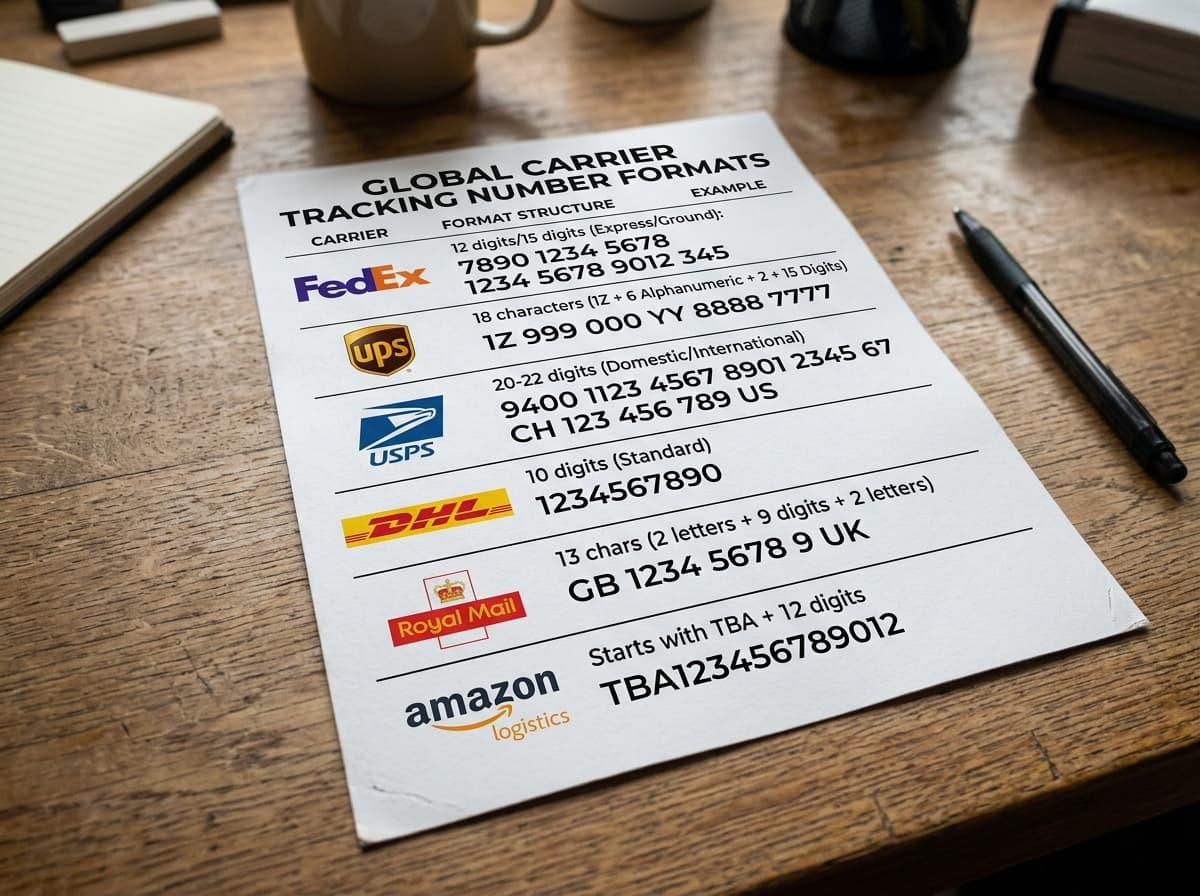
Nobody agreed on a standard. Each carrier invented its own numbering, kept it, and now the shape of a tracking number is the fastest way to work out who is carrying your parcel.
This page is the reference table. Match your number against it, then jump straight to that carrier's page for the transit windows and known problems.
How to use this table
Strip spaces and dashes first. Carriers print them for readability and they carry no meaning — 1Z 999 999 99 9999 9999 and 1Z9999999999999999 are the same number.
Then look at two things in order: the first two characters, then the total length. Between them they narrow almost every number to one or two candidates.
The examples below are format illustrations rather than live numbers, so don't expect them to return results.
Global couriers
These four move the majority of the world's express traffic, and their formats are the ones worth memorising.
| Carrier | Format | Example |
|---|---|---|
| UPS | 1Z + 16 alphanumeric | 1Z9999999999999999 |
| UPS Mail Innovations | T + 10 digits | T1234567890 |
| UPS SurePost | 22 digits, often starting 92 | 9274890100130088888888 |
| FedEx Express / Ground | 12 digits | 123456789012 |
| FedEx Ground | 15 digits | 123456789012345 |
| FedEx SmartPost | 20 digits | 12345678901234567890 |
| DHL Express | 10 digits | 1234567890 |
| DHL eCommerce | JD + 18 digits | JD014600003944793504 |
| DHL Global Mail | GM + digits | GM12345678901234 |
| TNT | 9 digits, or GE + 9 + WW | GE123456789WW |
UPS is the one certainty here. No other major carrier uses 1Z, so that prefix settles the question completely.
FedEx is the trickiest, because plain 12-digit numbers overlap with several regional operators. If a 12-digit number returns nothing under FedEx, it may belong to someone else entirely.
National postal operators
Postal operators mostly follow one shared standard, which makes them far easier to read than couriers.
The format is two service letters, nine digits, two country letters — 13 characters total. It is called S10, and it exists so postal services can hand parcels to each other across borders.
| Carrier | Example | Country code |
|---|---|---|
| USPS | 9400111899223033005282 or EA123456789US | US |
| Royal Mail | AA123456789GB, RR123456789GB | GB |
| China Post | RA123456789CN, LX123456789CN | CN |
| Japan Post | EA123456789JP, RR123456789JP | JP |
| Australia Post | 3456789012345, RA123456789AU | AU |
| Canada Post | 1234567890123456, RA123456789CA | CA |
| India Post | EM123456789IN, CP123456789IN | IN |
| La Poste | 6A12345678901, RR123456789FR | FR |
| Correos Spain | PQ1AB2CD3EF, RR123456789ES | ES |
| PostNL | 3SABCD1234567890, RR123456789NL | NL |
| Brazil Correios | SS123456789BR, RA123456789BR | BR |
Most also run a domestic format alongside the international one. USPS uses 20 to 22 digits domestically, Canada Post uses 16 digits, Australia Post uses 13. The S10 format appears when the item crosses a border.
Reading the service letters
The first letter of an S10 number tells you what was bought:
R is registered — signed for, with compensation cover. E is express, usually EMS. C is an ordinary parcel. L and U are economy or small packet services, the cheapest and slowest. V is insured.
So EA123456789CN is EMS express from China — expect 10 to 20 days. LX123456789CN is a small packet from China — expect 30 to 60 days with barely any scans. Same country, completely different expectations, and you can read it off the number before the parcel has moved.
Chinese e-commerce carriers
If you buy from AliExpress, Temu or Shein, these are the operators you'll meet.
| Carrier | Format | Example |
|---|---|---|
| Cainiao | LP + 14 digits | LP12345678901234 |
| Cainiao via AliExpress | AE + digits + CN | AE1234567890CN |
| YunExpress | YT + 16 digits | YT1234567890123456 |
| 4PX | 4PX + digits | 4PX1234567890 |
| 4PX direct line | FT + digits + CN | FT1234567890CN |
| China EMS | EA/EB + 9 digits + CN | EA123456789CN |
These are consolidators rather than end-to-end carriers. They collect thousands of small parcels, fly them together, and hand them to a local operator at the destination — which is why the number often stops updating partway. Our guide on why a parcel changes carrier mid-journey explains what happens next.
European regional carriers
| Carrier | Format | Example |
|---|---|---|
| DPD | 14 digits | 01234567890123 |
| GLS | 11 digits, or letters + digits | 12345678901 |
| Evri | Alphanumeric, varies by retailer | supplied by the shop |
| Yodel | Alphanumeric shipment ID | supplied by the shop |
| Colissimo | 2 characters + 11 digits | 6A12345678901 |
Evri and Yodel deserve a warning. Both frequently give customers a retailer reference rather than a carrier tracking number, and the two look similar. If a number from either returns nothing, check whether the shop gave you an order reference — see our guide on tracking numbers that show nothing.
Middle East and South Asia
| Carrier | Format | Example |
|---|---|---|
| Aramex | 8 to 12 digits | 12345678901 |
| TCS | 10 to 12 digits | consignment number on the receipt |
| India Post | S10 ending IN | EM123456789IN |
Aramex overlaps heavily with other numeric formats, so identification by shape alone rarely works here. This is the region where letting the lookup test the number is most worthwhile.
Why the formats look so arbitrary
There is a reason none of this is tidy, and knowing it makes the mess easier to remember.
Postal operators standardised because they had to. A parcel posted in Japan and delivered in Brazil passes through two organisations that have never spoken to each other, so the Universal Postal Union agreed a shared format decades ago. S10 exists because cooperation was compulsory.
Couriers never had that constraint. Each built a closed network where its own scanners read its own labels end to end, so each invented a scheme that suited its sorting hardware at the time and then kept it, because changing a numbering system means reprinting every label, retraining every depot and breaking every integration a customer has built.
That is why UPS still uses a prefix chosen long before e-commerce existed, and why FedEx runs several incompatible lengths side by side — each was introduced with a service and never retired.
The practical consequence is useful: formats almost never change. A pattern you learn now will still identify the same carrier in five years, because the cost of changing it is far higher than the cost of living with it.
Length is not the same as service level
A common assumption is that longer numbers mean better tracking. They do not.
USPS uses 20 to 22 digits on ordinary domestic parcels and 13 characters on international express. DHL Express — the fastest product they sell — uses a plain 10 digits, shorter than almost anything else in the table.
Number length reflects when the format was designed and how many parcels the carrier needed to number, not what you paid for. A short number can be a premium service and a long one can be the cheapest option available.
What does correlate with tracking depth is the service letter on postal items and the product name on couriers. An E prefix means express and will scan often. An L prefix means small packet and will barely scan at all.
The formats that fool people
Three patterns look like tracking numbers and aren't.
A 34-digit number starting 420. That's a USPS number with the destination ZIP code stuck on the front by shipping software. Delete 420 and the five digits after it, and what remains is the real number.
An order reference. ORD-88213, 112-4829471-2201856 or a plain six-digit number belongs to the shop, not the carrier. If it contains a slash, a hash, or letters scattered through the middle rather than grouped at the ends, it's almost certainly internal to a retailer.
A second barcode on the label. Shipping labels carry several barcodes — routing, postcode, warehouse reference. Only one encodes the tracking number. Use the one printed in human-readable text under the main barcode.
Formats you will meet on returns
Return labels behave differently from outbound ones, and the difference catches people out.
A return label usually carries a new tracking number issued at the moment the label was generated, not the one from the original delivery. Tracking the outbound number to see whether your return arrived gets you nowhere — it will still show the original delivery.
Some retailers use a QR code instead of a printed label, scanned at a drop-off point. In that case no number exists until you hand the parcel over, and the receipt printed at the counter carries it. Photograph that receipt; it is the only proof you returned anything.
Prepaid return labels bought in bulk by retailers sometimes carry the retailer's account reference rather than a customer-facing tracking number, which is why some returns show as untracked even on a tracked service.
If a return goes missing, the drop-off receipt is the document that matters. Without it there is no evidence the parcel ever entered the network, and the refund conversation becomes very difficult.
Keep the number somewhere durable
One practical habit is worth more than memorising any of the tables above.
Screenshot the tracking number the moment you receive it. Emails get deleted, marketplace orders archive after a few months, and thermal receipts fade to blank within weeks. A photo on your phone outlives all three, and it also preserves the format exactly, which removes transcription errors entirely.
Carriers purge scan history 30 to 120 days after the last event, so the tracking page itself is not a permanent record either. If a parcel might ever be disputed, screenshot the page as well as the number.
When the format doesn't settle it
Plain numeric formats overlap constantly, and no table fixes that. A 12-digit number could be FedEx or one of a dozen regional carriers.
The practical answer is to stop guessing. Paste the number into the tracker on our home page with the carrier field empty — the lookup tests it against every carrier whose format matches and returns the one that recognises it, along with the scan history.
Setting the carrier manually only helps when you already know it and the automatic match is picking wrong, which happens occasionally with short numeric formats.
A note on case and spacing
Tracking numbers are not case sensitive on any major carrier, so ra123456789cn and RA123456789CN resolve identically. Type them however is convenient.
Spacing is a different matter only because of how people copy. A number copied out of a PDF or a printed label sometimes carries a non-breaking space or a zero-width character that looks like nothing on screen and breaks an exact match. If a number that should work does not, retype the first and last few characters by hand rather than assuming the parcel is the problem.
Leading zeros matter and are frequently lost. Spreadsheets strip them automatically, so a number pasted out of a shipping manifest in a spreadsheet may be missing its first character or two. If the number is one or two digits shorter than the format expects, that is almost certainly what happened.
Why identifying the carrier matters
The point isn't trivia. Knowing the carrier changes what a silence means.
An express courier scans eight to twelve times across a journey and commits to a date. A postal small packet might scan three times across six weeks and be perfectly on schedule. Four days of silence is alarming on the first and meaningless on the second.
Every carrier in the tables above has a page in our courier directory with its realistic transit windows and the problems it's actually known for. Once you've matched the format, that's where the useful detail lives — and it turns a worrying gap into a normal one, or tells you it's time to act.