FedEx vs UPS — Which Is Better?
Updated 2026-08-039 min readCourier comparisons
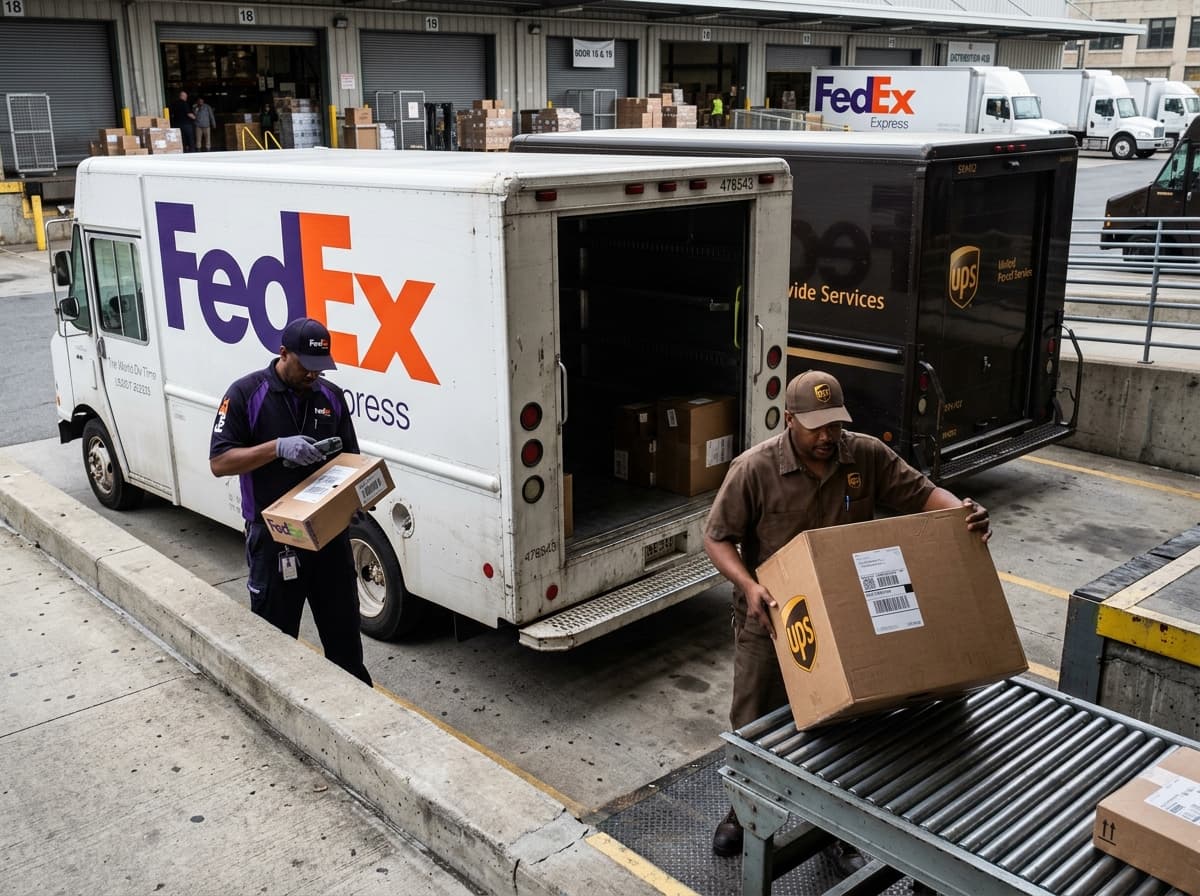
FedEx and UPS do almost exactly the same thing, at almost exactly the same price, with almost exactly the same reliability. Anyone claiming a clear winner is usually comparing one carrier's best product with the other's worst.
The differences that actually matter are narrower and more specific than the marketing suggests. Here's where they genuinely diverge.
Where each one came from
The origins explain most of the remaining differences.
UPS started in 1907 as a messenger service and grew into a ground network. Its structural advantage is density — vans already on nearly every street, which makes each additional stop cheap.
FedEx started in 1971 around overnight air freight, built on a hub-and-spoke model where everything flies to a central sorting facility overnight. Its structural advantage is speed over distance.
Both have since built the other capability. UPS flies, FedEx drives. But the underlying economics still lean the way they were built, and that shows up in pricing.
Cost: nobody wins on the list price
Published rates are close enough that the comparison is decided by your specific parcel rather than by the carrier.
UPS tends to be cheaper on dense ground routes — city to city, moderate weight, no rush. That is its network working as designed.
FedEx tends to be cheaper on express air, particularly on longer distances where the hub model earns its keep.
Two mechanics move the answer far more than the brand:
Dimensional weight. Both charge on size as well as actual weight, so a large light parcel is priced as though it were heavy. The divisors they use differ, and the difference is enough to flip which one is cheaper on a bulky item. If you're shipping anything low-density — pillows, packaging, empty containers — quote both.
Surcharges. Residential delivery, remote area, fuel, oversize, additional handling. These accumulate quietly and can exceed the base rate on an awkward parcel. A headline comparison that ignores them is meaningless.
Practical rule: quote your actual parcel, to your actual destination, with both. Anything else is guessing.
Speed and guarantees
Both sell guaranteed services with a money-back commitment if they miss, and both are genuinely reliable.
On overnight air they are closely matched. FedEx historically had the edge on very early morning delivery commitments; UPS on same-day and next-day ground reach. Those advantages have narrowed to the point where the difference on most lanes is hours.
The important thing is not which is faster but whether you bought a guarantee at all. A guaranteed service refunds the shipping cost when the carrier misses for a reason within their control. A ground service quotes an estimate, and missing it by a day is variance rather than failure.
Weather, customs, incorrect addresses and recipient unavailability are excluded from both companies' guarantees. That exclusion list is where most refused claims come from.
Tracking depth
Both scan far more often than postal operators, and the practical experience is similar.
A typical FedEx or UPS shipment produces eight to twelve events — collection, each hub arrival and departure, out for delivery, delivered. You can genuinely watch the parcel cross the country.
The differences are at the margins. UPS gives recipients more control mid-journey through its delivery preference tools: redirect to a pickup point, reschedule, authorise a leave-safe. FedEx tends to publish tighter delivery time windows on the day.
Either way, a two-day silence on a domestic shipment from either carrier is unusual and worth checking, unlike on a postal service where it means nothing. Our guide on tracking that stops updating covers how to read the gaps.
Claims and insurance
Similar structures, similar deadlines, and the same trap.
Both include a base declared value on most services, with additional cover purchasable. Both expect claims within roughly 60 days, filed by the shipper rather than the recipient.
Both routinely reject damage claims where the packaging was discarded, because they cannot assess whether the packing was adequate.
The base cover is where people get caught. A high-value item shipped with only the included cover is worth only that if it disappears, and the decision was made at booking rather than at claim time. Our guide on lost or damaged package claims covers the process for both.
The hybrid services that confuse tracking
Both run products where the parcel changes hands, and the tracking looks alarming if you don't expect it.
UPS SurePost and Mail Innovations carry the parcel through the UPS network and hand it to USPS for the doorstep. FedEx SmartPost — now branded Ground Economy — does the same thing.
Both are cheaper than the standard ground product and roughly a day slower. Your tracking shows courier scans, then a handover event, then a postal delivery scan.
That handover is not a problem, but it does mean the parcel leaves the courier's control for the last mile — which matters if the recipient is rural or the delivery needs care. Our guide on parcels changing carrier mid-journey explains what to expect.
Reach and restrictions
Nearly identical, with one shared limitation worth knowing.
Neither delivers to a PO box. Both are private carriers without access to postal boxes, so a PO box address means USPS or a hybrid service that hands over to it. This catches out a surprising number of senders.
Both apply delivery area surcharges to remote addresses, and both cover essentially the same national footprint.
For rural destinations, the hybrid products are often the sensible choice precisely because the postal service reaches everywhere by obligation.
International
Both ship worldwide on their own networks, and here the comparison sharpens slightly.
FedEx has historically been stronger in air freight and express international, reflecting where it started. UPS has invested heavily in international ground within trading blocs and in customs brokerage.
Both handle clearance in-house, which is the real advantage over a postal alternative — a broker who does this thousands of times a day makes fewer of the declaration mistakes that cause delays. Our guide on avoiding customs delays covers what goes wrong when it isn't handled well.
Both cost considerably more than a postal option and deliver considerably faster with far better tracking. That trade is the real decision on international shipping, not which of the two you pick.
Service names, side by side
The product ranges mirror each other closely, which makes translating between them straightforward once you have the map.
| Need | FedEx | UPS |
|---|---|---|
| Cheapest, light, hands to the post office | Ground Economy | SurePost |
| Standard ground parcel | FedEx Ground / Home Delivery | UPS Ground |
| Guaranteed two days | 2Day | 2nd Day Air |
| Guaranteed next day, end of day | Standard Overnight | Next Day Air Saver |
| Guaranteed next morning | Priority Overnight | Next Day Air |
| Guaranteed early morning | First Overnight | Next Day Air Early |
| Freight | FedEx Freight | UPS Freight |
The rows are close equivalents rather than exact matches, and delivery commitments differ by an hour or two in places. For most decisions the row is what matters, not the fine print inside it.
Where the reliability difference actually shows
Both publish very high on-time figures, and on ordinary lanes the difference is not something a customer would notice.
Where it becomes visible is at the edges.
Peak season. Both add capacity in November and December, and both slip. Historically each has had bad years, and neither has a permanent advantage.
Severe weather. Both suspend service in affected regions and both exclude weather from their guarantees. What differs is how quickly the backlog clears, which depends on how central the affected hub is to that carrier's network.
Remote destinations. The carrier with less density in an area takes longer and charges more, and this is where a lane-by-lane view beats a national one.
For a business shipping consistently, the sensible approach is to track your own on-time rate per carrier rather than trusting a published figure. Your parcel profile and your destinations are not the national average.
Which to choose, by situation
Heavy parcel, no deadline. Quote both; UPS often wins on dense ground lanes.
Urgent, long distance. Quote both; FedEx often wins on express air.
Bulky and light. Quote both specifically, because dimensional weight decides it and the divisors differ.
Going to a PO box or a very remote address. Neither directly — use a hybrid product or USPS.
High value. Either, but buy the declared value cover to match. The base amount is not insurance.
Regular business volume. Whichever gives you the better negotiated rate, which is a conversation rather than a table.
Drop-off, collection and the practical stuff
The operational details rarely appear in comparisons and often decide which carrier is genuinely easier to live with.
Drop-off density. Both have extensive networks of staffed locations and retail partners, and coverage varies street by street. If one has a shop two minutes away and the other means a drive, that is worth more than a small price difference on every parcel you send.
Scheduled collection. Both will collect daily on an account, and both offer one-off collections for a fee. For anyone shipping more than a few parcels a week, a scheduled collection removes a chore that quietly costs an hour a day.
Returns. Both support printed and paperless returns, and both let recipients drop returns at partner locations. If you sell online, the returns experience matters to customers roughly as much as the outbound one.
Software. Both integrate with every major shipping platform and e-commerce system. Neither has a meaningful advantage here for a small business.
Business accounts change everything
Everything above describes published rates. Once volume enters the picture the comparison stops being about brands.
Both carriers discount heavily for committed, predictable volume, and negotiated account rates can sit a long way below the table. The size of the discount depends on how much you ship, how consistent it is, and how attractive your parcel profile is — dense parcels on busy lanes are worth more to a carrier than awkward ones to remote addresses.
That produces a common outcome: a business quotes both, picks one on price, and finds a year later that the other would now beat it because its own shipping mix has changed.
The practical approach: review annually rather than choosing once. Track your own on-time rate and your own average cost per parcel by carrier, and re-quote when either drifts. Your figures are more useful than any published comparison, because they describe your parcels rather than an average.
Many businesses end up using both — one for ground volume, one for express — precisely because the strengths do not overlap perfectly.
What actually matters more than the choice
Three things affect your outcome more than which of these two you pick.
Whether you bought a guarantee. A guaranteed service and an estimated one behave completely differently when something slips, and the price gap is exactly the value of that difference.
Whether the declared value matches the contents. This decides what a claim is worth, and it cannot be changed afterwards.
Whether the address is complete. Missing unit numbers cause a large share of delivery exceptions on both networks, and a failed delivery starts a return countdown.
Get those right and either carrier will serve you well. Get them wrong and neither will.
Both carriers' numbers work in the tracker on our home page — a 1Z prefix identifies UPS immediately, and FedEx's plain 12 or 15 digits are usually resolved by the lookup. The FedEx carrier page and UPS carrier page list each one's formats and realistic transit windows.
Before you decide
Two minutes of checking beats any amount of brand comparison.
Quote your actual parcel — real weight, real box dimensions, real destination postcode — with both. Include the surcharges that will apply rather than the base rate alone. Confirm whether the service is guaranteed or estimated. And check the included cover against what the contents are worth.
If the quotes come back within a few percent of each other, which they often will, pick on something else: whichever has a drop-off point nearer you, whichever integrates with software you already use, or whichever your recipient prefers to deal with.