How to Offer Free Shipping Without Losing Profit
Updated 2026-08-039 min readE-commerce shipping
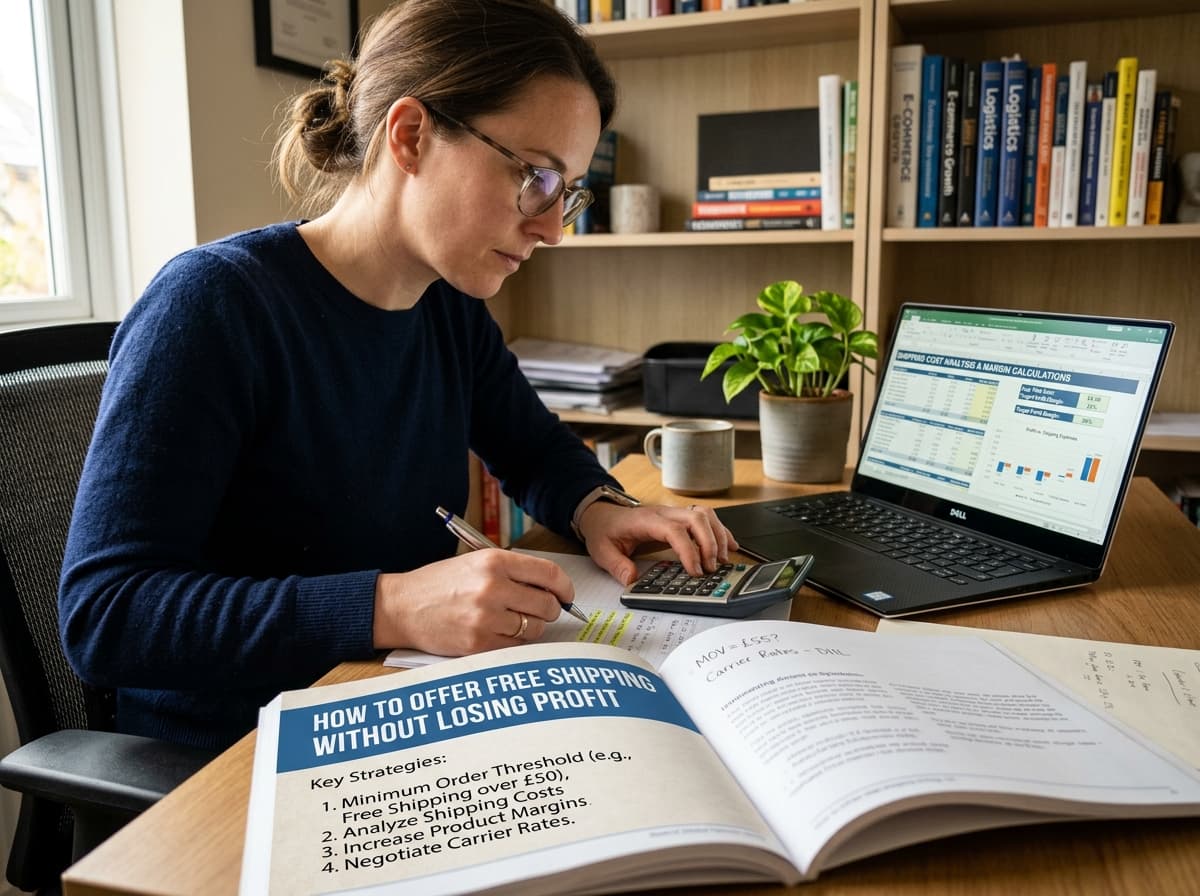
Free shipping is a pricing decision, not a discount. It works when the shipping cost is absorbed into product prices, recovered through a higher average order value, or funded by the margin on orders that would not otherwise have happened. It fails when it is bolted onto existing prices and treated as a marketing expense.
The maths is not complicated. Most stores lose money on it because they never do the maths at all.
Start with your true landed cost
Before you decide anything, work out what shipping an average order genuinely costs you. Not the base rate — the total.
That figure includes the carrier's base rate, the fuel surcharge applied on top, any residential or remote area surcharge, packaging materials, and the labour to pick and pack. For most small stores the true cost lands 25 to 45 per cent above the quoted base rate.
Our guide on hidden shipping fees lists what gets added after the quote. The residential surcharge alone applies to almost every direct-to-consumer order, and almost nobody includes it in their model.
Add returns. If 8 per cent of orders come back and you pay for return shipping, that cost belongs on every order, not just the returned ones. Divide the annual return shipping spend by total orders and add the result to your per-order figure.
The number you end up with is the one to plan around. Everything below assumes you have it.
The four models
There are only four ways to offer free shipping, and they behave differently.
| Model | How it works | Best for |
|---|---|---|
| Threshold | Free above a spend level | Most stores, most catalogues |
| Baked into price | Prices raised, shipping always free | Narrow catalogues, similar weights |
| Selective | Free on chosen products or members only | Mixed catalogues, loyalty programmes |
| Unconditional | Always free, absorbed as cost of sale | High margin, low weight, high AOV |
Threshold is the default for good reason. It funds itself by raising order values rather than by cutting margin, and it lets you keep charging on the small orders where shipping is a large share of the total.
Unconditional free shipping only works when shipping is a small fraction of order value — high-margin goods, light products, or an average order comfortably into three figures. Applied to a store selling £15 items, it is simply a price cut of unpredictable size.
Setting the threshold
The threshold should sit 20 to 30 per cent above your current average order value.
The reasoning is behavioural. A threshold works by getting customers who would have spent £45 to spend £60 instead. If the threshold is £45, they were spending it anyway and you have given shipping away for nothing. If it is £120, they will not get there and the offer is decoration.
Find your actual average order value from the last 90 days rather than an impression of it, and exclude outliers. Then set the threshold just far enough above it that reaching it requires adding one more typical item.
That last point matters more than the percentage. If your average order is one item at £40 and your next-cheapest item is £30, a threshold of £50 is unreachable without adding a £30 item to make £70. A threshold of £65 is reachable with the same addition. Set it where the arithmetic works with your actual product prices.
Round it to a memorable number. Thresholds are communicated constantly in banners and cart messages, and a clean figure gets remembered.
Recovering the cost through price
Absorbing shipping entirely out of margin is how stores get into trouble. Recovering part of it through product price is how they stay out.
Spread the increase across the catalogue rather than concentrating it. A 3 to 5 per cent lift across everything is usually invisible to customers and covers a meaningful share of shipping. A 20 per cent lift on your heaviest product makes that product uncompetitive and does nothing for the rest.
Two constraints. If you sell on marketplaces as well as your own site, price changes have to work in both places. And if you sell products with obvious reference prices — branded goods a customer can compare in three seconds — the room to raise price is close to zero, and free shipping has to come from somewhere else.
For own-brand products with no direct comparison, the room is considerable and most sellers underuse it.
The margin check that decides it
Run this on your five most common order shapes before committing.
Take the order value. Subtract cost of goods. Subtract your true landed shipping cost. Subtract payment processing, typically a small percentage plus a fixed fee. What remains is contribution.
If contribution is still positive and roughly matches what you need, free shipping at that order value is affordable. If it goes negative, either the threshold is too low or the price needs to move.
Do this at the threshold itself, not at the average order. The threshold is the worst case — it is the smallest order on which you will pay shipping, and it is exactly the order value customers will aim for.
A common failure: a store sets a £50 threshold, and customers overwhelmingly order at £50 to £55 rather than the £75 the store hoped for. Model the threshold as the modal order, because after you announce it, it will be.
What changes when you switch it on
Three effects, and they arrive at different speeds.
Cart abandonment falls immediately. Unexpected shipping cost at checkout is consistently among the leading reasons carts are abandoned, and the effect is driven by the surprise more than the amount. Showing the threshold early in the journey captures most of the benefit.
Average order value rises within weeks, provided the threshold is reachable. Customers add items to qualify, and the items they add are often ones they were considering anyway.
Margin per order falls, immediately and permanently. Whether the first two outweigh the third is the entire question, and you can only answer it with your own numbers after 60 to 90 days.
Measure contribution per order, not revenue. Revenue almost always rises when you offer free shipping. That is not evidence of anything.
Communicate the gap, not the policy
A threshold only changes behaviour if the customer knows how far they are from it.
The mechanic that works is a live message in the cart: how much more is needed, and what happens when they get there. Static banners announcing the policy perform far worse than dynamic messages naming the remaining amount.
Show it on the product page too, not only at checkout. A customer who learns about the threshold at the payment step has already decided what to buy.
Then suggest something. A customer told they are £12 away and shown three items between £12 and £18 converts at a much higher rate than one left to browse.
Where free shipping should stop
International orders. Rates vary by several multiples between destinations, and the buyer may owe duty on arrival regardless of what you charged. A global free shipping policy either loses heavily on distant markets or overcharges near ones. Set thresholds per region.
Remote and island postcodes. A small list of destinations will attract remote area surcharges that dwarf your margin. Excluding them explicitly is legitimate, common, and better than quietly losing money on them.
Heavy or oversize items. Anything triggering additional handling or oversize charges should be quoted separately. Our guide on calculating package dimensions explains where those thresholds sit.
Expedited delivery. Free standard shipping is a policy. Free next-day is a subsidy. Keep the fast option paid, and a useful share of customers will choose it, funding the standard offer.
Alternatives that cost less
Free shipping is not the only way to remove the checkout surprise, and two alternatives are cheaper.
A flat, visible shipping fee. A single low figure shown from the first product page removes the surprise entirely while still recovering part of the cost. Much of the benefit attributed to free shipping comes from predictability rather than from the price being zero, and a clearly stated fixed fee delivers that at a fraction of the margin cost.
Free pickup-point or locker delivery. Delivery to a locker or a shop counter costs the carrier less than a doorstep drop and avoids the residential surcharge entirely. Offering it free while charging for home delivery gives customers a genuine free option and often costs you nothing. It is standard practice across much of Europe and underused elsewhere.
A third worth testing is free shipping as a membership benefit rather than an order-level rule. It shifts the cost onto customers who ship often, who are also the ones whose repeat orders justify it.
Returns are part of the policy
Free outbound shipping and free returns are separate decisions that get bundled together in customers' minds and in sellers' budgets.
Free returns raise conversion and raise return rates simultaneously. Whether that trade favours you depends on your category. For apparel, where multi-size ordering is routine, free returns can push return rates past a third of orders. For most other categories the effect is far smaller.
A middle position works well: free returns on faulty or wrongly sent items, paid returns on change of mind, with the cost deducted from the refund. It is clear, it is defensible, and it removes the incentive to order three of something.
Whichever you choose, use a fixed-price return label rather than a weight-based one. Customers repack badly, and a reweigh adjustment on a return arrives weeks later against your account. Our guide on flat rate versus weight-based shipping covers why returns are the clearest case for flat rate.
Get the delivery right afterwards
Free shipping raises expectations even though it says nothing about speed. A customer who paid nothing still expects to know where the parcel is.
Two things do most of the work. Send the tracking number as soon as the label is created, and explain the gap — a number is issued at label creation and often shows nothing for 24 to 48 hours until the carrier scans the parcel. That gap generates a large share of support tickets and it is entirely preventable with one sentence in the dispatch email.
Then keep the tracking visible. Customers can check any carrier's number on our home page, and our guides on tracking numbers and tracking that is not updating answer the two questions support gets most.
Choosing the carrier that makes it affordable
The threshold you can afford depends directly on what you pay to ship. A store paying retail rates needs a higher threshold than one on a negotiated account for the same margin.
Below roughly 50 parcels a month, commercial rates through a shipping platform usually beat anything you can negotiate directly. Above a few hundred, a negotiated account with UPS, FedEx or DHL starts to win, particularly on heavier parcels. For light parcels, postal services like USPS and Royal Mail remain hard to beat at any volume.
Our guides on the best courier for e-commerce sellers and how to choose a courier work through the decision by seller profile.
Putting it in place
Calculate your true landed cost including surcharges and returns. Find your real average order value. Set the threshold 20 to 30 per cent above it, at a figure your product prices can actually reach. Run the margin check at the threshold, not the average. Raise catalogue prices slightly rather than absorbing the whole cost. Exclude international, remote and oversize from the policy. Then measure contribution per order for 90 days.
If contribution holds and average order value rises, the policy is working. If revenue rises and contribution falls, it is a price cut wearing a marketing label — and the fix is a higher threshold, not more promotion.